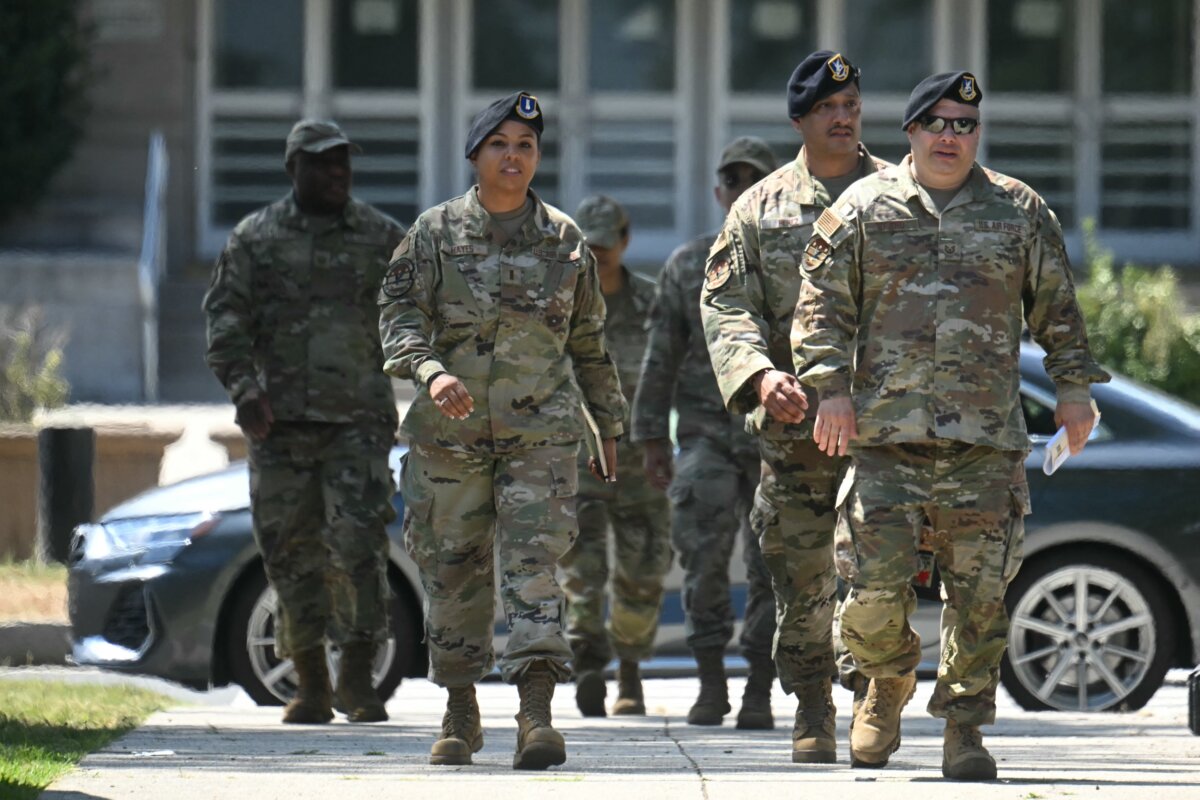

On Aug. 12, National Guard troops arrived in Washington after President Donald Trump federalized policing, citing a scourge of crime in the capital city.
White House press secretary Karoline Leavitt said on Aug. 12 that the addition of National Guardsmen to the federalized D.C. Metropolitan Police Department (MPD) force would help to end “violent crime in our nation’s capital as part of the president’s massive law enforcement surge.”
Leavitt said approximately 850 police officers “were surged” across the city on the evening of Aug. 11 ahead of the National Guard’s arrival, making nearly two dozen arrests.
The move comes as part of a push by the administration toward “beautification” of the capital city and a crackdown on crime.
“President Trump … is going to make our nation’s capital the most beautiful and safe city on Earth, just as he promised on the campaign trail,” Leavitt said.
Here is what to know.
Crime and Homelessness
On Aug. 10, Trump condemned crime and homelessness in Washington, saying that if changes were not made to local policy on crime and homelessness, he would federalize the police.
“Crime in Washington, D.C., is totally out of control,” Trump wrote in an Aug. 10 post on Truth Social. “If D.C. doesn’t get its act together, and quickly, we will have no choice but to take Federal control of the City, and run this City how it should be run, and put criminals on notice that they’re not going to get away with it anymore.”
In another post on Truth Social, Trump shared several photos showing tents and garbage on the streets in areas around the capital, saying: “The Homeless have to move out, IMMEDIATELY. We will give you places to stay, but FAR from the Capital.
“The Criminals, you don’t have to move out. We’re going to put you in jail where you belong. It’s all going to happen very fast, just like the Border.”
Trump suggested that local policies be changed to allow criminal offenders as young as 14 to be tried as adults. Currently, the youngest age at which a person can be charged as an adult in the federal district is 15.
To reinforce the message, the White House published graphics showing the city’s homicide rate at 27.54 deaths per 100,000 people in 2024, compared with a homicide rate of 15.1 per 100,000 in Bogotá, Colombia, during that same period and a homicide rate of 10.6 per 100,000 in Mexico City.
Violent crime in Washington remains high but statistics point to a decline in recent years.
Crime statistics released by the MPD indicate that the overall crime rate has fallen by 7 percent since the start of the year, with homicide down by 11 percent, all violent crime down by 26 percent, and all property crimes down by 4 percent.
Executive Actions
After his threats to federalize policing in the city, Trump on Aug. 11 declared that a crime emergency existed in the district, and announced that he would take command of local police.
“Rising violence in the capital now urgently endangers public servants, citizens, and tourists, disrupts safe and secure transportation and the proper functioning of the Federal Government,” Trump wrote.
Trump has the authority to command local police under Section 740 of the Home Rule Act of 1973, which allows him to take control of the MPD for up to 48 hours. He can renew this time span for up to 30 days while notifying Congress. Afterward, he will need approval from Congress to continue the federalization of the MPD.
Leavitt said the administration “will re-evaluate … and make further decisions after this 30-day period is up.”
“[During the 30 days,] our entire focus is making sure that this is the most efficient operation possible, and that we are removing as many criminals from the streets, and we are cleaning up D.C. as best as we can,” Leavitt said.
In another executive action on Aug. 11, Trump ordered the deployment of the National Guard to the city.
DC Police and National Guard
On Aug. 12, members of the National Guard began arriving in the city, the first of the 800 troops ordered to the capital by Trump.
The local MPD has already carried out about 23 arrests in the city, Leavitt said.
She said they involved charges including homicide, firearms offenses, possession with intent to distribute narcotics, fare evasion, lewd acts, stalking, possession of a high-capacity magazine, fleeing to elude in a vehicle, no permits, driving under the influence, reckless driving, and a bench warrant.
“This is only the beginning,” Leavitt said. “Over the course of the next month, the Trump administration will relentlessly pursue and arrest every violent criminal in the district who breaks the law, undermines public safety, and endangers law-abiding Americans.”
How Local Officials, Residents Are Reacting
Washington Mayor Muriel Bowser acknowledged in comments to reporters that the “plain language” of the law gave Trump the authority to federalize the MPD.
“Limited Home Rule gives the federal government the ability to intrude on our autonomy in many ways,” she told reporters, referencing the Home Rule Act.
She called the move “unsettling and unprecedented.”
Speaking after an Aug. 12 meeting with Attorney General Pam Bondi on the issue, Bowser again acknowledged the legality of the move and said she was instead focusing on “how to make the most” of the additional funding and support for MPD officers.
Locals have had mixed reactions to the move.
Greg, 45, an HVAC employee who only provided his first name, told The Epoch Times that the situation is not dire enough yet to justify deployment of the National Guard. He was also skeptical that the move would be helpful.
Two young black men who did not provide their names welcomed the plan, expressing the hope that it would address black-on-black crime.
“White folks ain’t killing each other,” one said. “Spanish people ain’t killing each other. It’s us killing each other.”
The other agreed.
“It’s time for a change,” he said.
Michele, 72, a former art professor, was protesting the announcement in front of the White House. She said she thought that the takeover was for public relations reasons, calling it “a show of force.”
Stacy Robinson contributed to this report.
 Friends Read Free
Copy
Facebook
Tweet
Friends Read Free
Copy
Facebook
Tweet