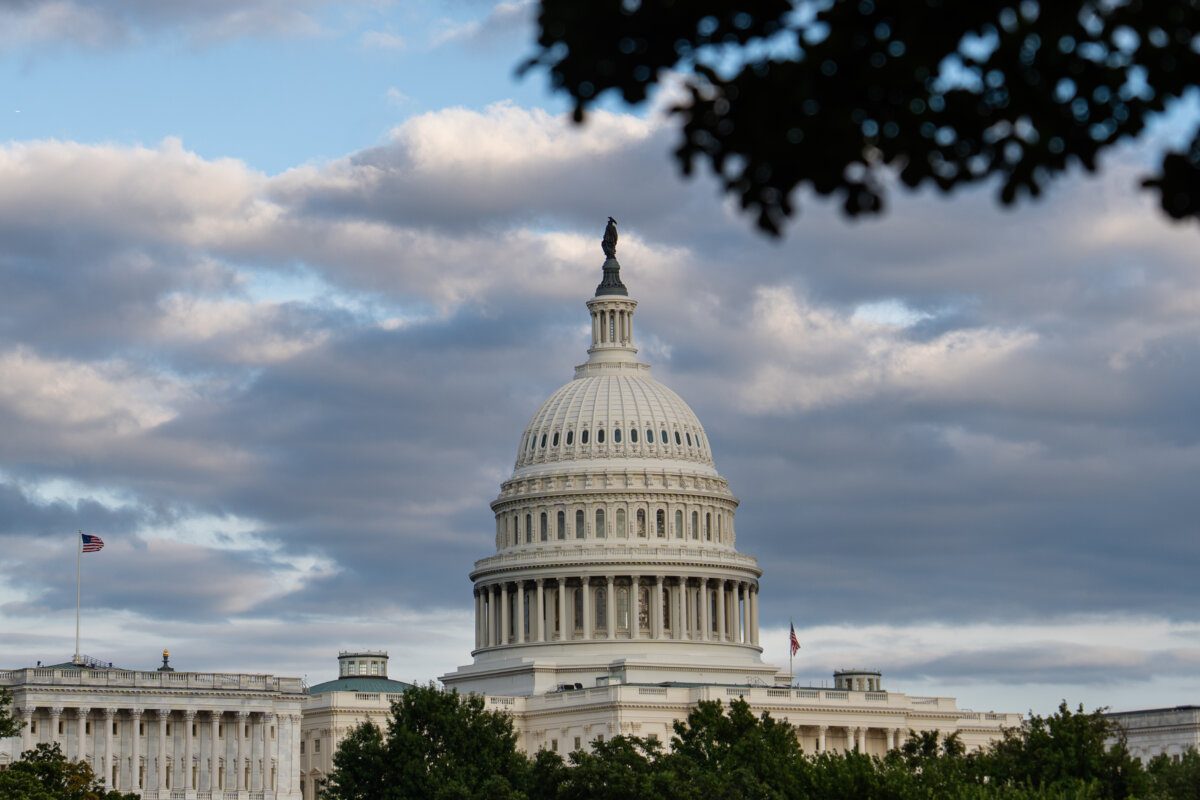


The House of Representatives on Sept. 17 advanced a measure to tee up a vote for a continuing resolution (CR) later this week to avert a partial government shutdown in two weeks.
Lawmakers in the Republican-controlled House voted 216–210 to approve a measure that will open debate on the CR, or stopgap legislation, which will fund federal agencies past the Sept. 30 cutoff through Nov. 21. This would give both chambers of Congress more time to reach agreement on full-scale funding bills for fiscal year 2026, which starts on Oct. 1.
The resolution includes $88 million to increase security for members of Congress, the executive branch, and the Supreme Court after the assassination of Christian conservative commentator Charlie Kirk on Sept. 10.
The House GOP is hoping to pass the CR by Sept. 19 to send it to the Senate, which needs time to approve it before sending the measure to President Donald Trump’s desk. The White House has supported the resolution, while Democrats have criticized it as being a partisan bill.
With less than two weeks until the deadline, both parties are locked in a standoff over government funding, leaving the possibility of a shutdown looming.
Democrats Oppose Bill, Cite Risks to Health Care System
Democratic leaders in Congress presented a unified front on Sept. 16 in rejecting the CR. They said the Republicans’ plan would lead to higher health care costs, considering the fate of Affordable Care Act subsidies set to expire at the end of the year. The Affordable Care Act is former President Barack Obama’s health care law, known as Obamacare.
On the Senate floor, Minority Leader Chuck Schumer (D-N.Y.) accused Republicans of pushing the country toward a shutdown.
In an appearance on Fox & Friends on Sept. 12, Trump said: “If you gave [Democrats] every dream, they would not vote for it. Don’t even bother dealing with them. We will get it through because the Republicans are sticking together for the first time in a long time.”
Schumer referenced the president’s remarks in his own floor speech on Sept. 16.
“I want to be very clear about something: When Donald Trump goes on Fox News and says to Republicans, ‘Don’t even bother to deal with’ Democrats, when he says out loud that he doesn’t need or want our votes, that means that Donald Trump wants a shutdown,” Schumer said.
Schumer said Republicans cannot pass a stopgap measure without his party’s support.
“It takes 60 Senate votes for anything to pass,” he said. “That means you need Democratic votes. That’s a plain fact. If Donald Trump says no negotiations at all, then it’s Donald Trump’s shutdown.”
Schumer claimed in a later news conference that Democrats have sought talks for weeks and that Republican leaders have refused to negotiate. Republicans said in response that their plan is a clean, short-term bill and that Democrats backed similar measures under former President Joe Biden. House Speaker Mike Johnson (R-La.) also said Affordable Care Act subsidy issues can be handled in December.
House Minority Leader Hakeem Jeffries (D-N.Y.) delivered a similar message to Schumer at a news conference, calling the Republican measure “a dirty spending bill.”
“House Democrats have been clear that we will not support a partisan Republican spending bill that continues to gut the health care of the American people,” Jeffries said. “That’s not a clean, continuing resolution.”
Earlier in 2025, Schumer and several Senate Democrats voted with Republicans to avert a shutdown over the objections of House Democrats. When asked whether he believed that Schumer would remain opposed to the GOP’s funding bill this time, Jeffries responded, “Yes.”
Republicans say their plan is necessary to keep the government open. Johnson said negotiations were complicated by demands for more security funding but that the GOP was working to prevent a shutdown.
“We don’t have that yet because we’re trying to resolve this,” he told reporters on Sept. 15.
Trump urged Republicans to support the measure.
“Congressional Republicans, including [Senate Majority] Leader John Thune and Speaker Mike Johnson, are working on a short-term ‘CLEAN’ extension of Government Funding to stop [Schumer] from shutting down the Government,” the president posted on Truth Social.
Republican leaders have said that their agenda will streamline government and spur economic growth, warning that without it, most families will soon face a tax increase. They have said that the law will restructure safety net programs to reduce dependency and ensure benefits for Americans who need them the most.
The law includes new Medicaid eligibility requirements and reimbursement changes that the Congressional Budget Office has projected could increase the number of uninsured Americans by 7.7 million. Republicans dispute that estimate, pointing to provisions such as a new Rural Hospital Stabilization Program aimed at offsetting effects on health care access.
 Friends Read Free
Copy
Facebook
Tweet
Friends Read Free
Copy
Facebook
Tweet