
Luis Carlos Davalos-Lopez from Mexico pleaded guilty on Sept. 4 to conspiracy to smuggle illegal immigrants into the United States through an underground tunnel connecting both countries.
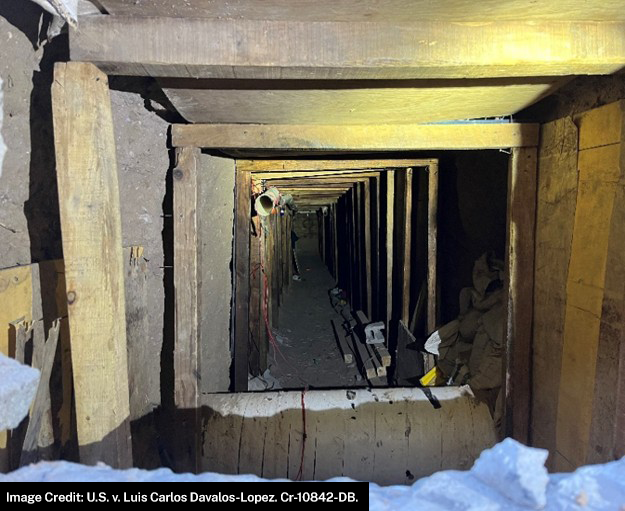
In January 2025, federal authorities discovered a “sophisticated” underground tunnel between Ciudad Juarez, Mexico, and El Paso, Texas, the Department of Justice (DOJ) said in a Friday statement.
Both cities sit on either side of the international border.
Law enforcement intercepted phone calls made by Davalos-Lopez, in which references were made to smuggling foreigners through the tunnel, with charges going above $30,000 for the task.
Davalos-Lopez, 29, and others were indicted in April 2025, after which the government of Mexico transferred him to the United States.
The defendant has pleaded guilty to a count of conspiracy to bring in aliens to the United States and faces a maximum prison term of 10 years.
“Davalos-Lopez and his co-conspirators thought they could exploit the United States southern border utilizing a secret tunnel which was constructed by the foreign terrorist organization, Cartel de Jalisco Nueva Generacion, to facilitate their illegal activities in smuggling of humans, drugs, and firearms,” Acting Special Agent in Charge Coult Markovsky of the FBI El Paso Field Office said in the statement.
According to the DOJ, Davalos-Lopez’s co-defendant, Maria Del Rosario Navarro-Sanchez, 40, from Mexico, had pleaded guilty last month to conspiring to provide material support to the Cartel de Jalisco Nueva Generacion (CJNG) Mexican cartel.
Specifically, Navarro-Sanchez is accused of trafficking firearms to Mexico from the United States.
The DOJ said that Navarro-Sanchez knew that CJNG engaged in terrorist activities, including assassinations and hostage taking.
Navarro-Sanchez also admitted to contracting with human smugglers to bring illegal immigrants into the United States from Mexico.
The Davalos-Lopez investigation was supported by Joint Task Force Alpha (JTFA), an initiative launched during the Biden administration to stop human smuggling activities.
Initially, JTFA focused on combating human trafficking and smuggling in Central America.
In September 2025, under the Trump administration, the DOJ announced an expansion of JTFA to cover districts along America’s northern and maritime borders.
The Davalos-Lopez case was pursued as part of the Homeland Security Task Force (HSTF) initiative. HSTFs were established by President Donald Trump through a January 2025 executive order.
U.S. Attorney Justin R. Simmons for the Western District of Texas said that defendants in the case were part of a criminal enterprise that trafficked illegal immigrants and drugs into the United States.
They also smuggled firearms into Mexico, which were then used to facilitate the transportation of narcotics and foreign nationals into the United States.
“The convictions secured in this case are just another nail in the coffin for these transnational criminal organizations and foreign terrorist organizations,” Simmons said.
“With the full force of the Homeland Security Task Force and Joint Task Force Alpha behind us, we will accomplish our mission of eradicating these groups and ending their reign of terror.”
Illegal Border Tunnels
According to Customs and Border Protection (CBP), there are three types of tunnels typically used by criminals to circumvent U.S. borders.
The first is a “rudimentary” tunnel that is built only for short-distance travel, such as less than 20 feet. The second type is an “interconnecting” tunnel that connects to existing underground infrastructure. For instance, a tunnel that uses sidewalks as one or more of its walls.
The third one is a “sophisticated tunnel,” which typically spans a long distance and could include electricity, water pumps, and railroads.
“The entrance and exit points of sophisticated tunnels are often located within homes or warehouses,” CBP said.
“These tunnels, even if they are only open for a short period, can allow traffickers to move massive amounts of drugs, humans, currency, and firearms back-and-forth between Mexico and the United States.”
In June, Immigration and Customs Enforcement (ICE) announced that an HSTF investigation discovered a “sophisticated” cross-border tunnel stretching 1,933 feet between Tijuana, Mexico, and a supposed retail store near the Otay Mesa Port of Entry in San Diego.
The tunnel was equipped with rail, electricity, ventilation systems, and reinforced walls.
When officials searched the store, they found the tunnel’s access hidden under the shop floor. The tunnel ran 1,064 feet from the store to the border and an additional 800 feet into Mexico.
 Friends Read Free
Copy
Facebook
Tweet
Friends Read Free
Copy
Facebook
Tweet