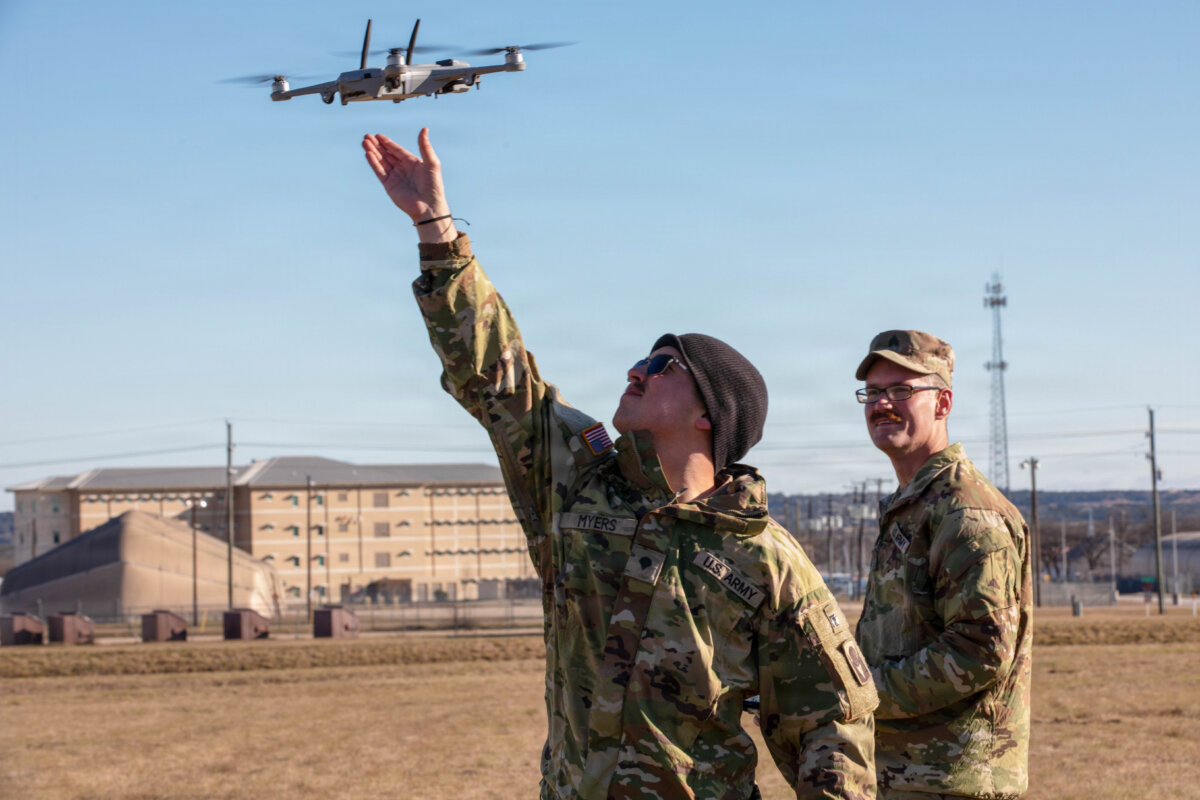

The Pentagon has extended invitations to 25 different drone makers to compete in the first phase of its program to find and field cheap one-way attack drones.
One-way attack drones have become a common feature on modern battlefields. Ukrainian forces, for instance, have employed these relatively cheap explosive-laden drones to great effect, targeting more expensive Russian military equipment and slowing Russia’s advance across the country.
Now, the Pentagon is working to rapidly adopt these cheap drone weapons across the U.S. arsenal and boost its overall drone production base.
Dubbed the Drone Dominance Program, the plan aims to bring hundreds of thousands of these disposable explosive-laden drones to the U.S. military by 2027.
In a December statement detailing the Drone Dominance Program, Secretary of War Pete Hegseth described the U.S. military’s acquisition model since the Cold War era as one that focused on quality over quantity.
“However, we now find ourselves in a new era—an era of cheap, disposable battlefield drones,” Hegseth said. “We cannot be left behind. We must invest in inexpensive, unmanned platforms that have proved so effective.”
The Drone Dominance Program is set to proceed in four stages.
On Feb. 3, the Pentagon named the 25 drone vendors it had invited to submit systems for evaluation for the first phase of evaluations.
This first phase of the drone program will begin at Fort Benning, Georgia, on Feb. 18, with military operators beginning to test out the various vendor submissions.
Initial testing is set to conclude in early March, after which the Pentagon plans to place up to $150 million in prototype orders. Deliveries of prototypes are expected to begin shortly thereafter and continue for another five months.
The Pentagon previously announced it intends for 12 vendors selected in the first phase to produce a total of 30,000 prototypes, at a cost of $5,000 per unit.
With each successive phase of the four-part program, the military intends for per-unit drone prices to decrease, while the volume of drone deliveries increases and their capabilities grow.
After this first phase, the Pentagon expects to whittle the competition down to five vendors, together producing 150,000 drone units at $2,300 per unit.
The four-phase program is set to run for about two years, yielding about 340,000 drones at a total program cost of about $1.1 billion.
In a July memorandum setting the stage for the Drone Dominance Program, Hegseth said he had begun rescinding policies that “hindered production and limited access to these vital technologies.”
Looking ahead, Hegseth said he seeks to “bolster the nascent U.S. drone manufacturing base by approving hundreds of American products for purchase by our military.”
 Friends Read Free
Copy
Facebook
Tweet
Friends Read Free
Copy
Facebook
Tweet