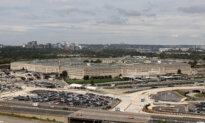
The Pentagon on March 23 announced changes to its media access policy after a court ruling determined that its previous policy violated both the First and Fifth Amendments.
“The Department always complies with court orders but disagrees with the decision and is pursuing an appeal,” Pentagon spokesman Sean Parnell said in a post on X.
“In the interim, and in compliance with the court’s order, I have signed the revised ‘Pentagon Reservation In-Brief for Media Members,’ effective immediately,” he added.
Under the revised policy, the Pentagon said it would close the correspondents’ corridor and set up a new workspace for press members in “an annex facility” on Pentagon grounds but outside the building.
The Pentagon said the move was taken after it determined that “unescorted access to the Pentagon cannot be responsibly maintained without the ability to screen credential holders for security risks.”
The updated policy states that reporters will continue to have access to scheduled press briefings, press conferences, and interviews, but they will be required to be escorted by authorized personnel.
The changes follow a March 20 ruling by U.S. District Judge Paul Friedman in Washington, which invalidated the Pentagon’s previous policy that the department said was needed to protect national security.
Under the previous policy, media credentials could be revoked for those deemed a security risk, while soliciting non-public information from department personnel or encouraging employees to break the law was deemed to fall outside “the scope of protected newsgathering activities.”
Most members of the Pentagon press corps declined to sign an acknowledgment of the new policy and lost their press passes.
The New York Times challenged the rules in December 2025, arguing that the policy violated the U.S. Constitution’s First Amendment by restricting journalists’ ability to “ask questions of government employees and gather information to report stories that take the public beyond official pronouncements.”
Friedman subsequently blocked the rules and ordered the Pentagon to reinstate the credentials of New York Times reporters.
In a statement announcing the revised policy on March 23, Parnell said that Friedman’s order removed provisions that allowed the Pentagon to screen press credential holders for security risks and to deny, revoke, or suspend press credentials on security grounds.
He said the department remains committed to transparency and working with credentialed reporters, while also upholding the security of the Pentagon and the safety of its personnel.
“The revised policy reflects both commitments,” Parnell said.
The National Press Club has criticized the Pentagon’s revised policy, saying again on March 23 that closing the correspondents’ corridor and requiring escorted access would undermine independent reporting at the Pentagon.
“For decades, that corridor has been central to independent reporting on the Pentagon. Eliminating it and requiring escorted access would sharply limit how journalists gather news, build sources and cover one of the most powerful institutions in government—reducing what the public is able to see and understand about decisions made in its name.
“At a time when the United States is engaged in active military conflict, the public depends on journalists being able to observe, report and ask questions freely,” it stated on X.
Matthew Vadum contributed to this report.
 Friends Read Free
Copy
Facebook
Tweet
Friends Read Free
Copy
Facebook
Tweet