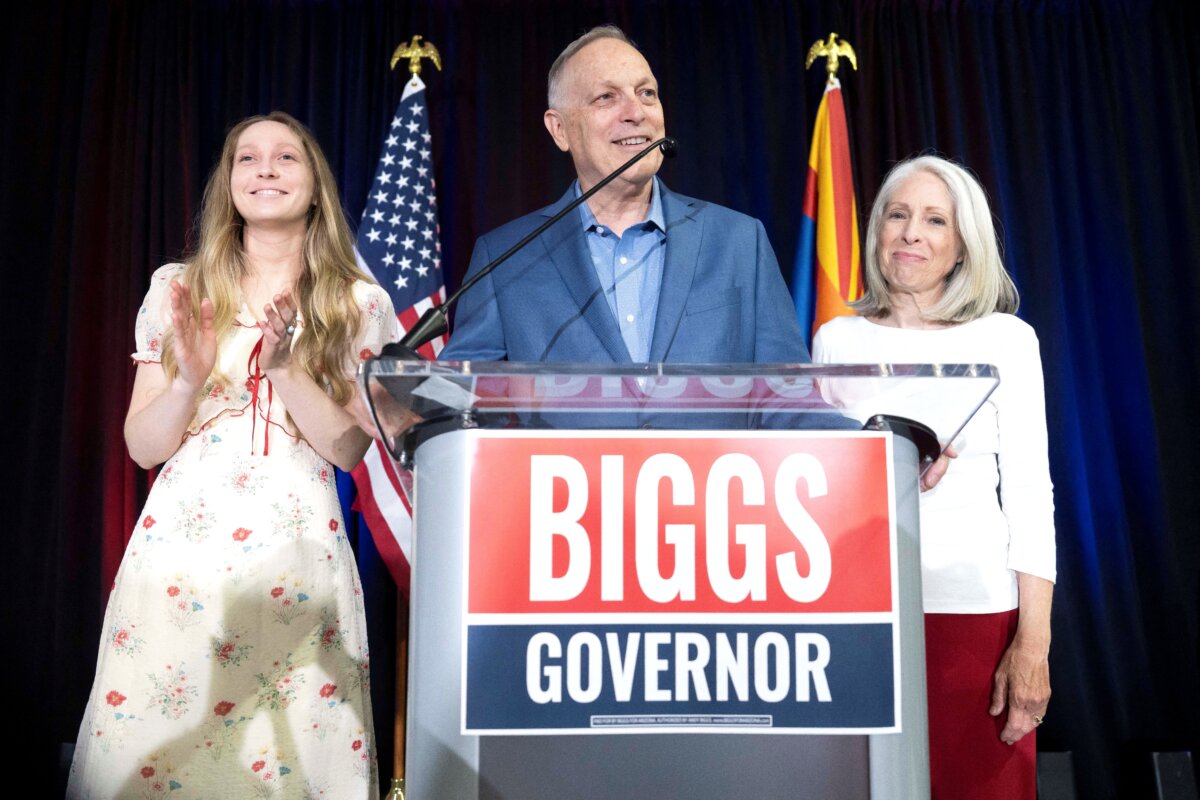

PHOENIX—Incumbent Gov. Katie Hobbs, a Democrat, will face Rep. Andy Biggs (R-Ariz.) in Arizona’s gubernatorial election this fall.
Biggs, who has served in the U.S. House since 2017, won the Republican primary in a landslide on July 21, defeating three long-shot Republican candidates.
“I am deeply honored to be chosen by Arizona Republicans as their nominee to defeat Katie Hobbs in November,” Biggs wrote in a social media post on the night of July 21.
“This campaign has been driven by our grassroots supporters from the day we launched in January 2025 with a clear mission of Restoring the American Dream in our great state. Tonight’s results show that Arizonans overwhelmingly believe in our vision and I’m grateful to have earned their support.”
Biggs was not at his watch party inside of Dillon Precision in Scottsdale, Arizona, when his campaign initially declared victory to a packed room of supporters because bad weather caused a series of flight delays, according to his wife.
The congressman arrived at his victory party just before 2:30 a.m. ET (11:30 p.m. local time) to a crowd of a few dozen enthusiastic supporters chanting “Andy, Andy, Andy,” as he walked up to the stage.
Biggs started his speech thanking God and then his supporters.
“I’m so grateful to have the support of all of you, and I’m thankful that everybody who voted today, got out and voted,” Biggs said. “I was overwhelmed when I started seeing those vote totals come in. It’s awesome! Thank you for all the work you did!”
The Associated Press called the race at about 11:03 p.m ET.
 Rep. Andy Biggs (R-Ariz.) spoke to a crowd of enthusiastic supporters who chanted his name as he took the stage at his victory party on July 21, 2026. (Jacki Thrapp/The Epoch Times)
The Cook Political Report predicted that voters in Arizona may lean Democrat in the general election this fall, which could help Hobbs grab her second term as governor in the purple state.
Hobbs won the 2022 gubernatorial election by flipping the seat blue in a margin of less than 1 percent. Two years later, President Donald Trump won the state in the 2024 presidential election.
Trump received 52.2 percent of the vote, while former Vice President Kamala Harris got 46.7 percent.
Jeff Burton, Republican strategist and co-founding partner at Maven Advocacy, told The Epoch Times on July 17 that voters may tilt back to the left this fall.
“If the environment in November is similar to what it is now, it should be Hobbs’s race to lose,” Burton said.
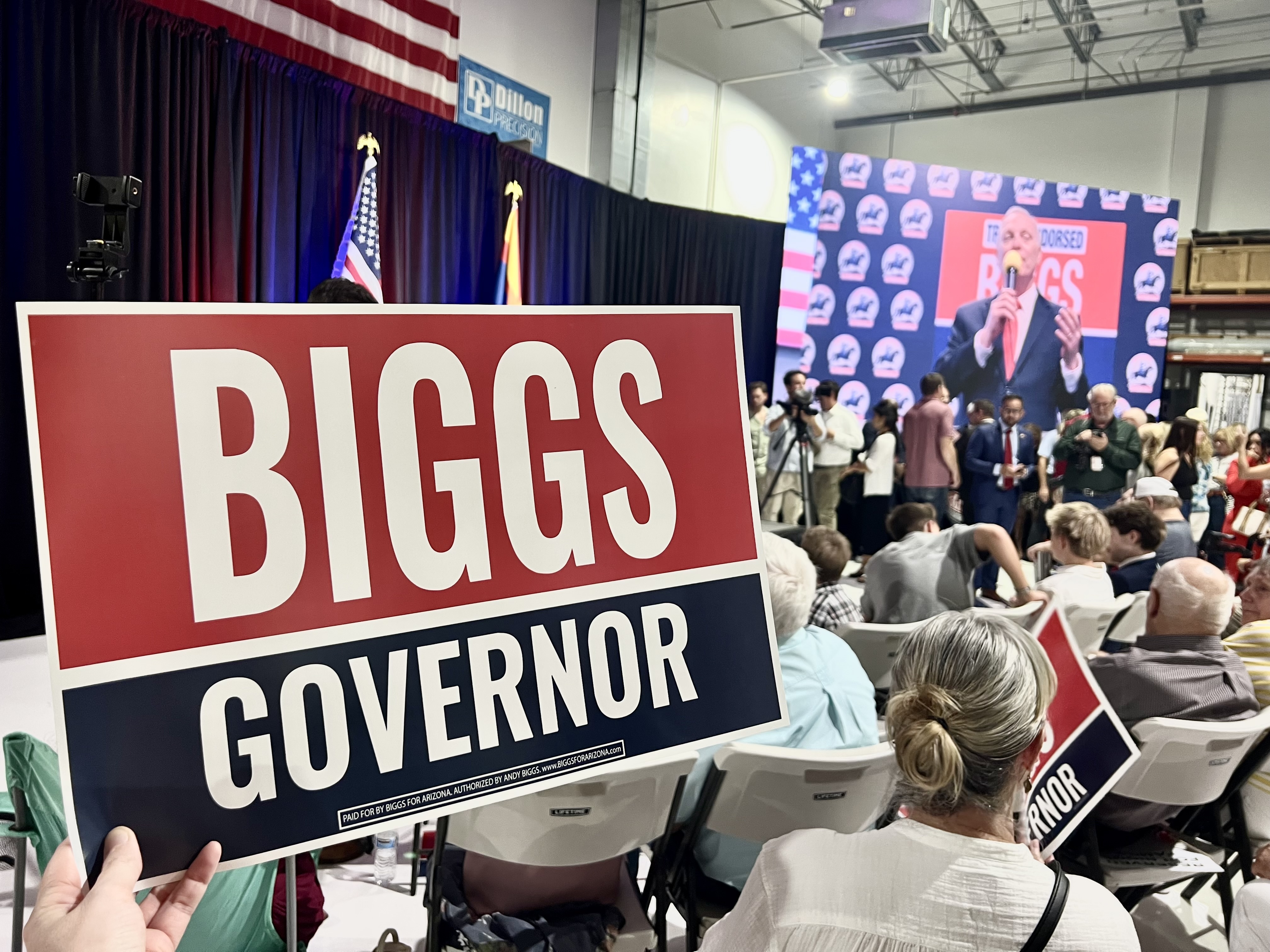 Supporters of Rep. Andy Biggs (R-Ariz.) attend a watch party for the politician at Dillon Precision in Scottsdale on July 21, 2026. (Jacki Thrapp/The Epoch Times)
“November, to some Republicans’ dismay, will be a nationalized election, and Republicans will be judged by whether voters feel better off: gas, groceries, rent and inflation will be most important,” Burton said.
The average cost for a regular gallon of gas in Arizona is up by more than $1 since last July, according to the American Automobile Association.
“Immigration and crime won’t be as salient as they were in 2024 when Trump carried Arizona,” Burton said.
The Epoch Times spoke to voters in Democrat-leaning Pima County and Republican-leaning Maricopa County on July 21 to get insights into their main concerns during the primary and general elections.
In Maricopa County, where Phoenix is located, voters braved the sweltering 100-degree heat to cast their ballots.
Locals told The Epoch Times they were concerned about high rent, gas prices, and the rising cost of healthcare and education.
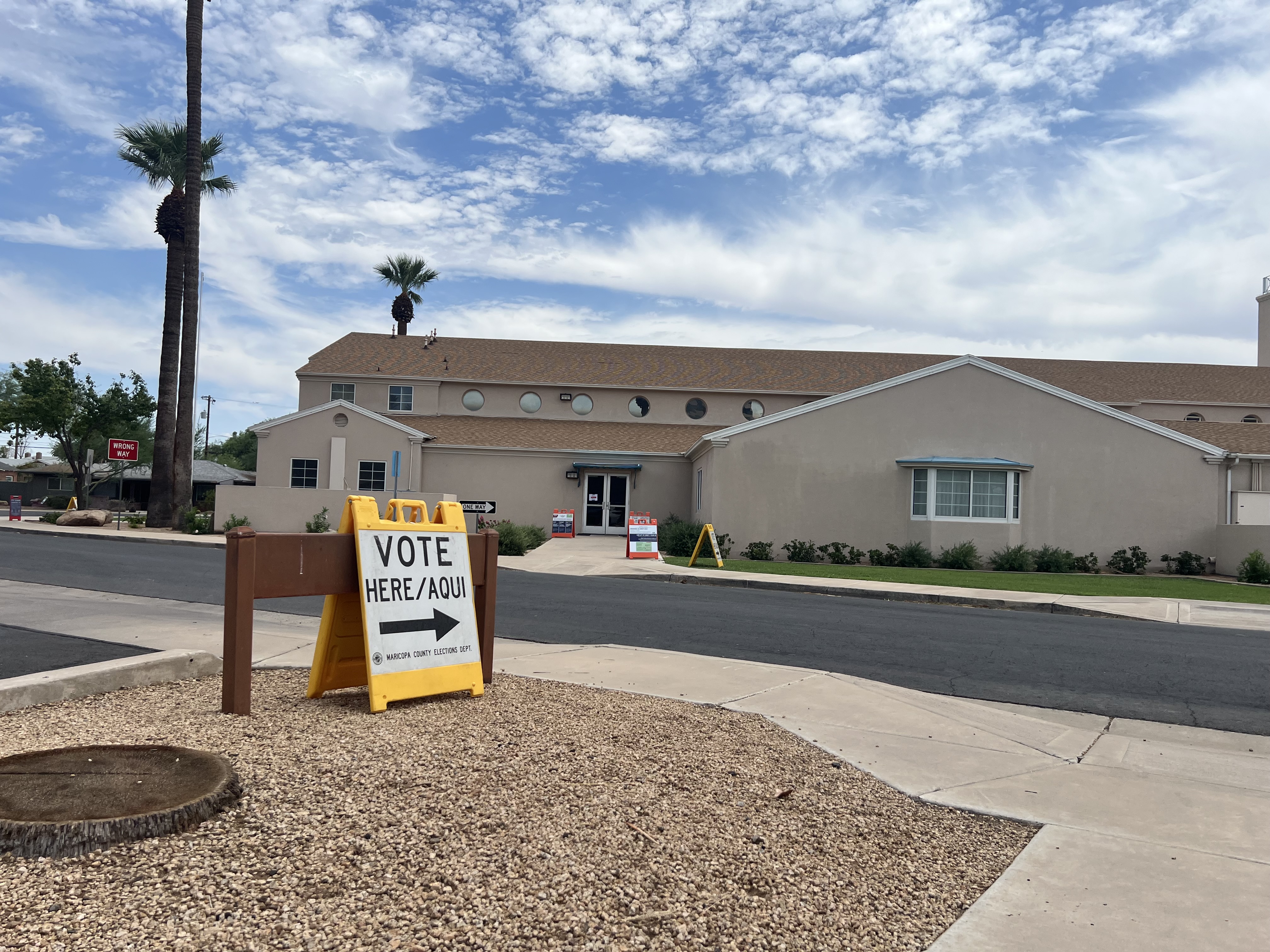 A polling site in Republican-leaning Maricopa County, Ariz., on July 21, 2026. (Jacki Thrapp/The Epoch Times)
A poll worker who did not want to be named told The Epoch Times that voter turnout on July 21 was “good” and similar to turnout in previous elections.
The poll worker confirmed that mail-in ballots delivered to polling locations on July 21 would be counted on the same day as opposed to later.
The new system is expected to speed up the counting process.
“The early voter ballots can now be tabulated on the same day as the vote-in-person process,” the worker said. “Normally, the early voter ballots that were submitted on election day were verified after election day.”
Meanwhile in Pima County, one of the main topics that energized voters to head to the polls on July 21 in the town of Marana was how local leaders recently advanced two rezoning applications that could pave the way for approval of a data center.
Voters in the area had mixed reactions to the proposals. Locals on both sides told The Epoch Times that the potential projects prompted them to vote for—or against—the town council members who sided with them on the potential developments.
One Republican voter suggested he went to the polls to show support for the town council, while another suggested it was time for new leadership.
“There’s a lot of talk about water usage and electricity concerns,” Olivia, a Republican, said. “It’s going to make our electricity bills go up and we don’t want that.”
The data center will use an air-cooled system, not a water-cooled system, and won’t cause water rates to increase, according to information about the proposed development on the town council’s website.
Council members said that they won’t regulate electricity of the data center because those agreements are controlled by the Arizona Corporation Commission.
“Utility agreements are structured to prevent the cost of serving the data center from being passed on to other customers,” the town council’s website stated.
Data centers have been a hot-button issue in several states.
Looking ahead to the general election, Hobbs said she hopes to continue the efforts she made as governor in recent years.
In a campaign video on her website, she told voters that it was her idea to send the National Guard to the border in late 2023 to assist law enforcement with combating drug-smuggling cartels and stopping human trafficking.
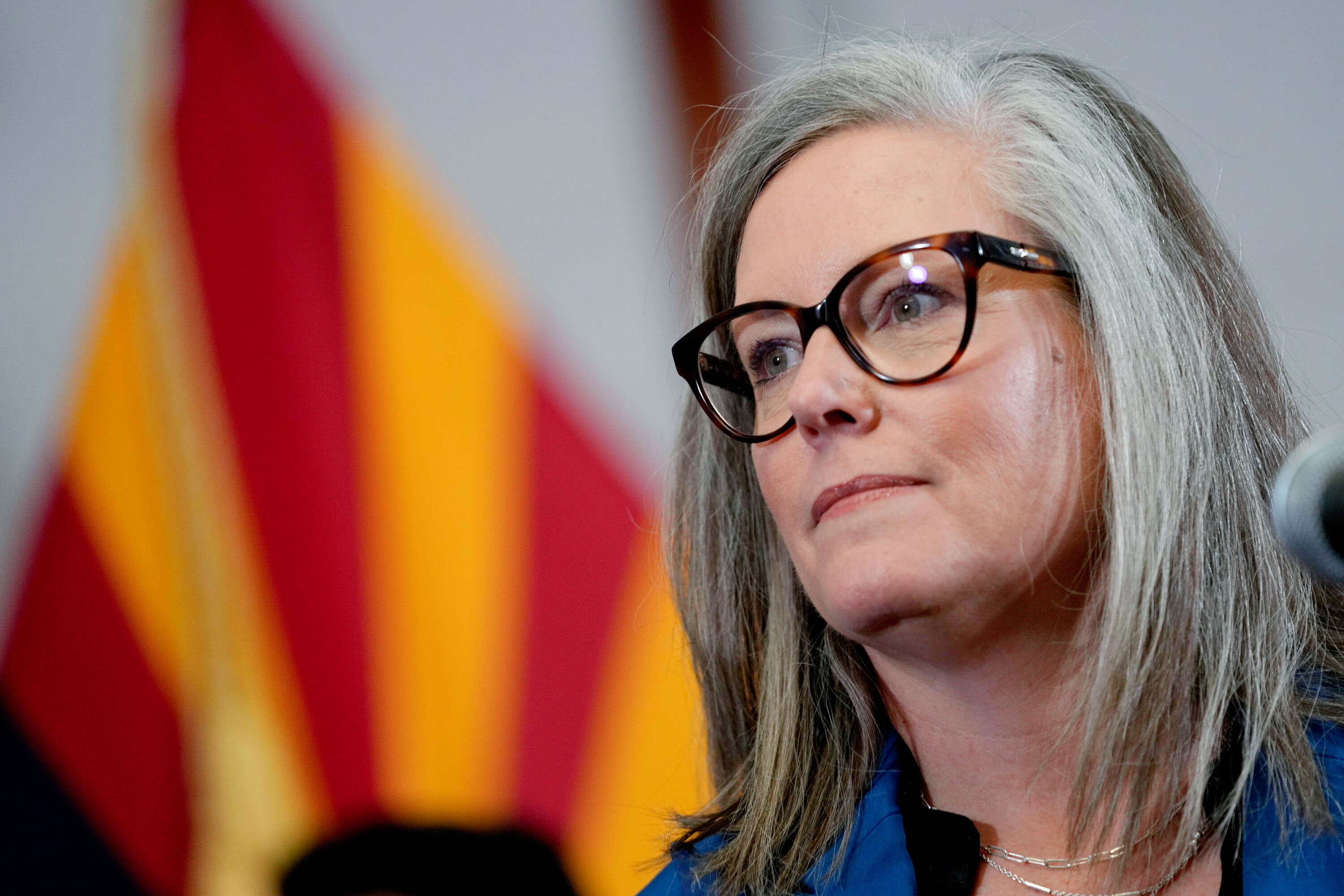 Arizona Gov. Katie Hobbs speaks at the Capitol in Phoenix on May 2, 2024. (Matt York/AP Photo)
Meanwhile, the Trump-endorsed Biggs polled strongly in the Republican primary and said he hopes to keep the momentum going into the fall.
One of his proposals is a plan to eliminate the state income tax.
The congressman said during the Republican gubernatorial debate on June 17 that eliminating the 2.5 percent income tax would entice businesses to move to the state rather than go to states with no income tax, such as Texas, Tennessee, and Florida.
Biggs, who questioned the results of the 2020 presidential election that sent then-former Vice President Joe Biden to the White House over Trump, is pushing for reforms to detect fraud and suggested that Arizona follow Florida’s lead on policies for a safe and secure election.
 Friends Read Free
Copy
Facebook
Tweet
Friends Read Free
Copy
Facebook
Tweet