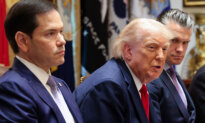

The Small Business Administration (SBA) has removed almost two dozen foreign products from federal agency procurement to ensure priority for domestically produced goods. [source]
The move, taken in collaboration with the General Services Administration (GSA), resulted in the foreign products being eliminated from the GSA Advantage list of approved vendors for federal procurement, the SBA said in a June 12 statement.
The decision was made after President Donald Trump and SBA Administrator Kelly Loeffler attended the White House Small Business Summit last month, where Sherrill Manufacturing, a small business, raised concerns about Chinese companies misusing GSA Advantage.
Sherrill cited concerns about Chinese companies marketing their goods as “Made in America” on GSA Advantage, even though the production process for these items is only partially conducted in the United States.
As such, when federal agencies buy these foreign goods, they violate the Trade Agreements Act, the Buy American Act, and country-of-origin requirements.
The Buy American Act requires federal agencies to procure America-made materials and products.
Meanwhile, the Trade Agreements Act limits the country of origin for products sold via GSA Schedule contracts, which are contracts for federal acquisition of products and services. China is not a signatory to this trade agreement.
In its latest statement, the SBA said that the inclusion of foreign companies in GSA Advantage puts American companies such as Sherrill Manufacturing, the sole domestic manufacturer of 100 percent Made in America stainless steel flatware, “at a distinct disadvantage in the federal marketplace.”
Steel prices in China are significantly lower compared to the United States, giving Chinese suppliers a cost advantage.
After the summit, Loeffler investigated mislabeled “Made in America” products on the GSA Advantage list at Trump’s request. The GSA, in coordination with SBA, subsequently identified and de-listed 22 foreign-made flatware products.
Loeffler said that Trump had directed agencies to take “aggressive action” on the issue.
“Consistent with a zero-tolerance policy on waste, fraud, and abuse, the Trump Administration is sending a clear message that we will not tolerate foreign impostors that hijack Made in America labels, or those that undercut honest, generational, American small businesses like Sherrill Manufacturing,” Loeffler said.
Small Business Conditions
In a June 9 statement, the National Federation of Independent Business said that optimism among small businesses declined in May.
“Despite the enthusiasm around AI, the overall picture is divided,” said Bill Dunkelberg, the federation’s chief economist.
“More small business owners are struggling with significant and unpredictable hikes in fuel prices, which are more challenging for small businesses to pass on to their customers compared to their larger corporate competitors.”
The National Association of Manufacturers said in a June 10 statement that rising input was the top business challenge in the second quarter of 2026.
Manufacturers’ optimism was “relatively steady,” dropping marginally from the first quarter to the second.
“While we continue to see a lot of new investment announcements here at home, there are still headwinds keeping us from reaching our full potential,” said National Association of Manufacturers President and CEO Jay Timmons.
“Manufacturers continue to press for policies that move the needle on the priorities that matter most to manufacturing certainty, growth, and investment.”
On March 31, SBA announced the Made in America Loan Guarantee program aimed at restoring “manufacturing dominance” in the United States.
The program provides businesses with loans that have a 90 percent federal guarantee. This is expected to help manufacturers boost production, hire more people, and expand their facilities.
More recently, on June 11, SBA said it reformed the 8(a) Business Development Program to end racial discrimination in federal contracting. Previously, the program had a race-based admissions framework that prevented Americans from certain races from accessing 8(a) contracting opportunities.
The update will “restore equal treatment under clear, objective criteria and help ensure the program serves legitimate job creators instead of political friends, shell companies, or bad actors,” Loeffler said.
 Friends Read Free
Copy
Facebook
Tweet
Friends Read Free
Copy
Facebook
Tweet