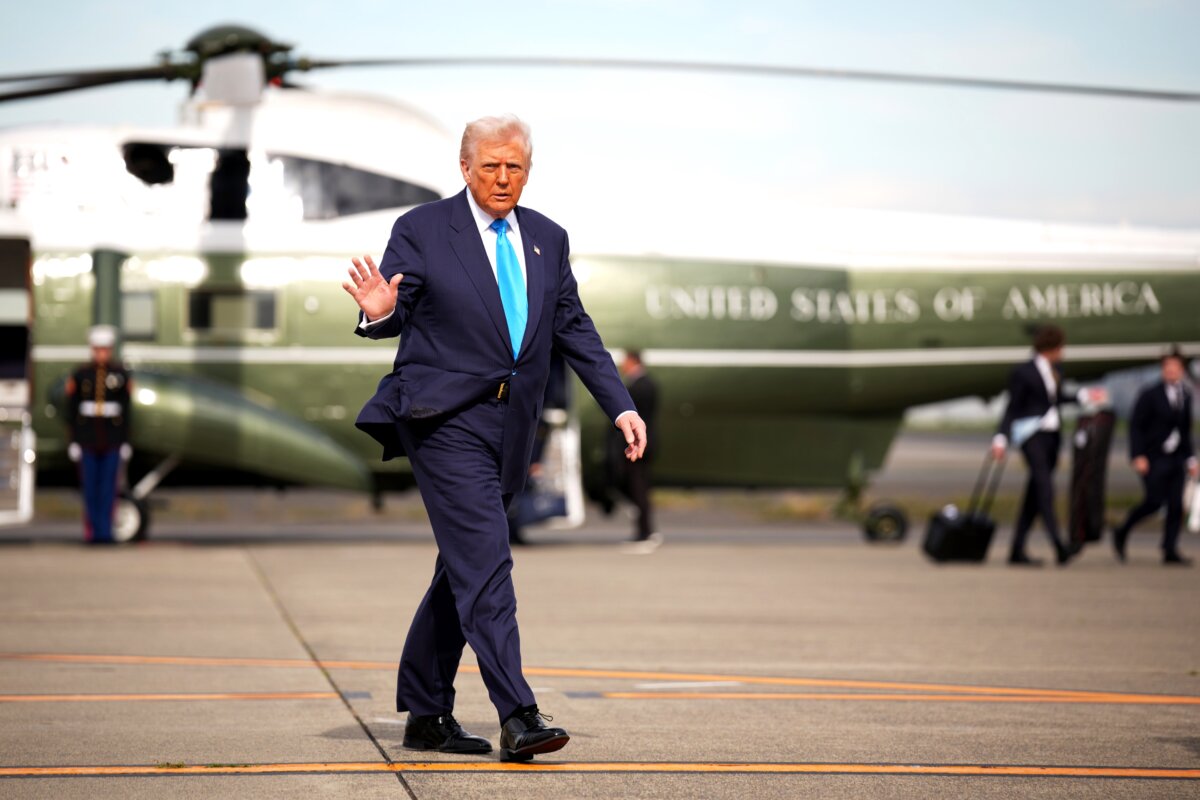

President Donald Trump said he would send U.S. Marines and members of other branches of the military into U.S. cities “in a heartbeat” if he were to think it necessary, asserting that he has the full legal authority to do so under the Insurrection Act but has so far chosen restraint.
“If you had to send in the Army or if you had to send in the Marines, I’d do that in a heartbeat,” Trump said in a Nov. 2 appearance on CBS News’s “60 Minutes.”
He was responding to a question about what he meant when he told troops at a naval base in Japan last week that he would be willing to send “more than the National Guard” to U.S. cities if needed.
Trump then pointed to the Insurrection Act, which allows presidents to deploy active-duty troops on U.S. soil in limited circumstances, such as to enforce federal authority or quell unrest when state governments fail to act. It was most recently invoked during the 1992 Los Angeles riots.
“Do you know that I could use that immediately and no judge can even challenge you on that?” Trump said, referring to the act.
“But I haven’t chosen to do it because I haven’t felt we need it.”
Trump stated that presidents have used the Insurrection Act “routinely” in the past, although he declined to provide details when asked what specific circumstances would prompt him to invoke the law.
“If I needed it, I could do it,” Trump said.
“And if I needed it, that would mean I could bring in the Army, the Marines, I could bring in whoever I want. But I haven’t chosen to use it.”
Trump made similar remarks while speaking to U.S. troops at the Yokosuka naval base near Tokyo on Oct. 27, saying, “People don’t care if we send in our military, if we send in our National Guard, if we send in Space Command—they don’t care who the hell it is, they just want to be safe.”
“We have cities that are troubled. We can’t have cities that are troubled, and we are sending in our National Guard,” Trump said.
“And if we need more than the National Guard, we’ll send more than the National Guard because we’re going to have safe cities.”
Those comments prompted renewed questions about whether the White House was considering a broader deployment of federal forces, a possibility Trump has repeatedly alluded to by referencing the Insurrection Act and its powers.
Trump has previously described the law as “the strongest power a president has,” telling Fox News in October that almost 50 percent of presidents have invoked the law and that he reserves the right to do so to protect residents in cities where he says local officials have been reluctant to fight crime.
The Insurrection Act has been used 30 times in U.S. history—often to quell riots or civil unrest—according to the Brennan Center for Justice. At least 16 of the nation’s 45 presidents have invoked it, although its use has declined sharply since the latter half of the 20th century.
National Guard Deployments and Legal Pushback
Trump has already deployed National Guard units to several Democrat-led cities, including Washington; Memphis, Tennessee; Los Angeles; and Portland, Oregon. He has said that the deployments are reducing crime.
“We’re taking a lot of bad people out,” he said aboard Air Force One on Oct. 28.
“We’re incarcerating some very bad people, some gangs. … We’re doing things that frankly local law enforcement’s going to have a hard time doing.”
Trump cited a decline of 60 to 70 percent in crime in Memphis following a recent National Guard deployment, and he described major progress on public safety in the nation’s capital.
However, the administration’s federal deployments have faced legal obstacles.
On Nov. 2, Judge Karin Immergut of the U.S. District Court for the District of Oregon extended an order blocking Trump from sending National Guard troops to Portland to protect federal immigration facilities.
In her ruling, she said Oregon, California, and the city of Portland were likely to show that the president overstepped his authority under the federal law that lets presidents call up state National Guard units without a governor’s consent in rare emergencies such as rebellions.
Immergut found that the unrest in Portland didn’t amount to a rebellion or true emergency, noting that violence had mostly subsided months earlier and that police were able to keep order.
Other lawsuits, including those filed by the state of Illinois and the city of Chicago, have been brought in response to National Guard deployments.
Opponents of the deployments have argued that the president is overstepping his constitutional authority by using military forces in civilian law enforcement.
“It is an abuse of presidential power, very disrespectful to and a misuse of our service members, and a reckless waste of our tax dollars to make Oregon a federal target for the purpose of bullying people for political theater,” Sandy Chung, executive director of the American Civil Liberties Union of Oregon, said in a recent statement.
Trump and other administration officials, by contrast, have argued that the deployments are lawful and necessary to protect federal property and personnel in cities where they say local leaders have failed to maintain order.
In a post in late September, Trump said that he had authorized the deployment of “all necessary Troops to protect War ravaged Portland, and any … ICE Facilities under siege from attack by Antifa, and other domestic terrorists.”
 Friends Read Free
Copy
Facebook
Tweet
Friends Read Free
Copy
Facebook
Tweet