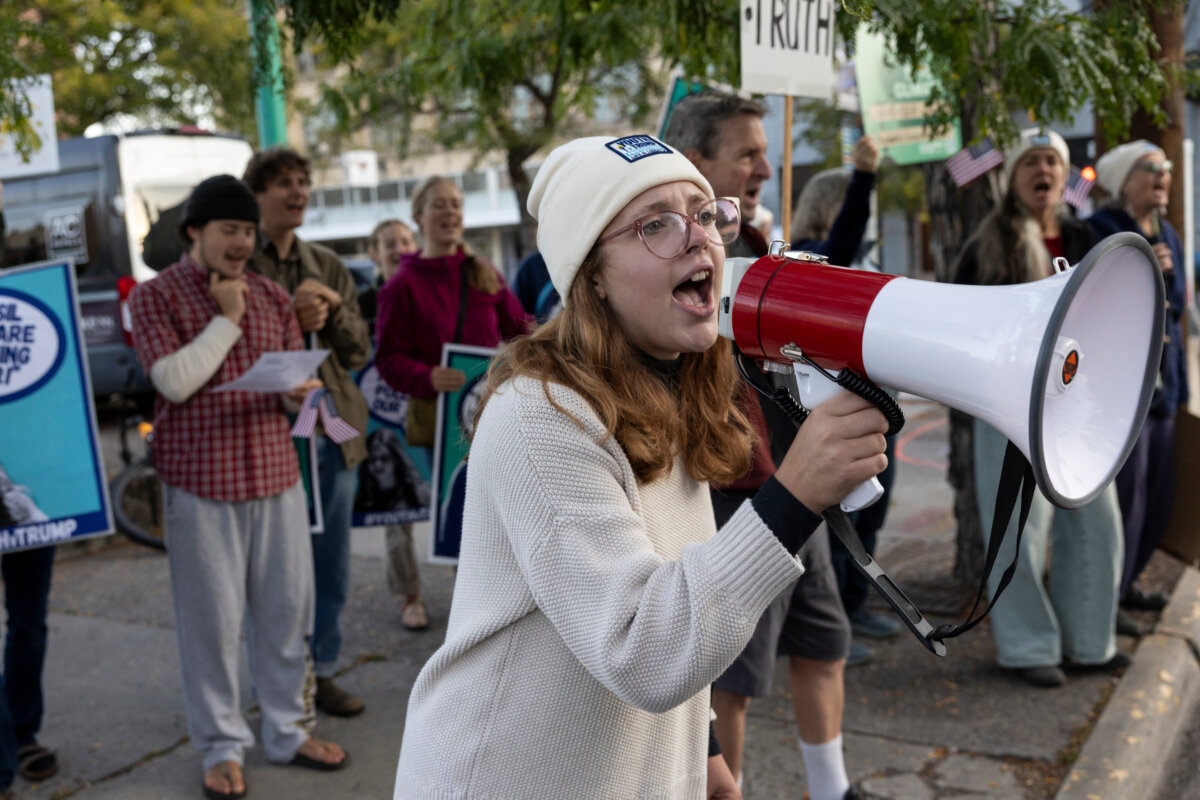

A federal judge on Oct. 15 dismissed a lawsuit attempting to block President Donald Trump’s executive orders that discourage renewable energy while promoting increased production of fossil fuels.
U.S. District Judge Dana Christensen said the plaintiffs, who included a group of young climate activists, had shown overwhelming evidence that their lives are affected by “climate change” and that the president’s executive orders would make it worse.
However, the judge concluded that the plaintiffs’ request for court intervention was “unworkable” because it went beyond the scope of the judicial branch’s power to establish environmental policies.
The group of 22 plaintiffs included youths who won in a major climate trial against Montana in 2023. A two-day hearing in Missoula, Montana, last month saw activists and experts testifying on their behalf say Trump’s energy policies, which increase drilling and mining while reducing renewable energy use, are a growing threat to children and the Earth.
In Trump’s Jan. 20 executive order declaring a national energy emergency, the president said that “the integrity and expansion of our Nation’s energy infrastructure—from coast to coast—is an immediate and pressing priority for the protection of the United States’ national and economic security.”
On the same day, the president also issued an order aimed at “Unleashing American Energy,” eliminating the “electric vehicle (EV) mandate” to promote “true consumer choice” for economic growth.
That order removed regulatory barriers regarding vehicles, charging agencies with taking action to remove “undue burden” on the development or use of domestic energy resources, including oil, natural gas, coal, hydropower, biofuels, critical minerals, and nuclear energy resources.
On Oct. 15, the World Meteorological Organization said heat-trapping carbon dioxide levels in the atmosphere jumped by the highest amount on record in 2024 and claimed that they were “turbo-charging” the planet’s climate and resulting in more extreme weather.
The agency stated that the increase from 2023 to 2024 in global average concentration of carbon dioxide was the highest annual measurement of any one-year span since record keeping began in 1957.
The activists and their counsel from Our Children’s Trust, an environmental group, faced steep odds in the federal case, according to legal experts. While Montana’s constitution declares that citizens have a “right to a clean and healthful environment,” the U.S. Constitution lacks that language, they noted.
Christensen’s ruling on Oct. 15 marked a victory for the Trump administration and for voters who back its agenda to establish American “energy dominance” via more fossil fuel production, according to Taylor Rogers, a White House spokeswoman.
“President Trump saved our country from Joe Biden’s wildly unpopular Green Energy Scam, and he will continue to ‘DRILL, BABY, DRILL’,” Rogers said in a statement.
In a 31-page ruling, the judge said the activists were seeking an injunction that would have effectively implied reverting to the Biden administration’s environmental policies. Christensen said that would have required scrutinizing every single climate-related policy the Trump administration has made since the president’s inauguration.
That would involve monitoring “an untold number of federal agency actions to determine whether they contravene its injunction,” the judge said.
“This is, quite simply, an unworkable request,” he said.
Julia Olson, chief legal counsel at Our Children’s Trust, said the climate activists will appeal the ruling.
“Every day these executive orders remain in effect, these 22 young Americans suffer irreparable harm to their health, safety, and future,” Olson said. “The judge recognized that the government’s fossil fuel directives are injuring these youth, but said his hands were tied.”
In March, the U.S. Supreme Court declined to consider Our Children’s Trust’s final appeal in a previous federal climate lawsuit it filed in Oregon that had gone on for a decade.
Christensen referred to that case while concluding that the plaintiffs in Montana did not have the standing to sue the government.
“This Court is certainly troubled by the very real harms presented by climate change,” he wrote. “This concern does not automatically confer upon it the power to act.”
Justice Department attorneys and those from more than a dozen states, led by Montana, had urged Christensen to dismiss the case.
Montana Attorney General Austin Knudsen said the ruling meant the rule of law had prevailed.
“Ultimately, the court rejected the plaintiffs’ request to force the Trump administration to revert to Biden’s nonsensical and unpopular policies,” Knudsen said in a statement. “Our suspicions were confirmed–this was just another show trial contrived by climate activists who wasted the taxpayer’s money.”
Montana, Illinois, Pennsylvania, Massachusetts, and New York are among the few states that have enshrined environmental protections in their state constitutions.
Last year, the Montana Supreme Court upheld the 2023 trial outcome, forcing officials to more closely analyze emissions.
The Associated Press and Savannah Hulsey Pointer contributed to this report.
 Friends Read Free
Copy
Facebook
Tweet
Friends Read Free
Copy
Facebook
Tweet