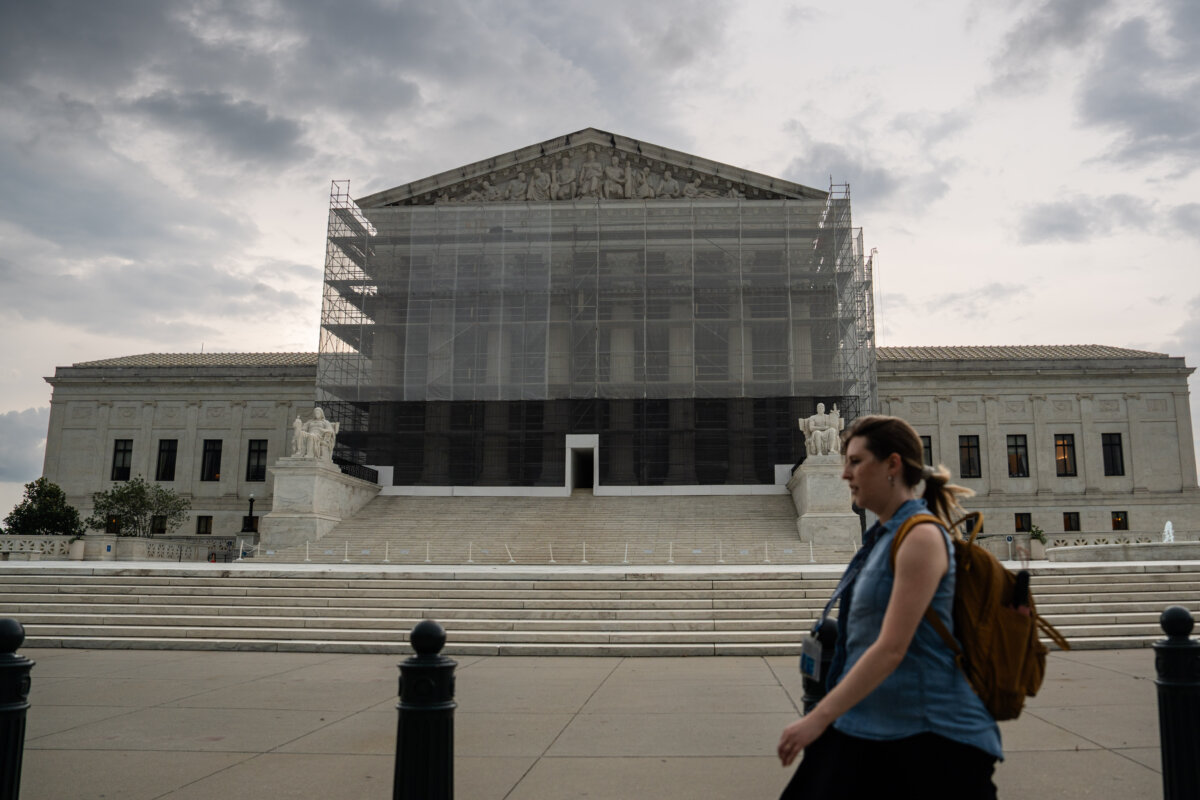

As the Voting Rights Act marks its 60th anniversary this year, the Supreme Court is set to hear at least one landmark case dealing with the legislation.
The outcome will have long-term ripple effects on the balance of power in Congress, especially as states square off to redraw congressional districts ahead of the 2026 midterm elections.
Here is what to know about the legislation and the brewing legal challenges.
The Voting Rights Act
The legislation was signed in 1965 by President Lyndon Johnson and was meant to shore up voting rights for minority groups across the country, especially African Americans.
The legislation dealt with the ongoing efforts of some states to hinder minorities from participating in elections despite the 14th Amendment, which grants equal protection under the law, and the 15th Amendment, which prevents voter discrimination based on race or “former servitude.”
Two sections of the legislation have been at the hub of legal battles over the past six decades.
One portion prohibits laws or policies that “deny or abridge the right of any citizen of the United States to vote on account of race or color.”
It has historically been used to prevent states from “gerrymandering,” or drawing congressional district lines to favor political interests. Gerrymandering can be used to dilute minority voting blocs or cram them all into one district.
The law was amended in 1982 to state that courts could see how many members of a minority group have been elected to office when deciding if that part of the law has been violated.
However, the amendment also states that “nothing in this section establishes a right to have members of a protected class elected in numbers equal to their proportion in the population.”
Other parts of the law targeted states that had a history of denying minorities the right to vote by using a “test or device” such as an exam to measure literacy or morality. These sections required those states to get federal approval before changing their voting laws—an action known as “preclearance.”
Two recent cases have narrowed the scope of the law, but another may expand its use.
The Supreme Court Removes Requirements
In 2013, the Supreme Court ruled that singling out states for past discrimination was unconstitutional, since it was “based on 40-year-old facts having no logical relation to the present day.”
This had the effect of nullifying the preclearance requirement.
The same day the decision was published, Texas Gov. Greg Abbott announced that his state would institute a voter ID law that the federal government had blocked under preclearance rules.
In 2021, the Democratic National Committee (DNC) sued Arizona over a rule that allowed the state to discard provisional ballots if they were determined to have been cast in the wrong precinct. The DNC said this placed an unfair burden on black and Latino voters.
The DNC also challenged a law that prohibited third-party early ballot collection by anyone other than a family or household member, a postal worker, or an election official. It alleged that this was a violation of the Voting Rights Act and the 15th Amendment.
The Supreme Court ruled in favor of Arizona and found that neither of these laws was racially discriminatory.
In his majority opinion, Justice Samuel Alito pointed out that 99.5 percent of nonminority voters used the correct precinct, compared with 99 percent of minority voters.
“Properly understood, the statistics show only a small disparity that provides little support for concluding that Arizona’s political processes are not equally open,” he wrote.
But in 2023, the court ruled 5–4 that an Alabama redistricting plan violated the law because it contained only one majority-black district.
Justice Clarence Thomas wrote, two years later, that this ruling “placed the [Voting Rights Act] in direct conflict with the Constitution.”
An upcoming case involving Louisiana may resolve that conflict.
Between a Rock and a Hard Place
Louisiana redrew its congressional district map in 2022. Private individuals and civil rights groups sued, arguing that the map was discriminatory because it created only one district with an African American majority, even though that demographic represents one-third of the state’s population.
A district court agreed and ordered that the lines be redrawn with another majority- or near majority-African American district; this occurred in 2024.
However, a group of nonminority voters filed suits against the state and the previous plaintiffs, alleging that the race-based redrawing discriminated against voters who were not African American.
Although the Supreme Court heard arguments in March for these now combined cases, it did not issue a ruling. Instead, it asked for more briefs, and will hear more arguments sometime after October when its next term begins.
Thomas objected to the delay.
“These are the only cases argued this Term in which our jurisdiction is mandatory,” the justice wrote in a dissent.
“That an Act of Congress requires that we decide these cases should have prompted us to resolve them expeditiously.”
Thomas also wrote that previous Supreme Court decisions had created an ongoing conflict between the Voting Rights Act and the equal protection clause of the 14th Amendment. He said lower courts had interpreted those decisions to mean that when a state could create extra mostly-minority districts, it must do so to balance out minority voting power.
The Impact
It should be noted that the Eighth Circuit Court of Appeals recently ruled in a similar case in North Dakota that private individuals or groups cannot bring civil lawsuits under the Voting Rights Act, reserving that right only for the U.S. attorney general.
Although the Supreme Court has not yet agreed to hear that case, it did temporarily halt the ruling.
Mike O’Neill, vice president of Landmark Legal Foundation, told The Epoch Times that these past Supreme Court decisions placed states such as Louisiana “between a rock and a hard place” because the Voting Rights Act seems to require them to draw districts based on racial considerations, while the 14th Amendment and 15th Amendment seem to prohibit this.
“So, it’s imperative that the court provides some clear guidance on what states are supposed to do,” he said.
O’Neill also highlighted an underlying current in proponents of mostly-minority district requirements.
“There’s the assumption here that African Americans—or any minority group—votes en masse,” he said. “And of course, I think that assumption has really been, for lack of a better term, eroded.”
 Friends Read Free
Copy
Facebook
Tweet
Friends Read Free
Copy
Facebook
Tweet