Ukrainian President Volodymyr Zelenskyy said on Aug. 13 that Russian President Vladimir Putin was “bluffing” when he said sanctions were not hurting the Kremlin.
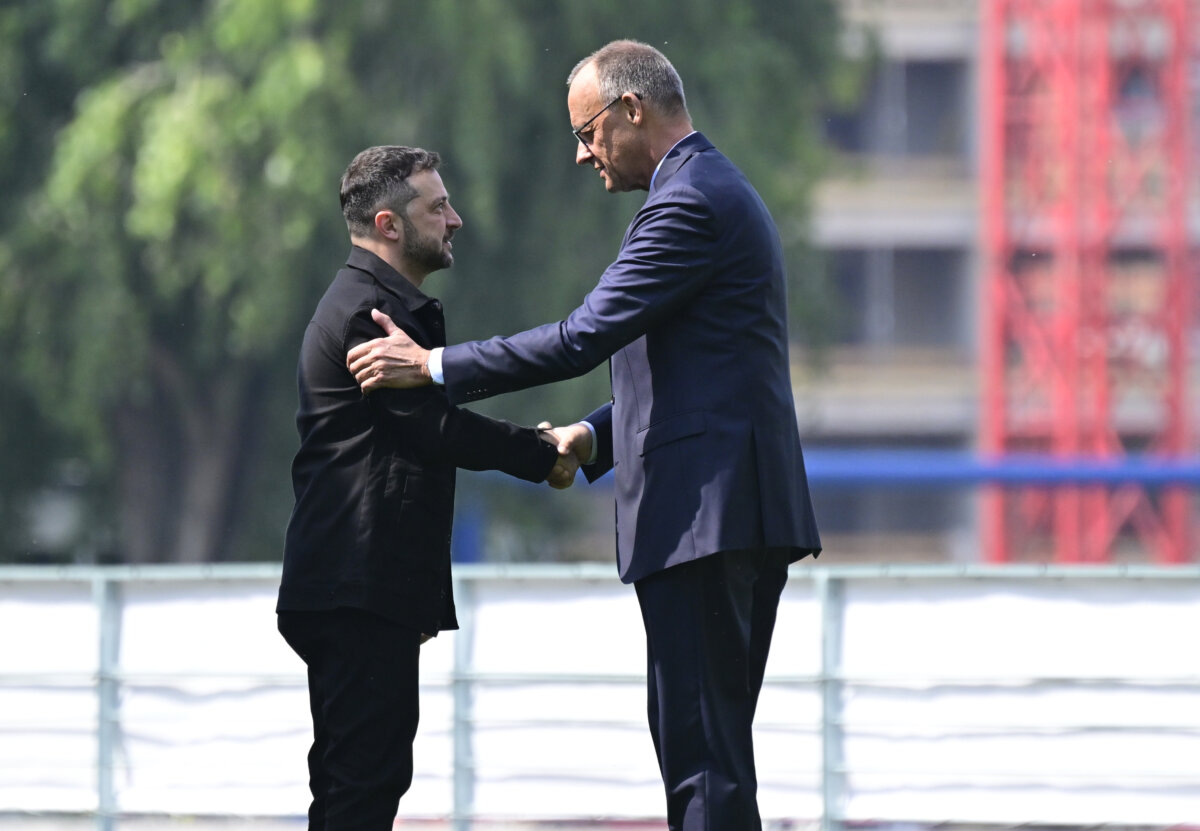
Zelenskyy was speaking after sitting in on a series of virtual meetings hosted by German Chancellor Friedrich Merz ahead of the summit on Aug. 15 between U.S. President Donald Trump and Putin.
Zelenskyy met with Merz and the leaders of several other European Union and NATO countries before having a virtual call with Trump and U.S. Vice President JD Vance.
After the meetings, Zelenskyy and Merz held a joint press conference, at which the Ukrainian president said he had discussed the Alaska summit with Trump.
“We really hope that a cease-fire, an immediate cease-fire, will be one main issue during this meeting,” Zelenskyy said. “President Trump has been talking about it.”
The Ukrainian leader said Trump told him that he would contact him immediately after the Alaska summit.
“He will tell me about all the results, if there are any results, and then we will discuss our steps together,” he said.
“I told the American president … Putin is bluffing. … Russia is pretending they can occupy the entire Ukraine, but this is not true. Also, he’s saying that sanctions are not important and they are not working, but I am sure that sanctions are effective; they are harmful for the Russian economy.”
Merz said Russia has reopened the “division of Europe,” which had ended 36 years ago with the fall of the Berlin Wall.
The German leader said he wished Trump all the best for his meeting with Putin and said he would speak to the U.S. president after the summit.
Earlier on Aug. 13, Merz said Germany would help Ukraine develop its own long-range missile systems that it could use to strike deep inside Russia.
Previously, the United States and other NATO countries had declined to supply Kyiv with such missiles, fearing that the Kremlin would see it as an act of war.
But in 2024, then-U.S. President Joe Biden agreed to allow Ukraine to use U.S.-made army tactical missile systems against Russia.
On Aug. 12, EU leaders urged Trump to defend Europe’s vital security interests during his meeting with Putin in Alaska on Aug. 15.
In a statement, they said: “The people of Ukraine must have the freedom to decide their future. The path to peace in Ukraine cannot be decided without Ukraine.”
Hungary was the only EU nation that refused to be associated with the statement.
‘This War Must Be Ended’
On Aug. 13, Zelenskyy posted on X: “This war must be ended. Pressure must be exerted on Russia for the sake of a just peace. Ukraine’s and our partners’ experience must be used to prevent deception by Russia.
“At present, there is no sign that the Russians are preparing to end the war. Our coordinated efforts and joint actions—of Ukraine, the United States, Europe, and all countries that seek peace—can definitely compel Russia to make peace. I thank everyone who is helping.”
On Aug. 13, Russia stated that its political and territorial demands have not changed in the past 14 months and that it still wants four regions of Ukraine and a guarantee that Ukraine will not join NATO.
The deputy spokesperson for the Russian Ministry of Foreign Affairs, Alexei Fadeev, told reporters, “Russia’s position remains unchanged, and it was voiced in this very hall just over a year ago, on June 14, 2024.”
That was the date Putin delivered a speech in which he demanded that Ukraine hand over the regions of Donetsk, Luhansk, Zaporizhzhia, and Kherson and accept that it cannot join NATO.
On Aug. 12, Zelenskyy ruled out handing over the Donbas region, which is made up of the Donetsk and Luhansk regions in eastern Ukraine and has a large ethnic Russian population.
Russian troops currently hold most of the Donbas region, as well as the majority of the Kherson and Zaporizhzhia regions in the south of Ukraine.
“For Russians, Donbas is a bridgehead for a future new offensive,” Zelenskyy told reporters in Kyiv, according to national news agency Ukrinform. “Any issue of territories cannot be separated from security guarantees.”
Trump told reporters at the White House on Aug. 8 that there could be “some swapping of territories to the betterment of both” Russia and Ukraine to end the war that began in February 2022.
But Zelenskyy has refused to consider giving up any Ukrainian territory, including Crimea. Crimea was part of Russia until 1954, when the leader of the Soviet Union at the time, Nikita Khrushchev, transferred it to Kyiv.
In an Aug. 13 Truth Social post, Trump said: “We are winning on everything. The Fake News is working overtime (No tax on overtime!). If I got Moscow and Leningrad free, as part of the deal with Russia, the Fake News would say that I made a bad deal!”
Leningrad was the name for St. Petersburg, Russia, from 1924 until 1991.
Russian and Ukrainian troops are engaged in heavy fighting in the suburbs of the crucial city of Pokrovsk, in Ukraine’s Donetsk region.
Pokrovsk—known to Russian speakers as Krasnoarmeysk—is a key logistics hub, often described in the Russian media as the “gateway to Donetsk.”
Zelenskyy said on Aug. 12 that Putin wants Ukraine to withdraw troops from the remaining 30 percent of the Donetsk region—including Pokrovsk—that it still controls as part of a cease-fire deal, a proposal he rejected.
On the night of Aug. 12, the Kremlin posted a report on its Telegram channel about a telephone conversation Putin had had with North Korean leader Kim Jong Un, who has sent troops to fight against Ukraine alongside the Russians.
It states: “Putin highly appreciated the support provided by the Democratic People’s Republic of Korea during the liberation of the Kursk region from the invading forces of the [Kyiv] regime, and the courage, heroism, and selflessness displayed by the [Democratic People’s Republic of Korea] soldiers.
“The President of Russia also shared information with Kim Jong-un in the context of the upcoming talks with U.S. President Donald Trump.”
On April 30, South Korea’s spy agency told lawmakers in Seoul, South Korea, that North Korea had suffered 4,700 casualties, including 600 deaths, in the conflict with Ukraine.
The Associated Press contributed to this report.
 Friends Read Free
Copy
Facebook
Tweet
Friends Read Free
Copy
Facebook
Tweet