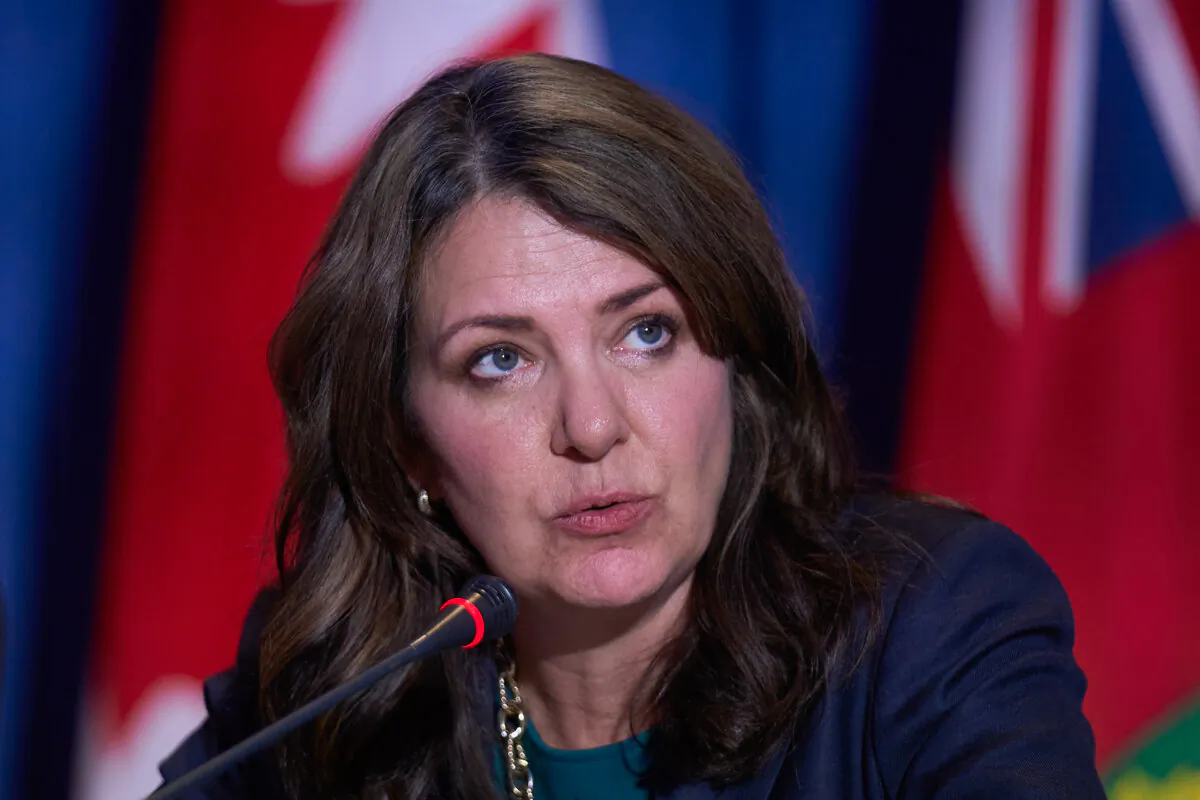

Premier Danielle Smith is asking Albertans to provide input on how her government should implement nuclear power in the province to fulfill its future energy demands.
Smith announced this week that a provincial panel has been appointed to interact with residents and give the public a chance to influence the province’s nuclear path.
“Nuclear power has the potential to expand our grid, support new industries, and keep pace with rising demand,” Smith said at an Aug. 25 press conference in Calgary. “This engagement gives Albertans a real voice in shaping our future, while positioning our province to lead the way in innovative, responsible energy development.”
The Nuclear Energy Engagement and Advisory Panel will be chaired by Parliamentary Secretary for Affordability and Utilities Chantelle de Jonge, and will include a group of five experts.
The panel members are Indian Resource Council of Canada CEO Stephen Buffalo, University of Calgary associate professor of law and research fellow in nuclear law and policy Rudiger Tscherning, University of Calgary professor of strategy and global management Harrie Vredenburg, retired ENMAX vice-president of public policy Tim Boston, and former MLA Deron Bilous, who is now the senior vice president at Western Canada Counsel Public Affairs Inc., a PR firm.
Panel members will work directly with indigenous communities and organizations to gather their perspectives on the province’s nuclear aspirations, the government said, but online surveys have also been set up to collect public feedback.
The Nuclear Energy Development survey is currently available online and will be open through Sept. 25. An online request for information from industry and local governments is also available and will be open until Oct. 25.
Affordability and Utilities Minister Nathan Neudorf said the engagement process will likely last for one year. He said if there is a demonstrated interest in nuclear power, it may take up to 10 years before a plant is constructed.
Nuclear Aspirations
The launch of both the survey and panel has been in the works for some time. Smith announced last month that her government planned to hold public consultations this fall on potentially adding nuclear power to Alberta’s energy mix.
Smith first spoke about using nuclear power in Alberta during a July 7 press conference, saying the province is interested in constructing nuclear reactors capable of supplying power to the province’s oilsands operations rather than relying on natural gas, a source that emits greenhouse gases.
The province heavily relies on natural gas for its electricity needs, but Smith said she would like to integrate nuclear into the provincial framework to provide a stable energy source for Albertans, noting that small modular reactors (SMRs) are the most logical option.
SMRs produce approximately one-third of the power generated by conventional nuclear power plants and can be manufactured in different locations prior to being transported to the installation site.
Canada’s first SMR is being built by Ontario Power Generation (OPG) at its Darlington plant an hour east of Toronto. It will be the first power company in North America to integrate such a facility into the electrical grid.
Smith said she wants Alberta to do something similar, but noted during this week’s press conference that it would work differently than Ontario’s system, which is government-owned.
“Because we have a power market where generation is privatized, we would anticipate that the private sector would pay for it,” Smith said.
“At the moment, we haven’t seen a need for us to establish a Crown corporation like they do in every other jurisdiction in Canada. We’re prepared to do that if we have to, if we cannot get enough baseload … But we want to see the private market work.”
Alberta’s interest in nuclear power dates back several years. The province joined Saskatchewan, Ontario, and New Brunswick in a Memorandum of Understanding in 2021 to collaborate on the development of nuclear power, specifically focusing on SMRs.
The partnership seeks to promote the implementation of SMRs in Canada to help support each of the province’s need for cost-effective, dependable power grids.
An interprovincial strategic plan for SMR development was released in March 2022.
Alberta also signed a bilateral agreement last May with Saskatchewan to work together on nuclear power generation in a bid to obtain affordable and sustainable electricity grids by 2050. The agreement adds areas of interest beyond SMRs such as industrial decarbonization and grid reliability.
Energy Alberta is currently developing a power station in the Peace River region, which is expected to feature two to four CANDU reactors, with a total capacity reaching up to 4,800 megawatts. This would account for as much as one-quarter of the current electricity generation in the province.
A preliminary project description was submitted in April for the Peace River Nuclear Power Project, initiating the federal review process.
Smith said the consortium of municipalities involved in the Peace River proposal is not alone in its interest in nuclear energy.
“I know that there’s at least another couple of municipalities who have expressed an interest as well, including Lloydminster,” she said. “And so now that we’ve started this [consultation], we’ll find out where those areas are, where they would like to host an installation like this, the uses for it, as well as some of the concerns people have.”
 Friends Read Free
Copy
Facebook
Tweet
Friends Read Free
Copy
Facebook
Tweet