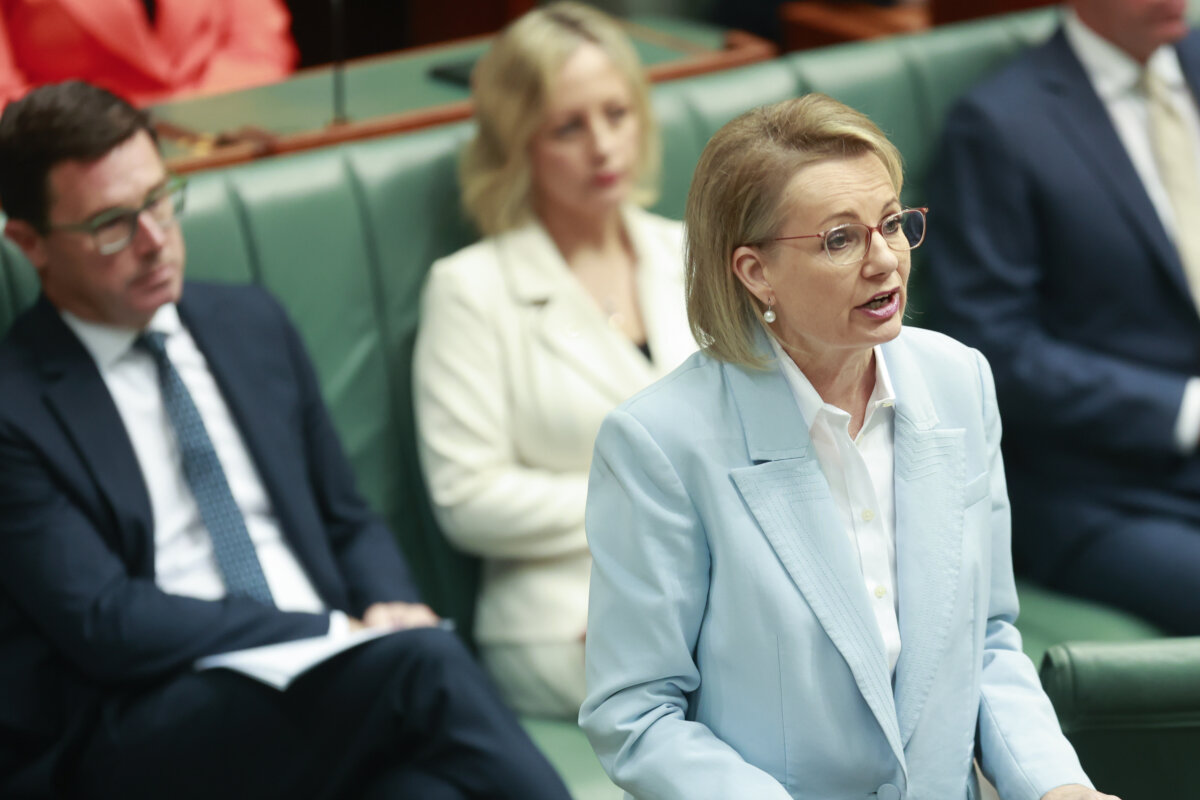

Australia’s opposition has been thrown into renewed turmoil after all National MPs withdrew from the Coalition frontbench after three members initially pulled out after defying a unified position on Labor’s hate crimes legislation.
On Jan. 21, Opposition Leader Sussan Ley accepted the frontbench resignation of Senators Bridget McKenzie, Susan McDonald, and Ross Cadell after they voted against the bill in the upper house on Jan. 20, despite the shadow cabinet agreeing to support it with amendments.
Under long-standing parliamentary convention, frontbenchers who cross the floor are expected to step down.
Hours later after an evening party room meeting, the remaining National Party members, including leader David Littleproud, also withdrew.
“As it was a party room decision, if these resignations are accepted, the entire NationaI party ministry will resign to take collective responsibility,” Littleproud wrote in a letter to Ley.
Littleproud argued the hate crimes legislation was rushed, creating “unique circumstances” which justified the split between the Coalition partners.

Cabinet Solidarity Enforced
Ley earlier confirmed in a statement to The Epoch Times, that the ousting of the trio was necessary to maintain collective responsibility within the Liberal-National Coalition.
She said all three senators had written to her confirming they are “ready to continue serving the Coalition in whatever capacity you consider appropriate …”
“I have asked each to continue serving in our Coalition team, across their various parliamentary and committee duties, but from outside the shadow cabinet,” she said.
Vote That Triggered the Fallout
Ley made her position clear ahead of the vote on the Combatting Antisemitism, Hate and Extremism (Criminal and Migration Laws) Bill 2026 that includes tougher hate speech laws and was passed in response to the Bondi terror attacks.
“Yesterday, in several conversations, I made it clear to [Nationals leader] David Littleproud that members of the shadow cabinet could not vote against the shadow cabinet position,” she said.
She said the shadow cabinet had unanimously backed the bill, subject to amendments later secured.
Nationals Explain Their Reasons
Senator Susan McDonald, who stepped down as Shadow Minister for Resources and Northern Australia, said she supported the intent of the legislation but opposed the process.
McDonald said she remained committed to Queenslanders and praised her time on the frontbench.
“Serving as the Shadow Minister for Resources and Northern Australia, and the shadow cabinet under both Peter Dutton and Sussan Ley has been a privilege. I thank my leader, David Littleproud, for entrusting me to serve in this position.”
Senator Bridget McKenzie, speaking earlier to Sky News, acknowledged the consequences of defying party conventions.
“I’m very aware of the conventions of Parliament, and I will be doing what I’ve always done is trying to do my very best to conduct my career here with integrity,” she said.
Senator Ross Cadell also signalled his readiness to step aside.
“I have prepared to resign … I will wear the consequences of that as I should, as more politicians should in this place is stand up and take your pain when you do the wrong thing. And if I have done that, I will go without a question. I’ll support the coalition,” he said.
Is There a Precedent?
Not all Nationals agreed that stepping down was necessary.
Backbench Senator Matt Canavan, who also voted against the bill but is not bound by shadow cabinet rules, said he was unaware of a precedent.
“I don’t think there’s a precedent for it,” he told Sky News.
He pointed to a 2008 split between the Liberals and Nationals over wheat market deregulation, noting no shadow ministers resigned at the time.
“They went on to play key roles, senior roles, in an opposition and ultimately winning government in 2013,” Canavan said.
The One Nation Question
The internal Coalition rupture has prompted questions about the future of the senators.
One Nation MP Barnaby Joyce said he would not be reaching out noting the difficulties of leaving a party, but said any defectors would be welcome—notably strong conservative-leaning MPs like Colin Boyce and Llew O’Brien, who voted against the legislation in the lower house.
Joyce praised the pair for opposing the laws, saying they deserved credit for “standing up against censorship.”
The New England MP, who recently left the National Party, told Sky News “of course” he would welcome his former colleagues if they chose to join.
His comments come as One Nation records an ongoing surge in support since the May election with a recent Newspoll finding the party had, for the first time, pipped the Coalition in terms of popular support.
 Friends Read Free
Copy
Facebook
Tweet
Friends Read Free
Copy
Facebook
Tweet