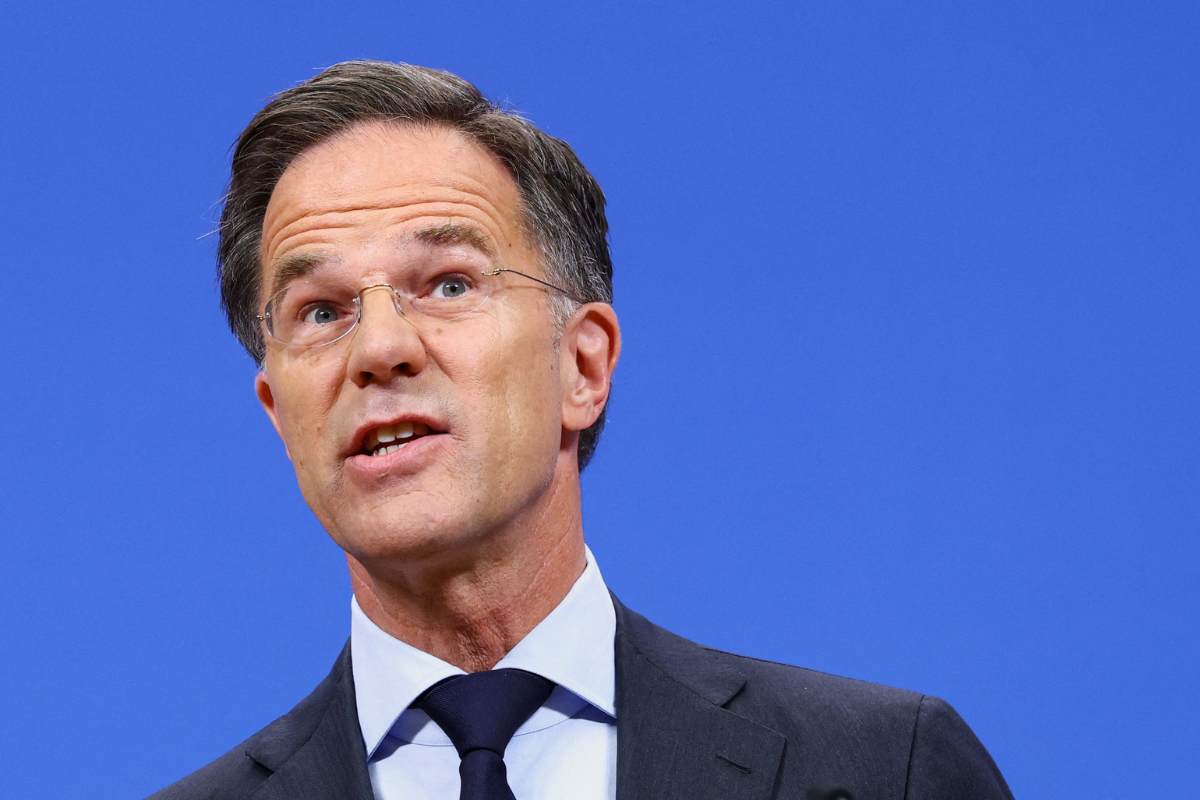

NATO allies will reaffirm their commitment to the defense alliance and announce billions in defense spending during July’s summit in Turkey, NATO Secretary-General Mark Rutte has said.
“At Ankara, we are going to show the world that we are delivering on the commitments we made in The Hague last year,” the NATO chief said during a speech to the Atlantic Council on June 25, alluding to allies’ commitment to increase defense spending to 5 percent of gross domestic product by 2035.
He said that since NATO made the target commitment, allies have already been working to increase their defense spending. This includes countries along NATO’s Eastern Flank, specifically Estonia, Latvia, Lithuania, and Poland, which Rutte said were “already spending well over the agreed targets” and are “moving with speed to continue investing more.”
Germany is also on track to double its defense investment from just a few years ago, Rutte said, amounting to more than 150 billion euros ($171 billion) a year.
Overall, in the last decade, European allies and Canada have spent an additional $1.2 trillion in defense, he said.
The next NATO summit will be taking place in Ankara, Turkey, on July 7 and July 8, where leaders are likely to discuss solidarity and defense spending commitments. President Donald Trump has long been an advocate for the other members of the alliance to take more practical and financial responsibility for collective defense.
Rutte’s remarks follow a group of European leaders’ earlier commitment to strengthening the European pillar.
On June 24, the European Group of Five, comprising France, Germany, Italy, Poland, and the UK, reaffirmed its commitment to Euro-Atlantic security and recognized the vital role of the United States in the alliance.
Defense Industrial Revolution
Rutte said that in Ankara, “we will announce tens of billions of dollars of new contracts.”
“The result is not only improved security,” he said. “We are in the early stages of a defense industrial revolution that will help grow our economies and support hundreds of thousands of jobs on both sides of the Atlantic, and this is the defense dividend.”
Rutte said that while countries are committed and investing more to increase their defense capabilities, industry must step up in terms of innovation and production.
“We need to ensure that we are translating our economic might into military capabilities,” Rutte said, adding that this means “overcoming fragmented national defense industries” in Europe, cutting red tape in the United States, and “keeping innovation front and center across the alliance.”
He gave the example of his visit to the new Rheinmetall ammunition factory in Germany, which went from blueprint to completion in just over a year, and which will soon produce 350,000 artillery rounds annually, he said.
Likewise, in the United States, Lockheed, Northrop Grumman, Boeing, and others are ramping up production, “spurred by President Trump’s leadership.”
Russia, China, Iran, North Korea
Rutte said that NATO’s “competition” was Russia, Iran, China, and North Korea, all of which posed threats to the alliance.
The secretary-general said that “Russia remains our current and long-term threat,” noting that Moscow invests more than 40 percent of its budget in defense and is producing its own military equipment “around the clock.”
“China continues to modernize its forces and to expand its nuclear capabilities without any transparency, investing massively in military technology and innovation,” he said.
North Korea, he said, “persists in growing its nuclear program and is gaining valuable experience from supporting Russia’s war against Ukraine.”
Rutte said that while recent U.S. operations on Iran have severely degraded Tehran’s nuclear and ballistic missile program, “we must remain vigilant.”
“On their own it is already an issue, but these countries are working together and we can easily agree that they do not have our best interests in mind,” he said.
Credits Trump Leadership
Rutte said that, aside from regional and other global threats, he believes the mindset shift toward boosting the alliance’s defense posture would not have occurred without Trump’s leadership.
“Every U.S. administration since President [Dwight D.] Eisenhower called on America’s allies to invest more and take burden sharing seriously, and one president got them to do it,” the NATO secretary-general said.
These comments echo remarks he made during a Bloomberg interview on June 24, where he said that the U.S. president “is really doing a huge amount of work to get NATO in better shape.”
Addressing the Atlantic Council, he said that European allies and Canada are now on a trajectory to equal the United States and are also taking on more leadership roles within the alliance, including bolstering deterrence along the Eastern Flank.
“This is NATO 3.0: a stronger Europe and a stronger NATO; conviction of purpose; magnitude of investment; true transformation,” Rutte said.
 Friends Read Free
Copy
Facebook
Tweet
Friends Read Free
Copy
Facebook
Tweet