
The German chancellor has said that Europe wants to strengthen itself within NATO, as European leaders reaffirmed their commitment to the defense alliance.
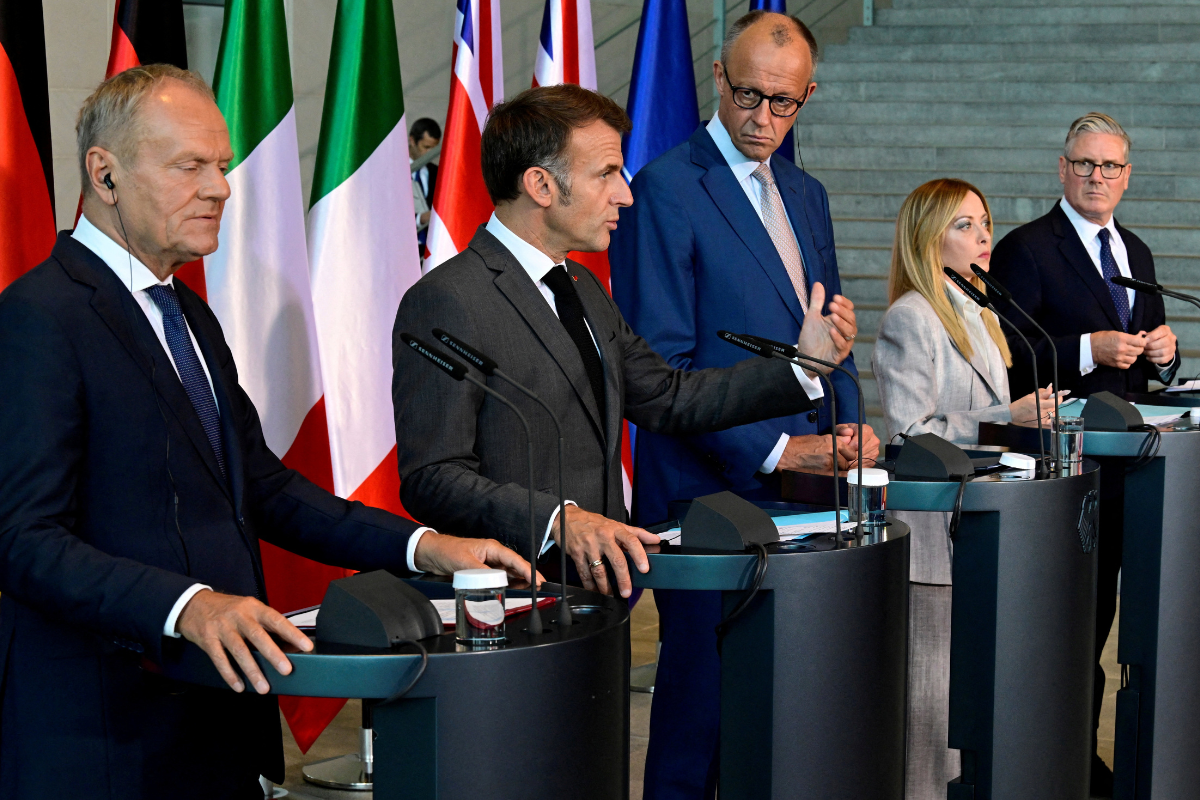
Friedrich Merz made the remarks before a June 24 meeting in Berlin with the leaders of France, Italy, Poland, and the UK, the five nations informally known as the European Group of Five (E5).
“We want to renew the Alliance,” he said. “We are strengthening its European pillar.”
Merz later shared a picture of himself, Polish Prime Minister Donald Tusk, French President Emmanuel Macron, Italian Prime Minister Giorgia Meloni, and British Prime Minister Sir Keir Starmer on X, saying that the five countries “stand closely together and take on more responsibility for the security of our continent.”
“Because Europe’s security can only be defended together,” Mertz wrote.
The E5 said in a joint statement released after the meeting that they “affirmed their unwavering commitment to Euro-Atlantic security and the transatlantic bond, recognising the vital role the United States continues to play in the Alliance.”
“They expressed their strong determination to build a stronger Europe in a stronger NATO and to pursue their respective defence industrial endeavors in the closest possible cooperation,” the statement reads.
One of the issues that leaders agreed to move forward on was boosting European leadership and burden-sharing. They said they were committed to developing stronger European roles in NATO, including taking greater responsibility for the alliance’s shared transatlantic security while continuing to coordinate closely with the United States.
The E5 also welcomed the U.S.–Iranian preliminary agreement aimed at ending the war, calling it a “moment of opportunity to restore regional stability and stabilise the global economy.”
The commitment comes ahead of next month’s summit, which is taking place in Ankara, Turkey, on July 7 and July 8.
NATO Members’ Loyalty
On June 23, U.S. President Donald Trump met with NATO Secretary-General Mark Rutte in the Oval Office, where the president said that other members of the alliance should show greater loyalty.
When asked during an Oval Office press conference what more the alliance members could do, Trump said: “I just want their loyalty.
“We don’t need their money, we don’t need anything. We have the most powerful military in the world by far, but I just want loyalty.”
The Trump administration has been frustrated with European allies in the past few months over their reluctance to support the United States during the Iran war, specifically European nations blocking U.S. forces from using their bases and airspace to support offensive operations against the Iranian regime.
During the meeting, Rutte broadly defended the record of European NATO members during the recent clashes with Iran.
He said between 4,000 and 5,000 U.S. aircraft took off from bases in Europe during the course of the conflict and described other instances in which airports in Romania slowed commercial traffic to accommodate U.S. aircraft.
Trump also reiterated concerns about NATO members meeting their military spending obligations, questioning whether they were hitting the target.
Rutte said the alliance has overall seen an increase in defense spending, calculating it at more than $1 trillion since the start of Trump’s first term in 2017 and referred to this increase as the “Trump Trillion.”
Getting NATO in ‘Better Shape’
Following his meeting with Trump, Rutte told Bloomberg that the U.S. president “is really doing a huge amount of work to get NATO in better shape.”
He called Trump’s efforts to get members to commit to increasing defense spending to 5 percent of gross domestic product by 2035 a “big success,” remarking that during the meeting, he wanted to show Trump that in the decade between his two presidencies, European and Canadian spending had seen a “staggering increase.”
Trump has long been an advocate for the other members of the alliance to take more practical and financial responsibility for collective defense.
Rutte said that with a year-over-year increase, in 2025, there was almost 20 percent more spending, “which is of course because of Russia and the threat and the war in Ukraine, but also very much because this president is quite forcefully encouraging allies to spend more, and I think it is fair to share that with him.”
“Allies are now delivering,” he said.
Ryan Morgan and Reuters contributed to this report.
 Friends Read Free
Copy
Facebook
Tweet
Friends Read Free
Copy
Facebook
Tweet