LOS ANGELES—A federal judge on June 26 declared a mistrial in a case accusing a troubled Uber driver of lighting a blaze in the Santa Monica Mountains that investigators say led to one of the most destructive fires in U.S. history.
The decision by Judge Anne Hwang of the U.S. District Court for the Central District of California came after the jury deadlocked on June 25. On the morning of June 26, several jurors responded tearfully as she asked each whether there was anything further the court could do to assist in deliberations.
All 12 said there was not.
After two weeks of presented evidence, dozens of witnesses, and only two days of deliberation, jurors said they were unable to unanimously agree whether prosecutors had proven their claim that Jonathan Rinderknecht, 30, had maliciously set fire to the hillside above a popular hiking trail early on Jan. 1, 2025, then lied to investigators and attempted to cover his tracks.
Ten jurors favored a “not guilty” verdict, while two voted “guilty.”
Rinderknecht faces three counts of arson related to federal property damage. The trial has been continued to Oct. 19.
Hwang ordered that Rinderknecht remain in custody until the new trial hearing in October.
“The evidence is strong that Jonathan Rinderknecht is responsible for igniting the fire on January 1, 2025, which eventually became the Palisades fire,” U.S. Attorney Bill Essayli said in a post to social media. “We fully intend to retry this case before a new jury and obtain guilty verdicts on all charged counts.”
Neither the evidence nor the government’s narrative, conjuring an angry and spiraling social outcast who sought revenge on “society at large,” convinced all jurors that Rinderknecht was responsible.
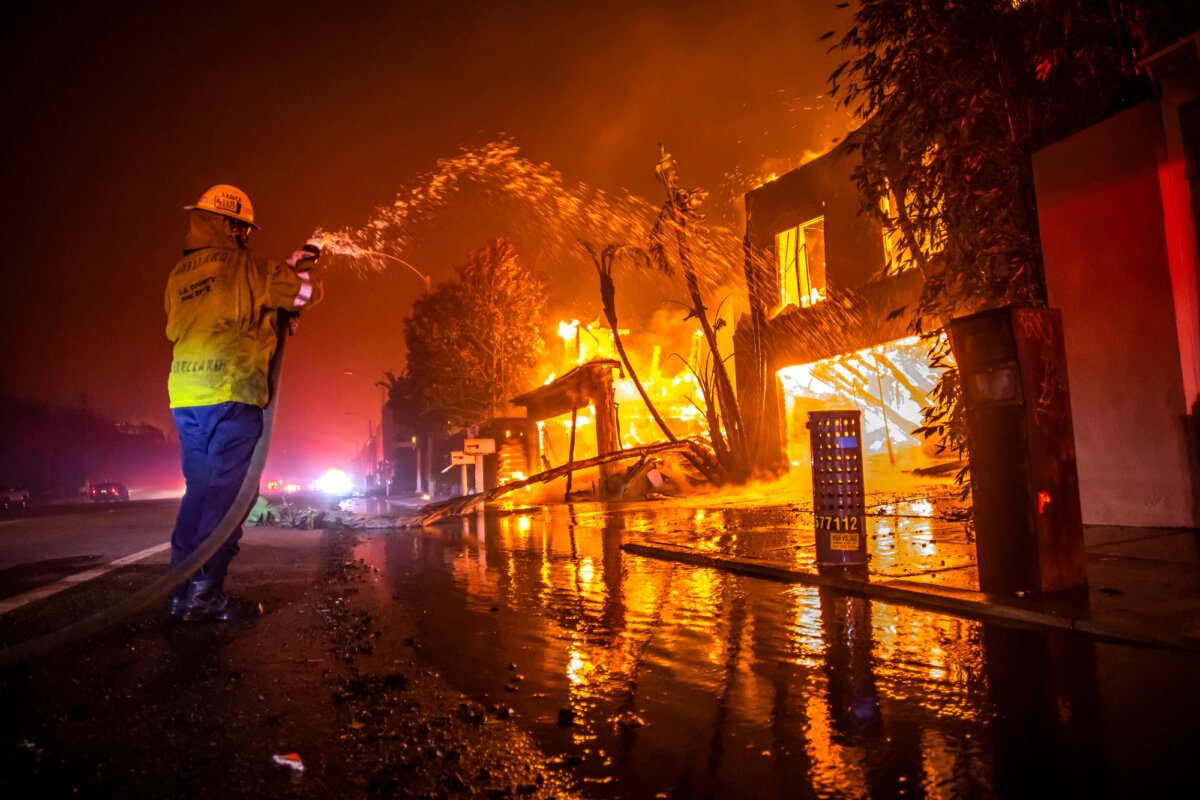
Investigators alleged that the defendant on Jan. 1 ignited a brush fire, dubbed the Lachman Fire, which smoldered underground for a week until reemerging to the surface through a single shrub. On Jan. 7, hurricane-force winds picked up the flame and propelled it through the surrounding canyons, killing 12 and razing more than 6,000 homes in the wealthy coastal enclave of Pacific Palisades.
Prosecutors presented geolocation data from nearby cell towers, video surveillance footage, and Rinderknecht’s 911 calls reporting the fire, as well as his own statements to investigators, as evidence, along with a cache of digital records pulled from his devices that they said illustrated a “revenge arson” motive.
Rinderknecht, a dual U.S. and French citizen, pleaded not guilty, and his attorneys argued that prosecutors presented a case heavy on motive and profiling but light on the reliable evidence needed to prove guilt beyond a reasonable doubt.
“Most investigations begin with a crime, then follow the evidence to a suspect,” Steve Haney, attorney for Rinderknecht, told the jury in his closing arguments on June 23.
“This investigation moved … in an opposite direction. It began with a man who called 911 on a hill. Then over time the theories changed to fit him. But the evidence never did.”
There was no evidence that Rinderknecht started the Lachman Fire, let alone was responsible for the Palisades Fire that followed it a week later, Haney told the court.
“I was very confident going into this that the government would fail to prove their case, and they did,” Haney told reporters after the trial. “They failed miserably; they didn’t even come close.”
In an emailed statement to The Epoch Times, Joel Rinderknecht, father of Jonathan, said his family considered the mistrial a major victory, and he questioned the government’s decision to retry a case “built on theories and scapegoating” and keep his son in detention longer.
“At this point, any citizen would expect the government to stop their singular pursuit of winning and instead value justice, integrity, and conclude, ‘we were wrong and we don’t have a case.’ That would go a long way towards restoring our trust in the justice system,” Rinderknecht’s father said.
“This case is frightening for any U.S. citizen.”
Asked why the government is opting to retry after 10 of 12 jurors rejected its case, Haney suggested it was a political issue.
“You know, they need a scapegoat,” he said. “They need somebody to blame, and they picked on the convenient loner Uber driver [and] they did nothing but engage in character assassination for two and a half weeks. That’s all they did is attack his character, present no evidence, no direct evidence at all, that he maliciously started a fire.”
A high-powered criminal defense attorney known for representing NBA all-stars, Haney’s flashy, pugnacious presence contrasted with more mild-mannered federal prosecutors.
Geolocation data placed Rinderknecht at the fire’s origin area just minutes before it was first visible on surveillance cameras at about 12:12 a.m. Then he watched the fire grow for two minutes before calling 911 multiple times as he descended the hill, prosecutors said.
After leaving, he then returned to watch the fire and first responders, taking several videos.
Weeks after the fire, Rinderknecht lied to investigators about his location and timeline in the origin area, prosecutors said, and attempted to construct a less sinister alibi of starting the fire accidentally.
“The defendant lied about his location because he didn’t want to be seen or shown anywhere near this fire—because he started it,” U.S. Attorney Mark Williams told jurors on June 23.
“I personally feel he was not guilty because there was just no way to prove that he was the sole and only person on that hill, regardless of what he was doing,” Syrena, 49, a juror from Lompoc, told reporters shortly after the jury was dismissed.
During the trial, the defense took aim at the government’s claim that Rinderknecht was the only one near the fire’s origin area, pointing out that cellular geolocation data that may have located others in the area was not available from all carriers and that some surveillance videos used as evidence had time lapses.
The juror said the government’s attempts to impugn Rinderknecht’s character had sharply backfired.
“I did not appreciate them demeaning his character because I myself have overcome a lot of depression and anxiety in my life,” she said, saying that it really angered her to see the government “trying to judge someone off of little bits and parts and pieces of their life.”
She said the majority of jurors leaned toward an acquittal from the beginning.
“It was hard at first,” she said. “But by the time we went to deliberate, I was really dead set. … I felt in my heart I was not budging.”
The fact that Rinderknecht was near the fire when it first became visible on surveillance cameras was never in question, his attorneys said.
“The government says that’s the voice and actions of a man who started a fire,” Haney told jurors during opening statements, referring to a recording, one of more than a dozen calls Rinderknecht placed to 911 in the minutes after the Lachman Fire erupted. “It’s the voice and actions of a man who was trying to stop a fire.”
Haney and expert witnesses for the defense argued that the alleged crime scene was irredeemably compromised—by public access, fire suppression efforts, and the Jan. 7 fire that burned over it—for nearly two weeks before investigators arrived to determine the cause and origin of the fire.
Surveillance footage that captured the first images of the fire, Haney said, failed to show the spark that actually started it—meaning the time and place remained unproven.
The defense also called witnesses who heard fireworks in the area around midnight, just before investigators believe the fire started, and suggested that a more likely fireworks origin theory was hastily discarded.
Jurors were left to contend with competing narratives. In one, Rinderknecht was an angry, socially isolated young man whose demons led him to set a fire in a place that symbolized an abstracted villain—the “rich and powerful.”
In the other, he was a convenient scapegoat, trapped in a corrupted investigation desperate to pin the blame on someone.
Technical experts for both sides disputed the government’s investigative process and whether Rinderknecht’s behavior and state of mind, as reflected in thousands of ChatGPT prompts and internet searches and interactions with strangers and acquaintances, were relevant to whether he lit the fire.
Haney said prosecutors offered fragments of data “dressed up as proof,” cherrypicked to turn the jury against him.
“When the government can’t prove what a man did, they go to work on who he is,” Haney said. “They get to work on him so you don’t like him.”
Prosecutors told the jury it was the totality of the evidence—and the fact that the defendant had motive, means, and opportunity—that should lead them to a “guilty” verdict.
 Friends Read Free
Copy
Facebook
Tweet
Friends Read Free
Copy
Facebook
Tweet