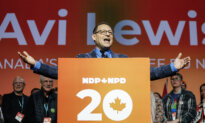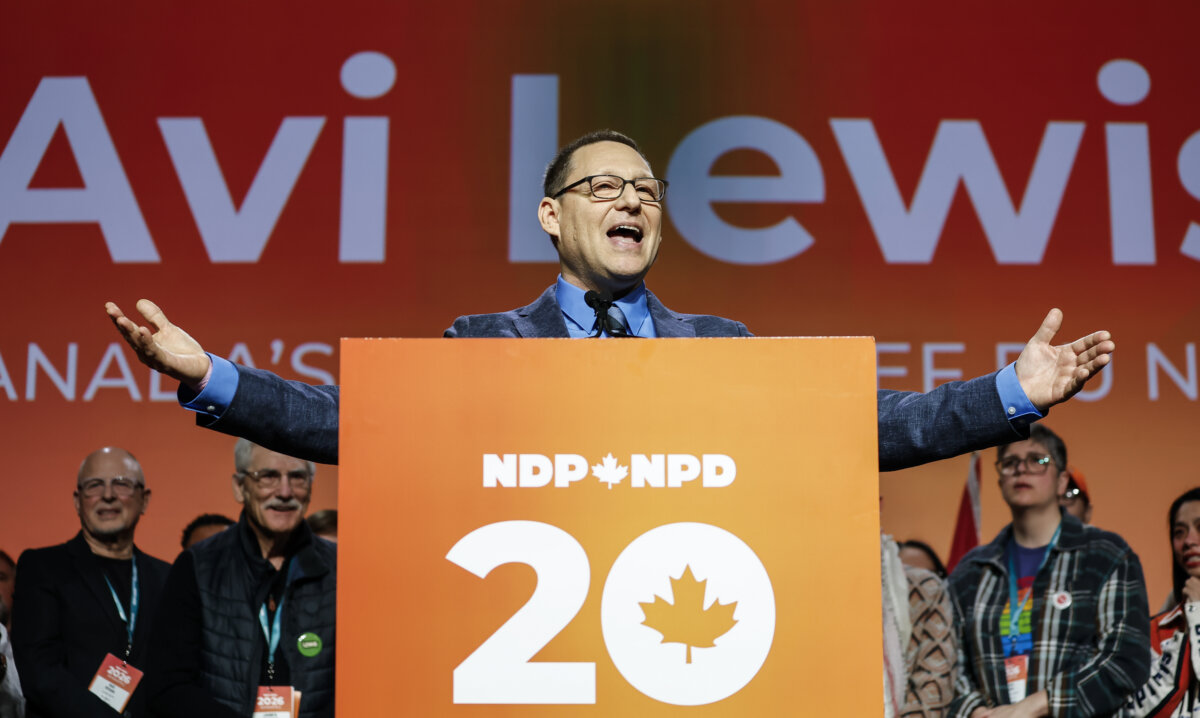

NDP members chose journalist and activist Avi Lewis as their new leader on the first ballot with nearly 40,000 votes out of the 71,000 ballots cast on March 29.
With 56 percent of the vote, Lewis defeated long-time Edmonton NDP MP Heather McPherson, who received 29 percent, and left the other candidates in the single digits, including social worker Tanille Johnson with 7 percent, union leader Rob Ashton with 6 percent, and farmer Tony McQuail with 1 percent.
Lewis, who was born into an NDP dynasty, has been a strong advocate against the oil and gas sector and has called for a greater government role across the economy, including government-run grocery stores and public construction companies to build more homes.
The new leader, who doesn’t hold a seat in the House of Commons, now faces the task of rebuilding the NDP after the party lost official party status in the last election.
The NDP’s ideological positioning will also have implications for the contest between the two leading parties: a further shift to the left under Lewis raises the question of whether the NDP would draw support away from the Liberals or continue to lose ground to them, which could shape how the Liberals fare against their Conservative rivals.
NDP Dynasty
Lewis’s grandfather David Lewis led the federal NDP from 1971 to 1975. His father, Stephen Lewis, who passed away on March 31, led the Ontario NDP from 1970 to 1978 and served as Canada’s ambassador to the United Nations from 1984 to 1988. His mother is feminist journalist and author Michele Landsberg.
The 58-year-old is married to Naomi Klein, a progressive author and filmmaker and co-director of the Centre for Climate Justice. The two have a son.
Lewis has worked as a journalist and filmmaker, working for multiple outlets including the CBC, co-creating the “Fault Lines” program for Al Jazeera, and co-directing the film “The Take” with Klein about Argentina’s worker-run businesses. He is currently an associate professor at the University of British Columbia teaching courses on social and political change, communication, and documentary filmmaking.
He previously ran for the federal NDP twice as a candidate in general elections, the first time in 2021 and then again in 2025, coming in third both times.
In 2015, Lewis co-authored the Leap Manifesto with Klein, a 15-point plan pushing Canada to transition beyond oil and gas. It proved divisive within the NDP, particularly in the West, with the Alberta NDP calling it “ill-considered and tone-deaf to the economic realities of Alberta.”
Those tensions resurfaced immediately after his leadership win on March 29, with the Alberta and Saskatchewan provincial NDP leaders both publicly distancing themselves from him, since they face an electorate that depends on the oil and gas sector for their prosperity.
Policies
Lewis’s leadership campaign centred on greater government control and climate action. His platform included:
- A wealth tax for the rich, which he says would generate $40 billion a year
- A Canadian Green New Deal, including a commitment to spend 2 percent of GDP in initiatives to reduce greenhouse gas emissions
- Publicly owned and operated grocery stores, telecom companies, home builders, pharmaceutical manufacturers, and postal banking
- Free public transit and post-secondary education
- Expanded universal health care including vision care
- Opposing U.S. tariffs and imposing an export tax on oil and gas shipped to the United States
Lewis said in his victory speech that his plan is to “Trump-proof” the economy by “investing massively in Canadian economic independence using the unmatched power of public ownership to ensure the fundamentals of a good life.”
According to him, this involves “a network of public providers for food, phones, and internet. A public housing developer and public construction companies to build millions of non-market homes. A 21st century electrical grid, an EV bus revolution and a heat-pump in every home, built with Canadian steel, creating tens of thousands of unionized jobs.”
He also said he would spend more on the “care-economy,” including expanding health care, elder care, and child care.
Reactions to Victory
Lewis’s leadership rival McPherson congratulated him in a short message on social media: “Congratulations Avi.”
Manitoba’s NDP Premier Wab Kinew stood on the stage with Lewis at the party’s convention in Winnipeg as he was announced winner of the leadership race. Kinew later told reporters that while he may not agree with Lewis on everything, Lewis has the right “values.”
“The big things are health care, education,” Kinew said. “I just love Avi. He’s just a great person and we don’t have to agree on everything in order to do the big things together.”
But there were more overt signs of division by NDP leaders of Alberta and Saskatchewan, who distanced themselves from Lewis’s position on the resource sector.
“We believe in Alberta and we believe in Canadian energy and the good jobs it creates. We believe in more pipelines and in reducing emissions,” Alberta NDP Leader Naheed Nenshi said in a statement after Lewis’s win.
Saskatchewan NDP Leader Carla Beck rejected a request by Lewis’s campaign for the two to meet, saying she’d only meet with him if he changes his position on the resource sector which Saskatchewan relies on.
Lewis has also clashed with B.C. NDP Premier David Eby, saying the province shouldn’t be expanding LNG development. Eby congratulated Lewis on his win but said his government will “work with anyone and any federal leader who shares our priorities, and stand firm against those who put that progress at risk.”
All federal party leaders were generous with their first statement on Lewis after his victory.
“Congratulations to [Lewis] on your election as NDP leader,” Prime Minister Mark Carney said on social media. “As Prime Minister I will always take a collaborative approach to how we build a stronger Canada, and I look forward to speaking about how we can work together to keep delivering for Canadians.”
Conservative Leader Pierre Poilievre also congratulated Lewis on his victory, emphasizing that he will work to hold the government to account.
“I look forward to working to hold the Carney Liberals to account for the worst grocery price inflation and fastest-shrinking economy in the G7,” Poilievre said.
Bloc Québécois Leader Yves-François Blanchet also extended his best wishes to the new NDP leader.
“The diversity of views is a strength in democracy. Best of success,” he said in French.
House of Commons Seats
Lewis has said he’s not looking to immediately win a seat in the House of Commons and won’t be running in any of the upcoming federal byelections in April.
In the 2025 election, the NDP went down from 24 seats to 7, losing official party status since it has fewer than 12 seats. Then-Leader Jagmeet Singh, who also lost his own seat, stepped down from his role, triggering the leadership race.
The party lost another seat after Nunavut MP Lori Idlout crossed the floor to join the Liberals on March 10, inching the governing party closer to a majority.
 Friends Read Free
Copy
Facebook
Tweet
Friends Read Free
Copy
Facebook
Tweet