
A man who went missing for six days in the mountains near Squamish, B.C., says he survived by rationing the little candy he had and eating what he could find.
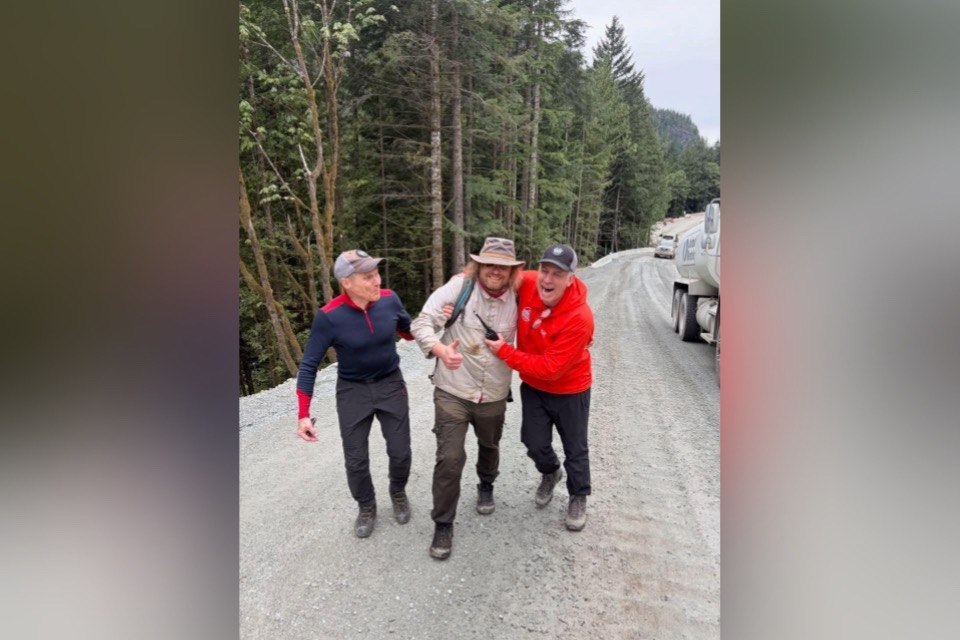
Stanislav Volo, 43, was found on Sept. 4 after he walked himself out onto a forest service road, according to the Squamish Search and Rescue.
“After several long days of searching, we are incredibly relieved to share that Stanislav has been found alive and is safe,” the volunteer organization wrote.
The rescue service had posted the day before that Volo was last seen on Sunday, Aug. 30, at approximately 1:00 p.m. in the Shannon Basin.
Searchers were able to narrow the search radius after a garbled phone call to 911 from Volo’s cellphone showed he was still in the area of the Mount Habrich Loop.
After leaving the hospital on Saturday, Sept. 5, Volo, a father of two, told CBC News that he survived by rationing gummy bear candies and later picking wildflowers to eat. He also spent several nights sheltering in a small cave where he kept warm, he said.
“With a broken heel and wrist, surviving on plants and twigs, he somehow made it down the cliff and out. We are with him now. I still can’t believe I get to say those words. He is safe. He is here,” Volo’s sister Ola wrote in a post to Instagram after being reunited with Volo.
In her message on Sept. 5, Ola, who had had appealed for help in an Instagram post a few days earlier, thanked everyone involved in the search for her brother.
Volo had first gone missing after getting off the Sea to Sky Gondola and setting off to hike to the Mount Habrich Loop.
The Sea to Sky Gondola Corporation, which refers to the loop as Al’s Habrich Trail, says the 5.8-kilometre trail is of advanced difficulty and normally takes three to six hours to complete.
The company advises hikers to download its app to have access to offline maps when hiking, as cellphone coverage in the mountains outside of the district municipality of Squamish is spotty. Google also provides an option to download maps for its Maps app on both iOS and Android for use outside of coverage areas, and the iPhone 14 and newer models can connect to satellites to send messages or share a location when outside of coverage areas.
On its website, Squamish Search and Rescue shares tips on what to do if you become lost in the wilderness.
As soon as hikers realize they are lost, the are advised stay calm and stop moving so that search and rescue teams can locate them more easily, the organization says. It adds that hikers should seek or build a reasonably dry shelter to protect themselves from rain and snow, such as one near the base of a tree or under a log.
They can also consider building a fire for warmth and comfort, while taking care to avoid starting a forest fire, the organization says. Finally, it advises hikers to make themselves as visible as possible from the air and ground, using a whistle or other signalling device to attract rescuers or other backcountry users.
The Canadian Press contributed to this report.
 Friends Read Free
Copy
Facebook
Tweet
Friends Read Free
Copy
Facebook
Tweet