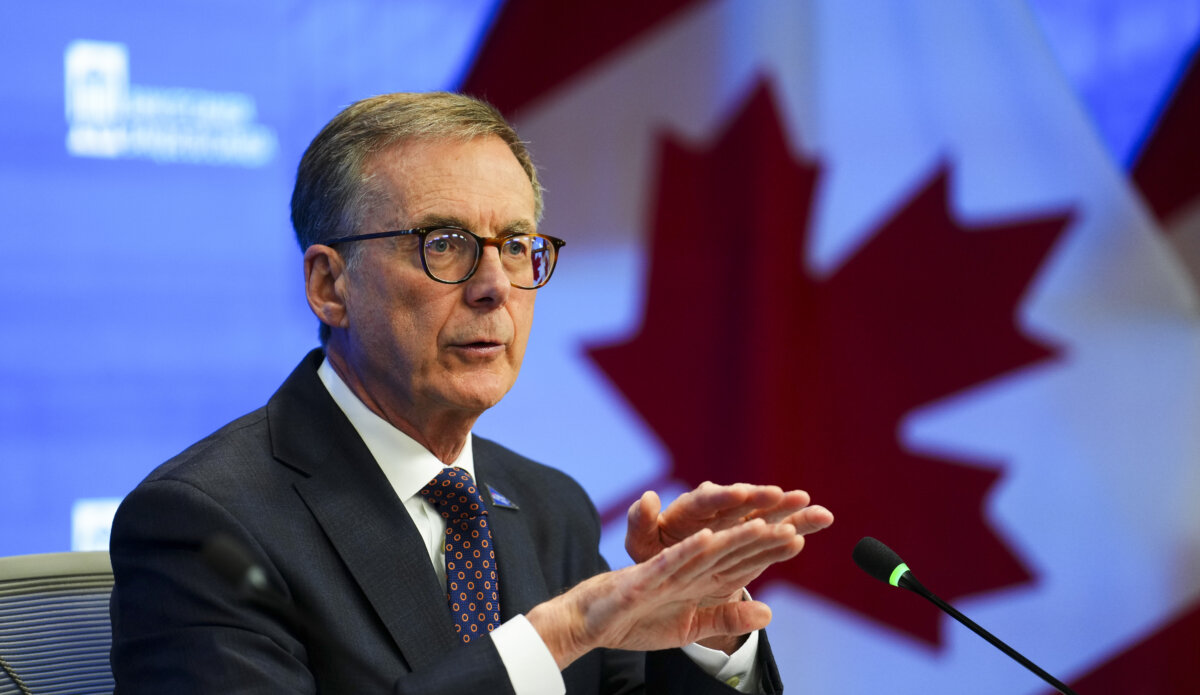

Bank of Canada Governor Tiff Macklem says the central bank will be maintaining its inflation target of 2 percent as it reviews its monetary framework, but warned global shocks to trade and geopolitical uncertainty could raise inflationary pressures in Canada.
Macklem told the Chamber of Commerce of Metropolitan Montreal on Dec. 16 that the Bank is reviewing and renewing its monetary policy framework with the federal government, which it must do every five years.
“One thing we’re not reviewing is whether 2 percent is the best target. We are confident it is,” Macklem said, adding that the central bank’s inflation target has remained between 2 and 3 percent 80 percent of the time for the last 25 years.
Macklem said the COVID-19 pandemic “tested our framework like never before,” but said that framework also allowed the Bank of Canada to restore inflation to lower levels. Canada’s inflation rate rose steadily following 2020 until it hit a high of 8.1 percent by June 2022, which led the bank to continue hiking interest rates. Inflation fell back to 3 percent by the start of 2024.
Macklem said that the global economic landscape is becoming more protectionist, and with the U.S. implementing tariffs on various countries, this is “adding costs and creating economic volatility.” Macklem added that these structural changes are “turning into headwinds that have the potential to disrupt supply and add inflationary pressures.”
The governor told reporters that these headwinds include more tariffs on various goods, extreme weather events disrupting supply chains, as well as “geopolitical tensions that could flare up.” Macklem said the world has become “more complicated” and a “more hostile place” compared to before the COVID-19 pandemic.
Macklem said the Bank of Canada will continue to support Canada’s economy while keeping inflation “well-controlled.”
The Bank’s Monetary Policy Report for October projected that inflation would fall from 2.4 percent in September to around 2 percent by early 2026, as the removal of Canadian counter-tariffs on the United States would put downward pressure on the metric.
According to Statistics Canada, the Consumer Price Index rose 2.2 percent on a year-over-year basis in both October and November, with slower growth in services being offset by higher prices for groceries.
Macklem said there is a difference between food inflation declining and overall prices for food declining. “I think food price inflation is going to be on the minds of many Canadians … our job is to keep overall inflation close to the target. And overall inflation has been close to the target for more than a year now,” he said.
The 2026 edition of Canada’s Food Price Report found that food inflation will remain elevated at 4 percent to 6 percent next year, and the average family of four in Canada is expected to pay an additional $994.63 for food in 2026 compared to 2025.
‘Stablecoins’ and Cryptocurrencies
During his speech, Macklem also touched on cryptocurrencies called “stablecoins,” which he said are the “next frontier of digital money.” While cryptocurrencies like Bitcoin are subject to price volatility and are seldom used for transactions, which Macklem said makes them a “lousy store of value,” stablecoins are tied to the value of countries’ currencies like the U.S. dollar and the euro.
The U.S. implemented a law in July, called the Genius Act, that implements a regulatory framework for stablecoins and requires them to be backed one-for-one by U.S. dollars or other low-risk assets. The Canadian government’s Budget 2025 also announced Ottawa’s intention to introduce legislation regulating stablecoins.
Macklem said the Bank of Canada will act as a regulator for stablecoins, and it will work with the department of finance in 2026 to support the drafting of the regulations “so Canadians can use stablecoins with confidence.”
Macklem added that while stablecoins have typically been used as an “off-ramp” between different cryptocurrencies, they could be used for cross-border payments that would be faster and more convenient than typical payments.
Macklem said there needs to be a “high degree of consistency across major jurisdictions” for stablecoins, so that they are not used as “some sort of arbitrage strategy” to profit from price discrepancies. Macklem also said stablecoins should be “backed one for one, with high-quality, liquid assets, so that there are no questions about the convertibility back to cash.”
“There are some important financial stability issues there, and it’s important that we really think those through in this design phase,” Macklem said.
 Friends Read Free
Copy
Facebook
Tweet
Friends Read Free
Copy
Facebook
Tweet