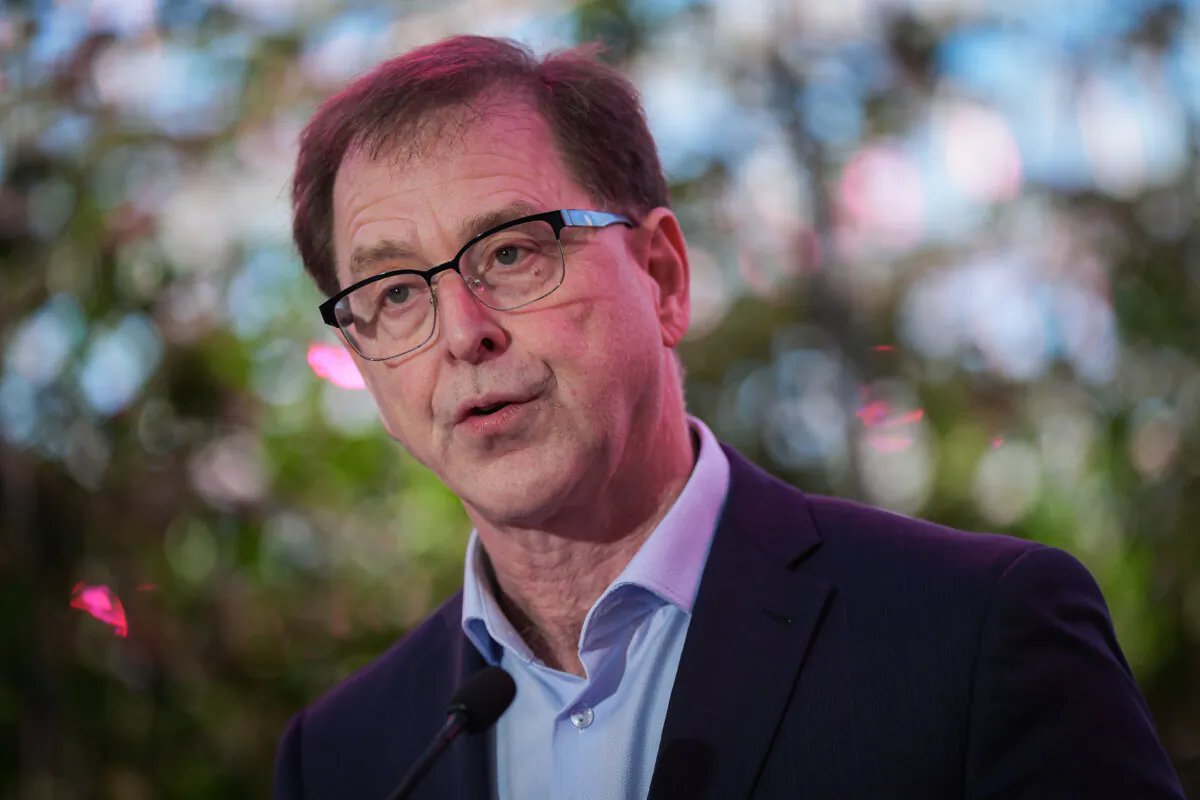

B.C.’s energy minister plans to introduce legislation next year to amend the provincial policy requiring all new light-duty vehicles sold by 2035 to be zero-emission, adjusting the target so it doesn’t apply to all sales. The move comes six years after B.C. became the first jurisdiction in the world to legislate such targets.
Energy Minister Adrian Dix told reporters in Victoria that the electric vehicle (EV) sales goal of 90 percent by 2030, and 100 percent by 2035, was no longer a “realistic” goal.
“I think targets should be things that you can reach with effort… So they shouldn’t be what you expect will happen, but what you can realistically reach with effort,” he said during a Nov. 18 press conference.
Dix said the B.C. government plans to introduce legislation next spring to revise the mandates and bring them in line with targets the federal government will announce in the coming months. He said the province is currently waiting for Ottawa to table its review of its climate plan, and will use those findings to work with the federal government on a new target for EVs.
Dix said the province will introduce regulatory changes expanding the types of vehicles that count toward the EV target, while giving manufacturers credit for making efforts to increase sales, such as lowering prices, providing low-cost or no-cost financing, and helping to install vehicle-charging infrastructure.
Prime Minister Mark Carney announced in September that Ottawa’s plan to incrementally impose EV sales targets on car manufacturers and importers would be delayed. He said 2026 model year vehicles would be exempted from the Electric Vehicle Availability Standard requirements, a 60-day review of the EV mandate would be launched, and Ottawa would explore options to bring more affordable EVs to Canada.
Industry Minister Mélanie Joly told reporters days later that Ottawa’s plan was not to get rid of the policy, but rather to boost the production and importation of the vehicles. The Liberal government has said it will share details of the new plan before the end of 2025.
The federal EV mandate was initially introduced by former Prime Minister Justin Trudeau in 2022, and was set to begin in 2026. It would have required auto manufacturers to make 20 percent of their sales electric vehicles, or they would face penalties managed through a credit system.
EV sales targets were set to increase to 60 percent by 2030 and 100 percent by 2035. The Liberal government created the mandate as part of its climate plan, which seeks to to reach net-zero emissions by 2050.
Ottawa’s federal subsidy program for the purchase of EVs that gave rebates of $5,000 was paused in January 2025 after the program ran out of money. Environment Minister Julie Dabrusin said earlier this year a rebate would be brought back, but Budget 2025 made no mention of it.
B.C. suspended its rebate program six months ago, which provided up to $4,000 to individuals purchasing electric vehicles. Dix said the program was “never intended to be permanent.”
Statistics Canada reported in May that EV sales had dropped 44 percent compared to 2024, while a recent Léger poll found there is little support for the mandate among Canadians. Seventy-one percent of respondents said banning the sale of new gas cars by 2035 is “unrealistic” and that the plan should be rolled back.
Car manufacturers in Canada have also pushed for Ottawa to abandon its EV mandate in recent months. The CEOs of Stellantis Canada, GM Canada, Ford Canada, and the Canadian Vehicle Manufacturers’ Association met with Carney in July to make the request.
The Canadian Press contributed to this report.
 Friends Read Free
Copy
Facebook
Tweet
Friends Read Free
Copy
Facebook
Tweet