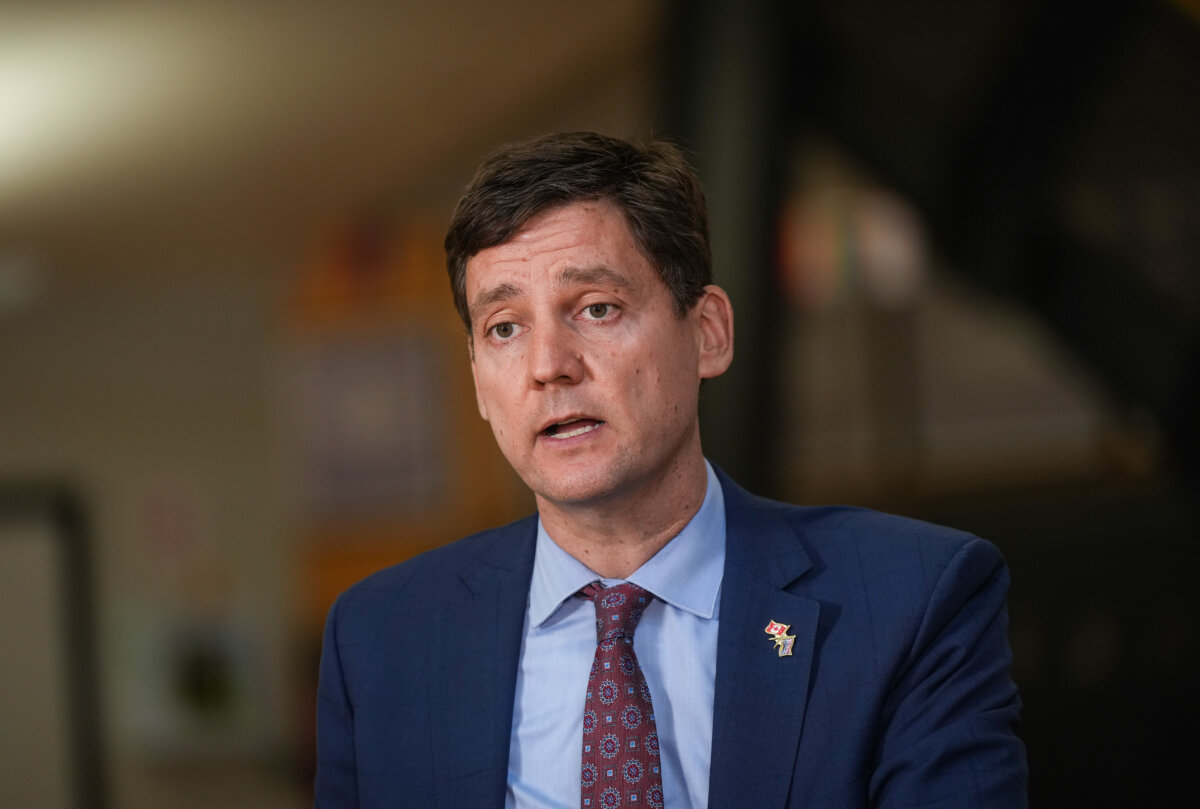

B.C. Premier David Eby says his province is preparing ads opposing U.S. tariffs on Canada, as U.S. President Donald Trump has targeted Ontario’s anti-tariff ad campaign.
“Americans need to hear how tariffs raise prices,” Eby said in an Oct. 24 X post. “We’re making ads to defend British Columbia and Canada’s forestry workers. Our wood faces higher US tariffs than Russia. Absurd. Truth will win!”
Eby’s comments came in response to Trump cancelling trade talks with Canada on Oct. 23 over a TV ad campaign opposing U.S. tariffs sponsored by the Ontario provincial government. The ad features the voice and images of the late Republican President Ronald Reagan speaking against protectionist measures.
Trump said the ad campaign was meant to interfere with an upcoming U.S. Supreme Court hearing on his administration’s tariffs. He also said the ad presented Reagan’s words “fraudulently” to make it seem like he was not in favour of tariffs, “when he actually loved tariffs for our country and its national security.”
“Tariffs are very important to the national security and economy of the U.S.A. Based on their egregious behavior, all trade negotiations with Canada are hereby terminated,” Trump wrote on Truth Social on Oct. 23.
Reagan’s radio address of April 25, 1987, did praise the value of free trade, but it began by announcing “new duties on some Japanese products in response to Japan’s inability to enforce their trade agreement” with the United States on semiconductors.
Reagan also mentioned Canada in his address, saying he had recently conveyed his message promoting free trade to Canada’s leadership, referring to then-Prime Minister Brian Mulroney, whom Reagan had worked with on a U.S.-Canada Free Trade Agreement that materialized in 1988. Reagan said there was “a growing realization” throughout the world that “the way to prosperity for all nations is rejecting protectionist legislation and promoting fair and free competition.”
Ontario Premier Doug Ford said on Oct. 24 that, following discussions with Prime Minister Mark Carney, he would pause the $75 million ad campaign, but only on Oct. 27, after Americans see the ads during the World Series baseball games over the weekend.
Ford said the intention of the TV ads was to “initiate a conversation” about the U.S. economy and the impact on tariffs on workers and businesses. He also said Ontario had achieved its goal, “having reached U.S. audiences at the highest levels.”
Eby’s comments came one day before Trump said on Oct. 25 he would hike tariffs on Canada by 10 percent because the Ontario ads didn’t end immediately.
The B.C. premier said his province’s initiative will be a “digital campaign” and that it will be unveiled next month “to explain who wins and who loses.”
“It’s important to speak directly to Americans looking to build home or renovate. Their costs are going up – because Donald Trump has slapped additional tariffs on top of already unfair softwood duties. We didn’t do it, so we shouldn’t wear it,” Eby said.
Forestry Sector
Canadian imports to the United States are currently subject to 35 percent tariffs, with an exemption applied to products covered by the United States-Mexico-Canada Agreement. Canadian products are also subject to sectoral tariffs, including those applied to steel, aluminum, copper, autos, and lumber.
Canada’s forestry sector has been hit hard with U.S. tariffs, with lumber products facing average tariff rates of from 35 percent to more than 45 percent after Trump signed a proclamation on Sept. 29 that put 10 percent tariffs on imports of timber and lumber, on top of existing anti-dumping and countervailing rates.
The Forest Products Association of Canada (FPAC) says the U.S. administration’s decision to impose high tariff rates on Canada’s forestry sector is “unjustified,” noting Canadian forest products strengthen U.S. national security, not threaten it.
“This broad action further undermines a deeply integrated North American supply chain that supports housing affordability, infrastructure, manufacturing, and shared prosperity and security on both sides of the border,” the association said in a Sept. 30 statement.
The White House says tariffs on lumber are needed to “bolster American industry and protect national security.”
“It is vital for the United States to possess manufacturing capabilities in the wood and lumber sector to ensure readiness and guarantee the national security,” Washington says.
U.S. lumber industry groups also accuse Canada of subsidizing its lumber study, a charge that Canada denies.
Manitoba, Alberta Views on Ads
Manitoba Premier Wab Kinew says he supports Ontario’s ads, noting that the U.S. tariffs “go against Ronald Reagan’s legacy.” He also says the ads present Reagan’s views on tariffs “accurately and powerfully.”
“It’s clear that these ads are working,” Kinew said in an Oct. 24 video posted on X. “If you throw a rock at a lake and you don’t hear a splash, you’ve probably missed. So, to my good friend Doug Ford, keep the ads on TV. They’re effective, and this country is behind you.”
Meanwhile, Alberta Premier Danielle Smith says she is “pleased” Ontario will be pausing the ad campaign, adding that she is urging Ottawa to continue negotiations with the United States. She said the path to a positive resolution with the United States involves “strong, consistent diplomacy” and “a commitment to working in good faith toward shared priorities.”
“To that end, I am pleased to see Ontario’s ad campaign is being suspended and I once again urge the federal government to continue negotiating to resolve these tariff issues and restore a free and fair trade agreement with the United States, while diversifying and strengthening the Canadian economy by unleashing our world-class natural resource sector,” Smith wrote in an Oct. 24 X post.
Carney’s Comments
While Carney hasn’t specifically commented on Ontario’s TV ad campaign, he says Canada is ready to resume trade discussions with the United States.
“The Government of Canada stands ready to build on the progress that we had been making in our negotiations or discussions with our American counterparts, and we have a consistent focus in those discussions of doing the best deal for Canadian workers and their families,” Carney told reporters in Kuala Lumpur, Malaysia, where he attended the 47th Association of Southeast Asian Nations (ASEAN) Summit on Oct. 26.
Carney also added that trade negotiations with the United States are the “sole responsibility” of the federal government.
Carney also emphasized the need to diversify Canada’s trade partners.
Prior to Trump’s decision to end trade talks, momentum had appeared to be building in discussions between the two countries following Carney’s visit to the White House on Oct. 7.
During the meeting, Trump had said that deals would be made and that Canadians would “love us again.” Canada-U.S. Trade Minister Dominic LeBlanc said “substantial progress” had been made and that Carney and Trump had directed their teams to “quickly land deals” in the sectors of metal and energy.
Jacki Thrapp, Matthew Horwood, Noé Chartier, and Omid Ghoreishi contributed to this report.
 Friends Read Free
Copy
Facebook
Tweet
Friends Read Free
Copy
Facebook
Tweet