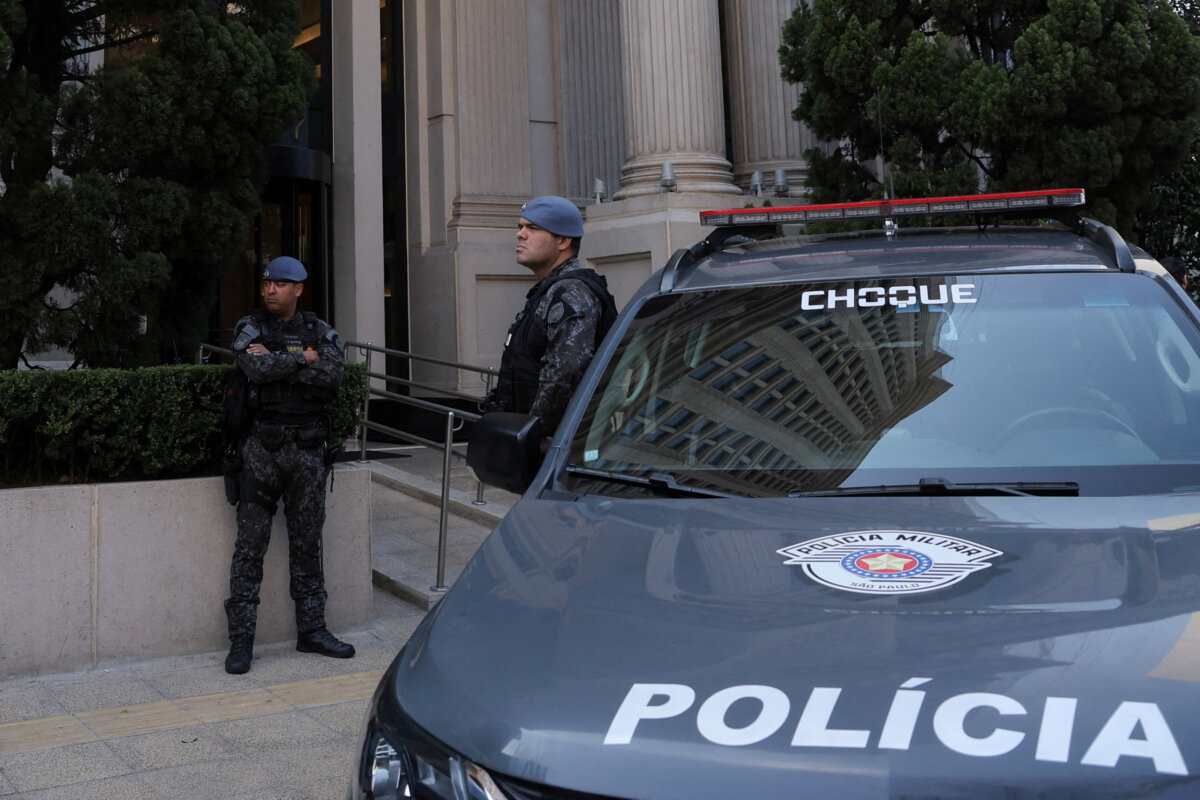
Brazilian police and tax authorities carried out raids on Aug. 28, and said they had seized 1.2 billion reais ($220 million) in assets they believe are owned by one of the country’s biggest organized crime groups, the Primeiro Comando da Capital (PCC) or First Capital Command.
Brazilian federal officials executed 14 search and seizure warrants and 14 preventive arrest warrants during a nationwide investigation into a money laundering network targeting investment funds and the fuel sector.
Brazilian Justice Minister Ricardo Lewandowski told reporters on Aug. 28: “Today we launched one of the biggest operations in history against organized crime.
“This operation addresses how criminal organizations have infiltrated and appropriated parts of the fuel industry, and how this connects to the financial sector through money laundering schemes.”
Brazilian President Luiz Inacio Lula da Silva wrote on X, “Today, we have witnessed the largest response by the Brazilian government to organized crime in our history.”
‘Flow of Illicit Money’
“Our commitment is to protect citizens and consumers: to cut off the flow of illicit money, recover resources for the public coffers, and ensure a fair and transparent fuel market, with quality and fair competition,” he said.
The Brazilian authorities identified 40 investment funds with a combined asset value of 30 billion reais ($5.5 billion) they believed PCC was using to hide its money.
These funds allegedly owned assets including port terminals, ethanol plants, and around 1,000 gas stations across 10 Brazilian states.
The federal authorities did not identify any of the individuals or companies targeted, citing sealed and ongoing investigations.
But the state prosecutors in Sao Paulo, who were part of the crackdown operation, said the scheme involved members of the PCC, one of Brazil’s most powerful organized crime groups.
PCC was founded in 1993 by prisoners inside Taubate Penitentiary in Sao Paolo to pressure the authorities to improve conditions, but gradually morphed into a criminal organization.
It was originally involved in drug dealing and extortion inside prisons, but later developed narcotics smuggling and selling operations on the outside.
In recent years, it has allegedly invested its money into various markets.
Finance Minister Fernando Haddad told reporters, “People know how it has worked, but it took a national effort to reach the heart of the problem and be able to confront it.”
Warning From Tax Chief
The deputy secretary for tax enforcement at the Brazilian Federal Revenue Service, Andrea Chaves, said: “This affects the entire supply chain, from fuel importation, production, distribution, and commercialization.
“In the financial sector, it involves asset concealment and shielding, in schemes similar to the hiding of shareholders in offshore tax havens. The Brazilian state cannot allow this to happen.”
Sao Paulo’s State Public Prosecutor’s Office said its investigation found that criminal organizations sold fuel, adulterated with methanol, at more than 300 gas stations and used the proceeds to launder illegal money.
“A significant portion of the unbacked funds was used to acquire ethanol plants and expand the group’s criminal operations, which now include fuel distributors, transport companies, and gas stations,” prosecutors said in a statement.
“Consumers were allegedly charged for less fuel than indicated by the pumps or received fuel that was chemically altered and failed to meet technical standards set by Brazil’s National Petroleum Agency.”
The prosecutors said the fraud involved irregular imports of methanol through the port of Paranagua, in Parana state.
PCC is one of the biggest criminal networks in Brazil.
Its main rival is the Comando Vermelho (Red Command) or CV, which was founded by left-wing political prisoners under Brazil’s military dictatorship in the 1970s, but gradually morphed into a criminal organization.
In 2006, after authorities announced plans to move hundreds of PCC prisoners—including Marcos Willians Herbas Camacho, known as “Playboy”—to higher-security prisons, PCC organized a series of huge prison riots and coordinated attacks in Sao Paulo that left more than 150 dead and brought the city to a virtual standstill.
In 2017, PCC was implicated in a huge bank heist just across the Paraguayan border in Ciudad del Este, which turned into a massive gunfight.
The Associated Press and Reuters contributed to this report.
 Friends Read Free
Copy
Facebook
Tweet
Friends Read Free
Copy
Facebook
Tweet