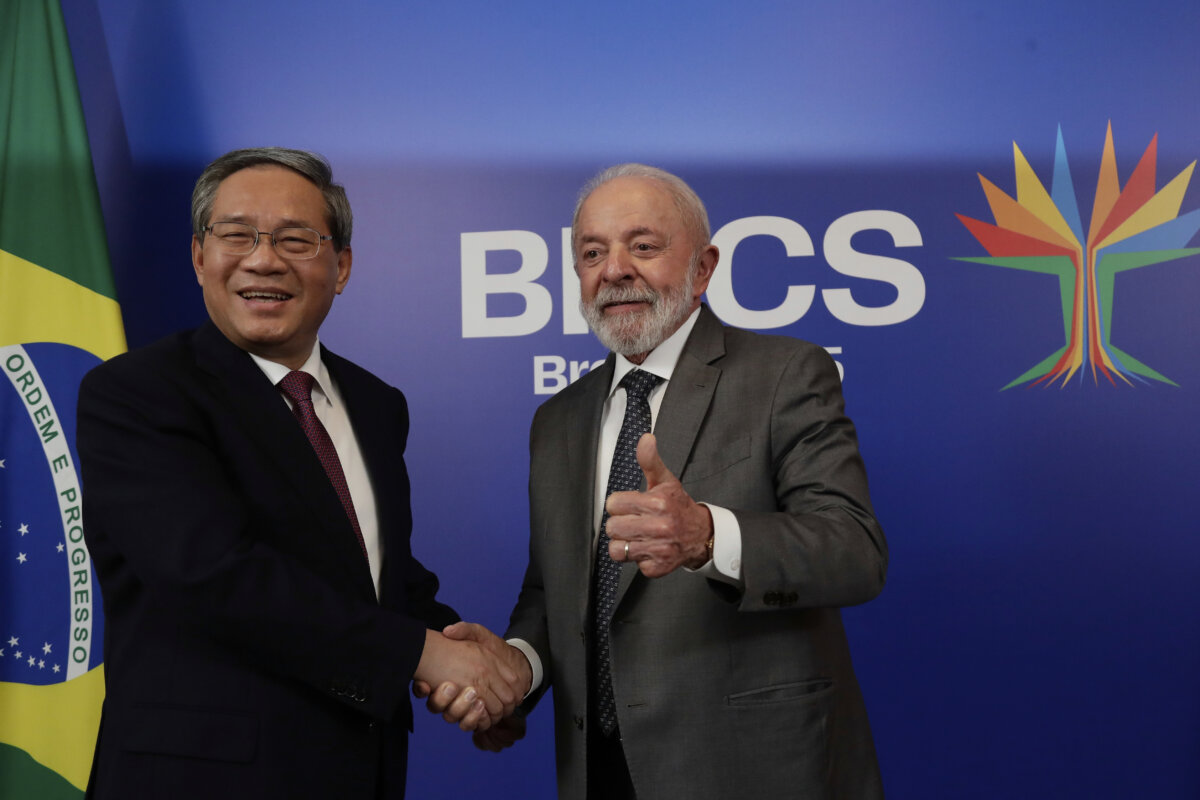

Leaders of the BRICS bloc said on July 6 that wealthy countries should pay to help poorer nations transition to net zero.
BRICS, made up of countries such as Brazil, Russia, India, China, and South Africa, is an alliance that sees itself as a counterweight to Western-led institutions.
In a joint statement released ahead of the final day of the 17th BRICS Leaders’ Summit in Rio de Janeiro, BRICS leaders said that providing climate finance “is a responsibility of developed countries towards developing countries.”
“We emphasize that ensuring accessible, timely and affordable climate finance for developing countries is critical for enabling just transitions pathways that combine climate action with sustainable development,” the group stated.
According to the U.N. Environment Programme, climate finance refers to all financial flows related to climate action.
During last year’s COP29 U.N. climate summit in Baku, Azerbaijan, negotiators said they were working toward a goal of up to $1 trillion annually in climate financing for developing countries, aiming to replace the previous $100 billion target.
Multilateral development banks are also proposing to increase climate finance for low- and middle-income countries by up to $120 billion per year by 2030, aligning with Paris Agreement goals.
Leaders who gathered in Rio included Indian Prime Minister Narendra Modi, Russian Foreign Minister Sergey Lavrov, Iranian Foreign Minister Abbas Araghchi, and South African President Cyril Ramaphosa. Chinese leader Xi Jinping sent Premier Li Qiang in his place.
Brazilian President Luiz Inácio Lula da Silva opened the summit with a speech in which he drew a parallel to the Cold War-era Non-Aligned Movement, a group of developing nations that sought to remain neutral and avoid aligning with either the United States or the Soviet Union.
“BRICS is the heir to the Non-Aligned Movement,” Lula told leaders. “With multilateralism under attack, our autonomy is once again in check.”
According to a June report by the Council on Foreign Relations, China is South America’s top trading partner and a major source of both foreign direct investment and energy and infrastructure lending, including through its massive Belt and Road Initiative.
In June, Brazil and China signed 20 cooperation agreements in energy, science and technology, agriculture, railroads, and other sectors, including a $1 billion investment by China’s Envision Energy to produce sustainable aviation fuel in Brazil.
Sun Guoxiang, a professor at Nanhua University’s Department of International Affairs and Business in Taiwan, told The Epoch Times in May that Lula “has long been pro-China and attaches great importance to establishing a ‘Global South Strategic Partnership’ with China.”
According to Sun, Lula, who is in his third term, has placed more emphasis on “multilateralism and ‘de-dollarization.’”
On diplomacy, Sun said, “Lula tends to deepen cooperation with non-Western powers such as China and Russia while avoiding direct confrontation with the United States.”
On July 6, U.S. President Donald Trump warned that the United States would impose an additional 10 percent tariff on any country “aligning themselves with the Anti-American policies of BRICS.”
“There will be no exceptions to this policy,” Trump said in a post on Truth Social.
Without mentioning Trump or the United States, the BRICS nations said in the joint statement that “proliferation of trade-restrictive actions, whether in the form of indiscriminate rising of tariffs and non-tariff measures, or protectionism under the guise of environmental objectives threatens to further reduce global trade, disrupt global supply chains, and introduce uncertainty into international economic and trade activities, potentially exacerbating existing economic disparities and affecting prospects for global economic development.”
Alex Wu contributed to this report.
 Friends Read Free
Copy
Facebook
Tweet
Friends Read Free
Copy
Facebook
Tweet