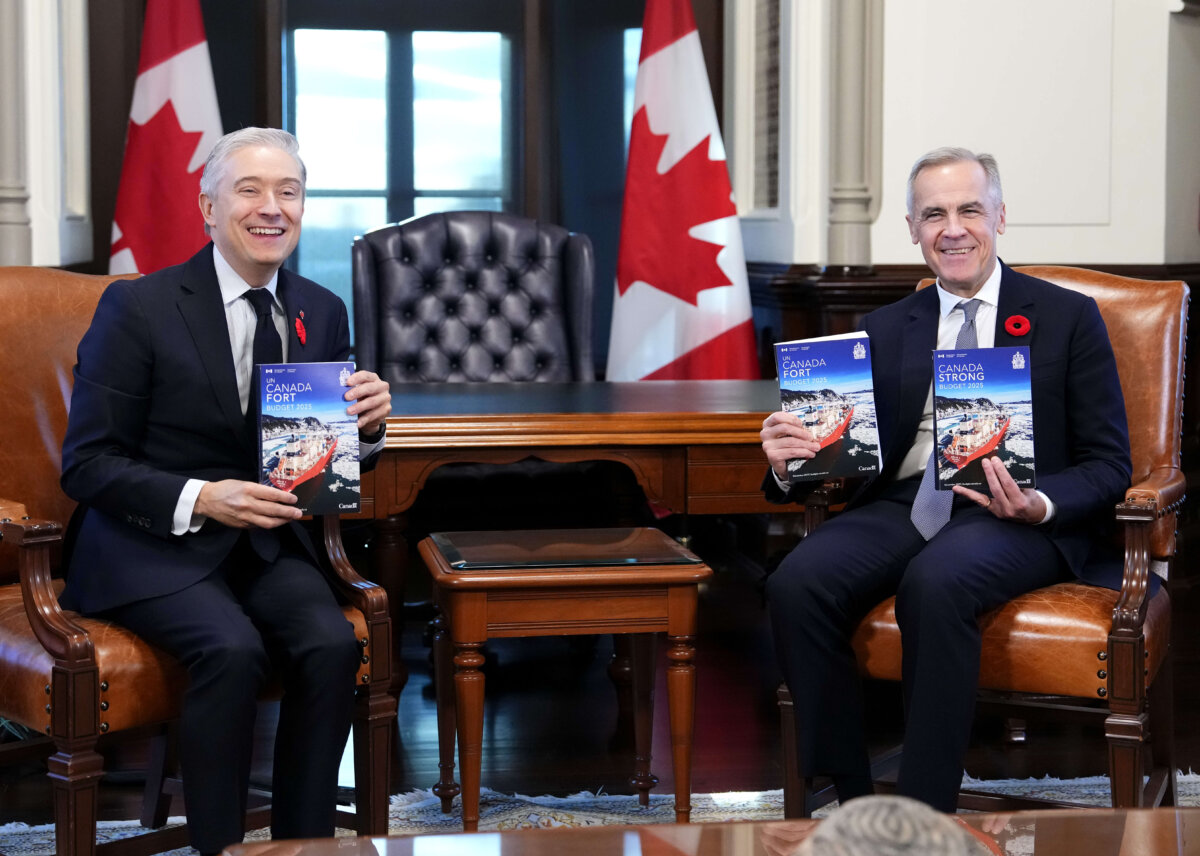

While the federal budget has several “green” initiatives that push Canada toward a low-carbon economy, Ottawa has also made some choices that could please fossil fuel companies.
The budget contains several initiatives to further a “low-carbon economy” through measures like industrial carbon pricing, tax credits for expanding non-fossil fuel-generated electricity, and stronger methane regulations.
The government says these measures are a part of its new “Climate Competitiveness Strategy,” which aims to create “the conditions for the investment needed to build an affordable net-zero future.”
The budget also contains measures supporting the fossil fuel industry, such as expanding capital cost-allowances for liquefied natural gas (LNG) facilities and fast-tracking infrastructure that will support major energy and export infrastructure.
The budget also implies that the federal government’s oil and gas emissions cap, which the governments of Alberta and Saskatchewan have repeatedly criticized, could be scrapped.
Net-Zero Initiatives
The Nov. 4 budget states that with global investments in “clean energy” reaching US$2 trillion in 2024, nearly double the level of investment in fossil fuels, Canada must reduce its carbon footprint to “compete internationally.”
It says that those buying Canadian resources are emphasizing “low-carbon sourcing” more and more, and portrays the government’s new Climate Competitiveness Strategy as a way to secure access to global markets that increasingly prioritize sustainability.
While the Liberal government got rid of the consumer carbon tax shortly after Prime Minister Mark Carney took office, the budget states that the industrial carbon pricing system is “essential to providing certainty to businesses looking to invest and compete internationally.”
The budget states that the industrial carbon taxing system is expected to “deliver more emission reductions than any other policy” while having “negligible impacts on affordability for Canadians.”
Meanwhile, the federal Conservatives say the industrial carbon tax drives away investment while increasing costs for Canadian consumers. Conservative Leader Pierre Poilievre said in question period on Nov. 5 that the industrial carbon tax increases the cost of food production by taxing farm equipment, fertilizer, storage bins, and food processing plants.
The budget states that Ottawa will improve the effectiveness of the system by engaging with provincial and territorial governments to develop a “multi-decade” industrial carbon pricing system, improve the benchmark that ensures all industrial pricing systems across Canada are “harmonized,” and ensure the Canada Growth Fund guarantees a minimum carbon price for major investors in order to reduce uncertainty. Provinces such as Alberta and Saskatchewan are objecting to the measure, saying it harms Canada’s investment environment.
The budget says Ottawa will also soon be introducing legislation to finalize the Clean Economy Investment Tax Credits, which encourage companies to invest in “clean” energy, manufacturing, and emissions-reduction projects.
Ottawa will also remove the restrictions that had prevented provincial and territorial Crown corporations from claiming the credit, extend the full credit rate for Carbon Capture, Utilization, and Storage projects by five years, and broaden the Clean Technology Manufacturing Investment Tax Credit to cover additional critical minerals like antimony, indium, gallium, and germanium.
The budget states that the government is seeking to clarify its greenhouse gas regulations, such as by finalizing its enhanced rules to reduce methane emissions for the oil and gas sector, and updating the Clean Fuel Regulations to help reduce Canada’s reliance on imported fuels and strengthen domestic supply chains.
When it comes to the government’s electric vehicle (EV) mandate, the budget states that the government has launched a 60-day review of the overall regulation and will “announce next steps on electric vehicles in the coming weeks.”
Ottawa’s EV mandate had required that 20 percent of new vehicles sold in 2026 be zero-emission, with the share rising each year until hitting 100 percent in 2035, but under pressure from the auto sector already facing headwinds from U.S. tariffs, the government announced in September that 2026 model year vehicles would be waived from the requirements.
The Conservatives and the province of Alberta have been vocal in their opposition to the EV mandate, saying it doesn’t match the reality faced by rural Canadians, and that it’s not supported by consumers.
The budget also proposes supporting nuclear energy by allocating $2 billion through the Canada Growth Fund to construct a small modular nuclear reactor in Ontario.
When compared to Carney’s election campaign platform, the budget delivers on many of the promises made around green initiatives. That document promised to promote low-carbon emission purchases wherever possible, finalize clean-energy tax credits, promote Carbon Capture, Utilization, and Storage technology, strengthen methane reductions, and work with provincial and territorial governments to “ensure carbon markets continue to function well.”
Traditional Energy and LNG
The budget implies that the federal government’s proposed oil and gas emissions cap, which aims to reduce emissions to 35 percent below 2019 levels by 2032, could be scrapped before they ever come into force.
The document states that policies like oil and gas methane regulations and carbon capture and storage technologies would create the conditions where the cap would “no longer be required as it would have marginal value in reducing emissions.”
The governments of Alberta and Saskatchewan have called for the cap to be removed, saying it acts as a de facto limit on production. Alberta Premier Danielle Smith said in a statement that she was “reserving judgment” on the potential removal of the emissions cap, as Alberta and Ottawa are currently in negotiations on a memorandum of understanding around energy that she hopes will be completed in November.
“We will then have a much better idea regarding whether or not the current federal government is serious about repealing or overhauling the various policies and laws that have devastated Alberta’s economy over the past decade and put the very stability of Alberta’s electricity grid at existential risk,” Smith said.
The budget also details some of the projects that the government has said could be fast-tracked for approval through the newly created Major Projects Offices, which includes the LNG Canada Phase 2 in Kitimat, B.C., that Ottawa says will double the company’s liquefied natural gas capacity.
Additionally, the budget lists “strategies” that are at an “earlier stage and require further development,” such as Alberta’s Pathways Plus carbon capture and storage network and oil “pipeline project that will substantially reduce emissions,” as well as Manitoba’s Port of Churchill that would include an all-weather road, upgraded rail line, marine ice-breaking capacity, and “a new energy corridor.”
The budget also states the government would reinstate the accelerated capital cost allowances (CCAs) for LNG equipment and related buildings, which expired at the end of 2024. This would allow LNG projects to write-off the cost of these assets faster than usual, but with the new condition of being “low-carbon.”
LNG facilities that are in the top 25 percent for emissions performance will be eligible for accelerated CCAs with the same previous rate of 30 percent for liquefaction equipment and 10 percent for nonresidential buildings used in the facilities.
Those that are in the top 10 percent in terms of emissions performance would be eligible for accelerated CCAs of 50 percent for liquefaction equipment and 10 percent for non-residential buildings.
While the Liberal Party’s campaign platform had promised to speed up the review process for major projects in the national interest, it had not mentioned incentives for LNG facilities or potentially getting rid of the proposed oil and gas emissions cap.
 Friends Read Free
Copy
Facebook
Tweet
Friends Read Free
Copy
Facebook
Tweet