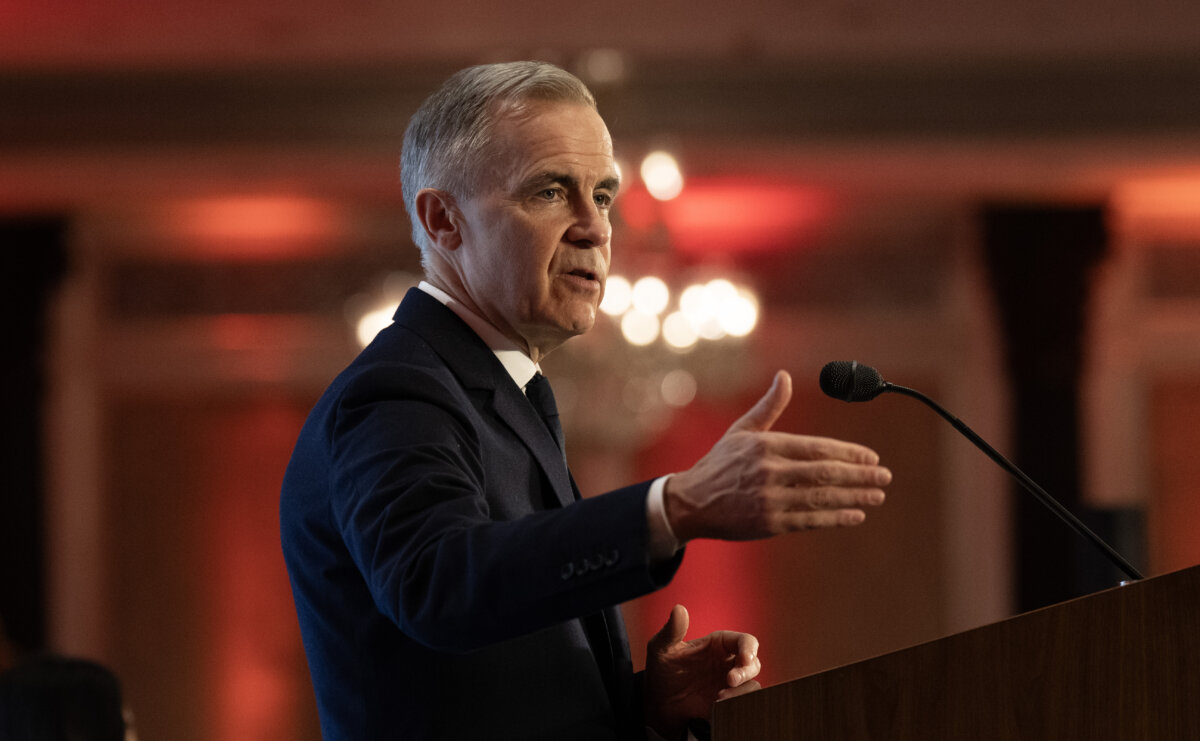

Prime Minister Mark Carney says Ottawa is aiming to sign a comprehensive trade agreement with New Delhi by the end of this year and double two-way trade by 2030.
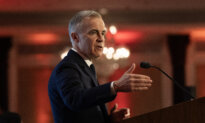
“We’re now negotiating a Comprehensive Economic Partnership Agreement with the intention to double two-way trade by 2030,” Carney told a business audience at the Canada–India Growth and Investment Forum in Mumbai, India, on Feb. 28.
“Our goal, to be clear, is to sign that agreement by the end of this year.”
Carney is currently visiting India as part of an ongoing effort to reset Ottawa and New Delhi’s bilateral relationship and build stronger trade ties.
Carney said at the forum that India is one of Canada’s “natural partners” and that his visit is focused on the “core areas” where Ottawa and New Delhi can work together to create “greater sovereignty, greater choice, and greater prosperity for our people.”
He said investment between the two countries totals $100 billion, with two-way trade exceeding $30 billion per year. The two countries should “aim much higher” and “be more strategic in our partnership,” he added.
He also said Canada is being “pragmatic in recognizing that progress is often incremental, that interests of nations can diverge, and that not every partner will share all of our values.”
Canada can be India’s “strategic partner in critical minerals and metals for your manufacturing, for your clean tech, and for your nuclear industries,” Carney told the Indian audience, adding that India can help Canada double its grid with clean power by 2040.
In addition to signing the comprehensive trade deal by year-end, Carney said he expects Ottawa and New Delhi to sign a series of other agreements to expand cooperation in areas such as defence, artificial intelligence, critical minerals, and digital trade.
Canada and India have also launched a new strategy on talent and innovation, which includes 13 new partnerships between Canadian and Indian universities, Foreign Affairs Minister Anita Anand announced on Feb. 28. Global Affairs Canada said the new strategy will facilitate research, student exchanges, hybrid campuses, and AI centres of excellence between Canada and India.
Meanwhile, Conservative MP and international trade critic Adam Chambers questioned whether there will be “follow through” on the deals signed in India.
“The Prime Minister celebrates the signing of a communiques, MOUs & agreements to agree, as though it is job done,” Chambers said in a Feb. 28 post on X.
“But will there be any follow through? There should be clear milestones and expectations for when results will actually be delivered.”
Canada-India Reset
Canada-India relations soured after the last visit by a Canadian prime minister, Justin Trudeau, to India in 2018. Relations broke down further when Trudeau accused India in 2023 of being involved in the assassination of Sikh separatist Hardeep Singh Nijjar in British Columbia. India has denied the allegation.
Carney’s government has sought to repair relations with India since he took office last spring. Carney invited Indian Prime Narendra Modi to the G7 Summit in Alberta last year, which Carney said triggered the repair.
Since then, there have been multiple engagements between Canada and India at the ministerial level. Anand and her India counterpart launched a new roadmap to rebuild ties last October during her visit to New Delhi. She also said at the time the two countries had agreed to return previous diplomatic staffing levels.
Anand said a month later that Canada and India had agreed to relaunch negotiations for the Comprehensive Economic Partnership. The Trudeau government had halted the deal’s negotiations in the summer of 2023, before accusing India of having a hand in the killing of Nijjar.
Energy Minister Tim Hodgson also visited India in late January, with the two countries on Jan. 27 issuing a joint statement on expanding trade in oil and gas.
Foreign Interference
Carney’s speech came amid pressure on his government to clarify whether it believes India is still engaged in foreign interference, after a federal government official told media on Feb. 25 that foreign interference by India is no longer a threat.
Anand, speaking to reporters on Feb. 28, would not say whether India is still engaged in foreign interference. She said foreign interference and transnational repression are “taken extremely seriously by our government and it will continue to be taken seriously because no country has a pass when it comes to domestic public safety and security.”
She added that in order to address the issues of foreign interference and transnational repression, Canada needs to be “at the table.”
“Diplomacy is not about hiding under a rock and saying, ‘I am not going to deal with you because of the actions of your government,’” Anand said. “Diplomacy, in my view, is very much about sitting at the table, having conversations that are difficult, but conversations that represent Canadian interests, Canadian foreign policy, and Canadian work with multilateral partners.”
Public Safety Minister Gary Anandasangaree said this week his government remains concerned about threats and violence that Canada’s Sikh community faces from “transnational organized crime and … a range of other challenges they faced by foreign actors.” He said Ottawa continues to have “robust” conversations on security issues with New Delhi.
Indo-Pacific Trip
Carney left Mumbai and arrived in New Delhi on the evening of March 1 and is set to meet with Modi on March 2.
“There’s a rapidly growing demand across India for more energy, technology, and services — exactly what Canada has to offer,” Carney said in a social media post shortly after arriving in New Delhi. “We’re here to make sure our workers and businesses can seize these opportunities.”
The Prime Minister’s Office also says Carney will witness a presentation of signed agreements and participate in the India–Canada CEO Forum with Modi on March 2 before departing for Sydney, Australia, that evening.
While in Australia, Carney is expected to meet with Australian Prime Minister Anthony Albanese to discuss further cooperation on defence, critical minerals, and trade and to deliver an address to both Houses of Australia’s Parliament, marking the first time in nearly two decades that a Canadian prime minister has done so.
Carney will then head to Japan, where he is expected to meet with Japanese Prime Minister Sanae Takaichi and discuss partnerships in energy, advanced manufacturing, critical minerals, and food security as well as the strengthening of defence cooperation in the region.
Noé Chartier contributed to this report.
 Friends Read Free
Copy
Facebook
Tweet
Friends Read Free
Copy
Facebook
Tweet