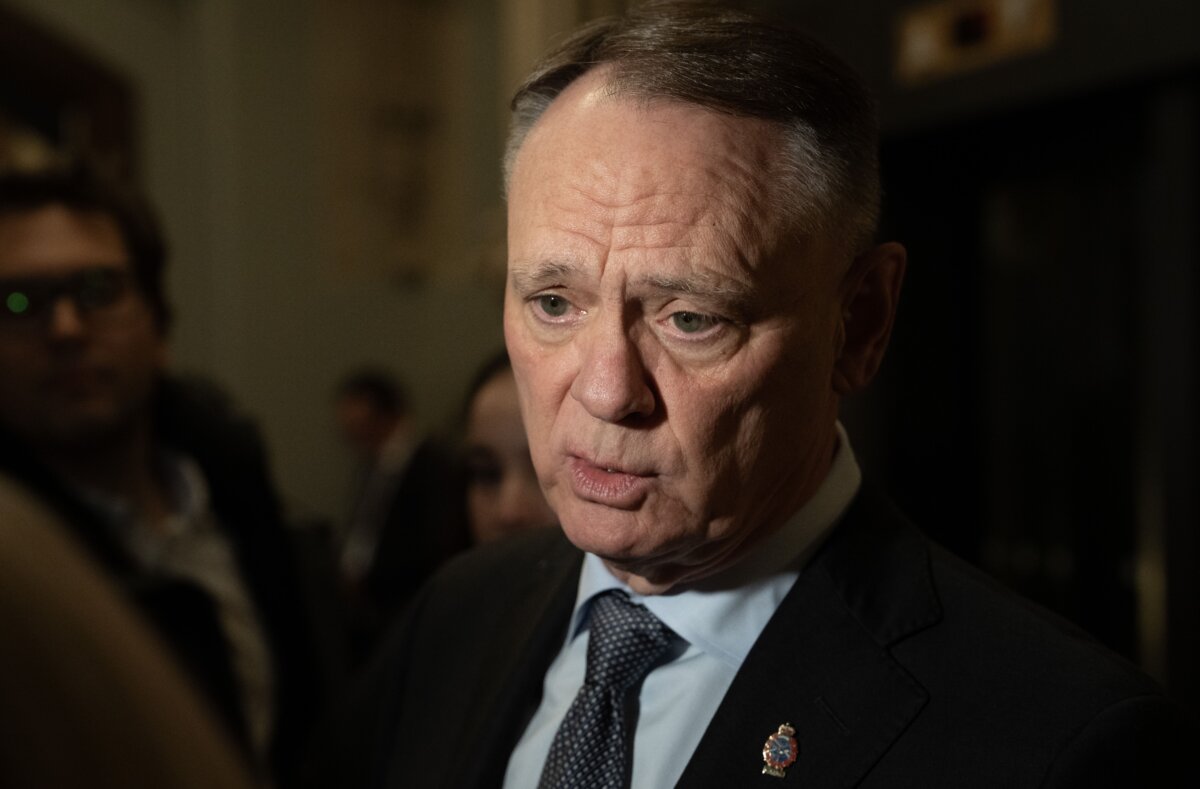

Defence Minister David McGuinty says Ottawa remains uninterested in acquiring nuclear weapons after the former chief of the defence staff said Canada should remain open to the possibility.
“Canada has absolutely no intention to pursue nuclear weapons,” McGuinty told reporters in French on Feb. 3. He noted Canada is a signatory to international treaties that prohibit it from acquiring nuclear weapons, and that Canada has long been a non-nuclear-weapon state.
“We are going to continue to build conventional weapons. We’re going to continue to rearm, we’re going to continue to reinvest, we’re going to continue to rebuild our Canadian Armed Forces, and we’re doing that,” he added.
McGuinty’s comments come after former Chief of Defence Staff General Wayne Eyre, who retired from his role in 2024, said while speaking at a defence forum in Ottawa on Feb. 2 that Canada should keep its options open when it comes to possibly acquiring nuclear weapons.
In his remarks, Eyre said Canada will “never have true strategic independence” without nuclear weapons, according to the Globe and Mail.
He reportedly said that Canada should not pursue acquiring nuclear weapons at the moment, but that since other countries are currently considering whether to acquire them, Canada should also remain open to the possibility.
“Let’s just have the conditions in place so that if we decide to go that way, we can do it in shorter order than some other countries who have no nuclear enterprise,” he added, according to the Globe.
When asked by reporters about Eyre’s comments and whether Canada can remain fully independent militarily without nuclear weapons, McGuinty said, “Absolutely. We’re in the process of rebuilding the military.” He also said he has “a lot of respect” for Eyre, adding that he is “a man who has served well his country.”
McGuinty was also asked by reporters whether he was concerned about the upcoming expiration of the New START Treaty limiting nuclear missiles between the United States and Russia. He said he was not familiar with the situation but would look into the matter.
The New START Treaty, which is the last remaining nuclear arms pact between the United States and Russia, is set to expire on Feb. 5. Russian President Vladimir Putin had offered to extend the treaty for another year, but U.S. President Donald Trump has not committed to extending it.
Arms control advocates have voiced concern about the expiration of the treaty, warning it could lead to a new U.S.–Russia arms race and increase the risk of nuclear conflict.
The treaty was signed in 2010 by then-U.S. President Barack Obama and his Russian counterpart, Dmitry Medvedev, and it restricted each side to a limit of 1,550 nuclear warheads on no more than 700 missiles and bombers. The treaty was originally set to expire in 2021, but was extended for five additional years.
Greenland, F-35
Speaking on other current defence issues, McGuinty told reporters on Feb. 3 that “no decision has been made” on whether to send Canadian soldiers to Greenland, while noting Canada continues to participate with NORAD in “a number of settings.”
“We’ve had helicopters, for example, in Alaska last week. We’ve had the Coast Guard back and forth to Greenland, and we’ll continue to pursue those responsibilities,” he said, adding that Canada is opening a new consulate location in Greenland.
Trump has repeatedly commented in recent weeks on his desire to acquire Greenland, saying the United States needs the Arctic island for “national security.”
Trump has also said that China and Russia have ambitions to acquire the territory, and argued Denmark is unable to adequately defend it. After several European countries send troops to take part in military exercises in Greenland, Trump threatened to impose tariffs on imports from those countries due to their opposition to U.S. efforts to acquire Greenland. He later rescinded the threat after saying he and NATO Secretary-General Mark Rutte had agreed on a “framework of a future deal” concerning Greenland and Arctic security.
Prime Minister Mark Carney has said that Canada will support Denmark and Greenland and “fully support their unique right to determine Greenland’s future.”
McGuinty said he had a “very good, productive” two-hour meeting with U.S. Ambassador to Canada Pete Hoekstra two weeks ago. He said they discussed many issues around Canada-U.S. relations, with defence being a key part of the discussion.
“We also spent a lot of time reviewing what Canada is doing in the Arctic and the significant investments that are going into the Arctic, like our over-the-horizon radar system, for example,” he said. “[Hoekstra] was very interested in learning more and bringing more details back to the United States. So it was a very good discussion.”
McGuinty noted that the F-35 and the acquisition of a fighter jet fleet “remains under review.”
Canada’s plan to buy 88 U.S.-made F-35s was put under review by Ottawa in March 2025. The contract has only been finalized and payment made for the first 16 jets, which are slated to become fully operational in the early 2030s.
Procurement of the remaining 72 jets is still being finalized. Ottawa said it is also considering alternatives such as the Swedish Saab Gripen fighter jet. No public timeline on concluding the review has been announced.
Matthew Horwood, Paul Rowan Brian, and The Associated Press contributed to this report.
 Friends Read Free
Copy
Facebook
Tweet
Friends Read Free
Copy
Facebook
Tweet