Canada has announced the first round of 26 new investments, partnerships, and measures as part of a G7 critical minerals alliance to counter China’s current global dominance in the sector.
Energy Minister Tim Hodgson said $6.4 billion in investments in Canadian projects is a significant step forward in creating a resilient G7 supply chain for critical minerals that will be less reliant on China and protect member nations’ national security interests.
The Critical Minerals Production Alliance was put forward by Canada in June of this year to put its Critical Minerals Action Plan into effect. The alliance aims to incentivize public and private investments in the mining and processing of critical minerals, including rare earth elements, among G7 countries and allies.
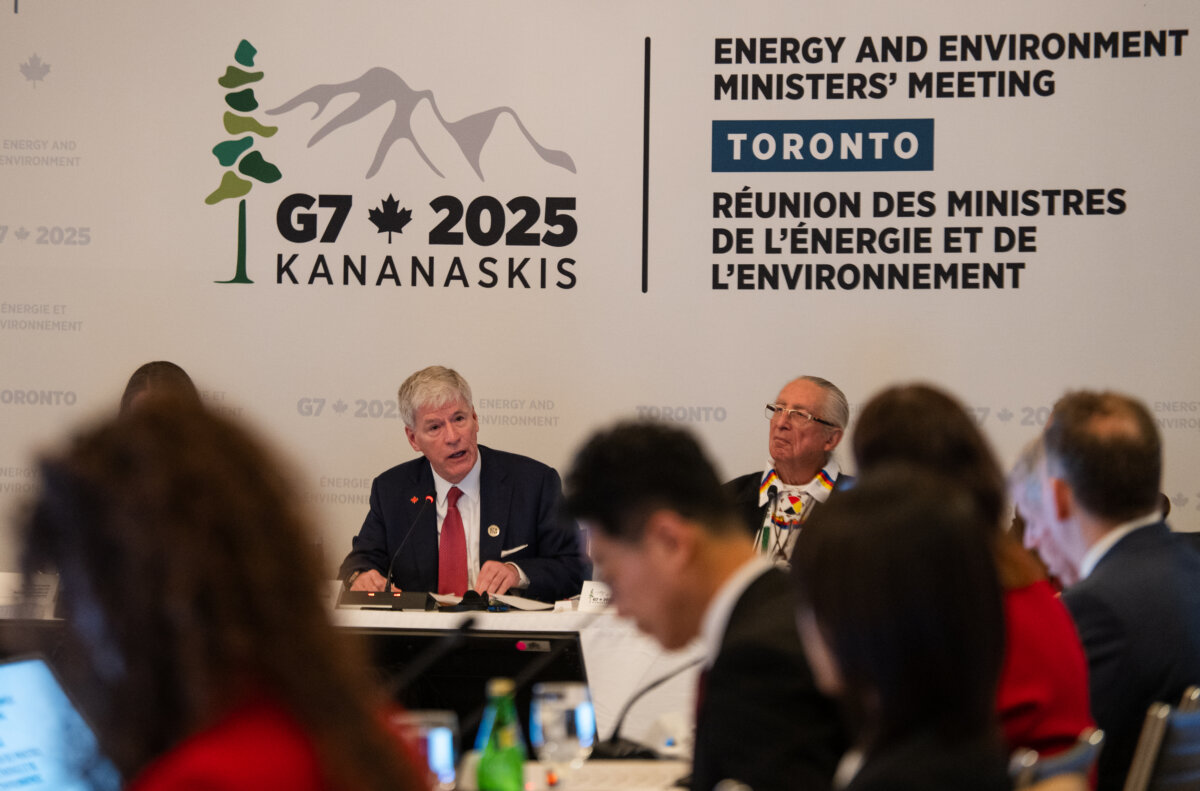
“The first round of G7 alliance projects sends the world a very clear message,” Hodgson said at the conclusion of the G7 Environment Ministers’ Meeting, which was held Oct. 30–31 in Toronto. “We are serious about reducing market concentration and dependencies, safeguarding national security and sovereignty, mobilizing capital, and driving investments in sustainable critical mineral projects.”
Various G7 nations, including Japan, Germany, France, and Italy, will be involved in funding or assisting the projects, along with private sector money from various corporations and Canadian federal government investment. Canada has nearly all of the critical minerals prioritized by the G7, including nickel, cobalt, graphite, lithium, and rare earth elements that are key for many modern technologies including defence applications.
Among the projects announced by Hodgson is Nouveau Monde Graphite’s Matawinie mine close to Montreal; a pilot scandium facility by Rio Tinto in Sorel-Tracy, Que.; Northern Graphite’s Lac des Îles mine; a rare earth mineral processing operation by Torngat Metals in Nunavik, Que.; an expansion phase of Ucore Rare Metals’ facility in Kingston, Ont.; and a $2 billion synthetic graphite factory in St. Thomas, Ont.
The synthetic graphite factory was announced by Norwegian company Vianode, who said it previously obtained a multi-billion-dollar deal with General Motors to supply graphite for its electric vehicle production. The project will potentially receive up to US$500 million in funding from Export Development Canada.
Some of the 26 projects are slated to begin producing in months, but others will require two to three years to be operational, according to Hodgson.
“Supply chain security is something we have long talked about. Well, we’re now not just talking, we’re acting. Today is proof of concept: now it’s time to sustain and accelerate this progress,” Hodgson said. “What we hear from our allies is: ‘We don’t want to buy from Vladimir Putin. We don’t want to buy from non-democratic states who produce this. We want to buy from you, because you’re responsible, you do it in an environmentally responsible way, you don’t use your resources for political coercion. You’re allies—we need your help.'”
Defence Production Act
Hodgson also said that Canada has formally used the Defence Production Act to list critical minerals as a national security matter, allowing them to be stockpiled by Ottawa.
“This enables Canada to launch our own defence stockpiling regimes and to support multilateral stockpiling efforts,” Hodgson said. “By protecting domestic production under volatile global conditions, we ensure a secure supply of critical minerals to Canadians and to allied defence industries.”
Hodgson said that more upcoming deals will be announced by other G7 nations in the future, noting that the current deals were formed after five months of collaborative discussions among members of the alliance. He said that G7 countries will continue to work together so that they can form “mine-to-magnet” supply chains that are independent of China, where primarily state-controlled entities account for about 70 percent of the world’s rare earth mining, 90 percent of separation and processing, and 93 percent of magnet manufacturing, according to the Center for Strategic & International Studies (CSIS).
“All the other G7 countries are investing in our projects,” Hodgson said. “We have an incredible set of cards in our critical mineral resources,” he said, adding that these actions are designed to ensure Canada develops them.
Hodgson said Canada is also in ongoing talks with companies such as Teck Resources to grow their refining capacity for minerals such as germanium, gallium, and antimony, which are key for semiconductor production and various defence technologies.
Canada also issued new joint statements with Japan, Italy, and Australia to deepen cooperation on nuclear energy, critical mineral production and processing, and producing low-carbon liquefied natural gas. Canada is also fast-tracking $10 million to Ukraine to help rebuild energy infrastructure destroyed by Russian airstrikes.
In addition to the announcement on critical minerals investment, Environment Minister Julie Dabrusin, who co-chaired the meeting, said the group of G7 energy ministers moved forward on making plans with regard to using AI in energy systems and advancing nuclear energy. She also said that G7 members talked about being more prepared for natural disasters and enhancing water security in the future, noting that Canada will be hosting an expert workshop in 2026 to work more closely together in advance of the 2026 U.N. Water Conference to be held Dec. 2–4 in the United Arab Emirates.
 Friends Read Free
Copy
Facebook
Tweet
Friends Read Free
Copy
Facebook
Tweet