
Ottawa has eliminated a far greater number of counter-tariffs on American products than was announced last month by Prime Minister Mark Carney, according to government documents published online.
Carney announced in August that Canada would remove retaliatory tariffs on U.S. goods covered by the United States-Mexico-Canada Agreement (USMCA) as a goodwill gesture to kickstart stalled trade talks between the two nations.
However, an order-in-council dated Aug. 29 indicates all Canadian retaliatory tariffs have been removed, with the exception of sectoral tariffs for the steel, aluminum and auto industries. The order appears to contradict what the prime minister has said about Canada’s stance on reciprocal tariffs.
The order issued by Ottawa, which is referred to as an order-in-council, indicates that a product crossing the border, even if it does not comply with the USMCA, will not be subjected to counter-tariffs—suggesting that Canada’s approach is not entirely reciprocal, contrary to the portrayal by the Liberal government.
Canada and China were the only two countries to retaliate against the tariffs U.S. President Donald Trump placed on all U.S. trading partners earlier this year. Ottawa implemented three separate rounds of counter-tariffs, targeting nearly $100 billion worth of U.S. goods.
That stance officially changed at the beginning of this month.
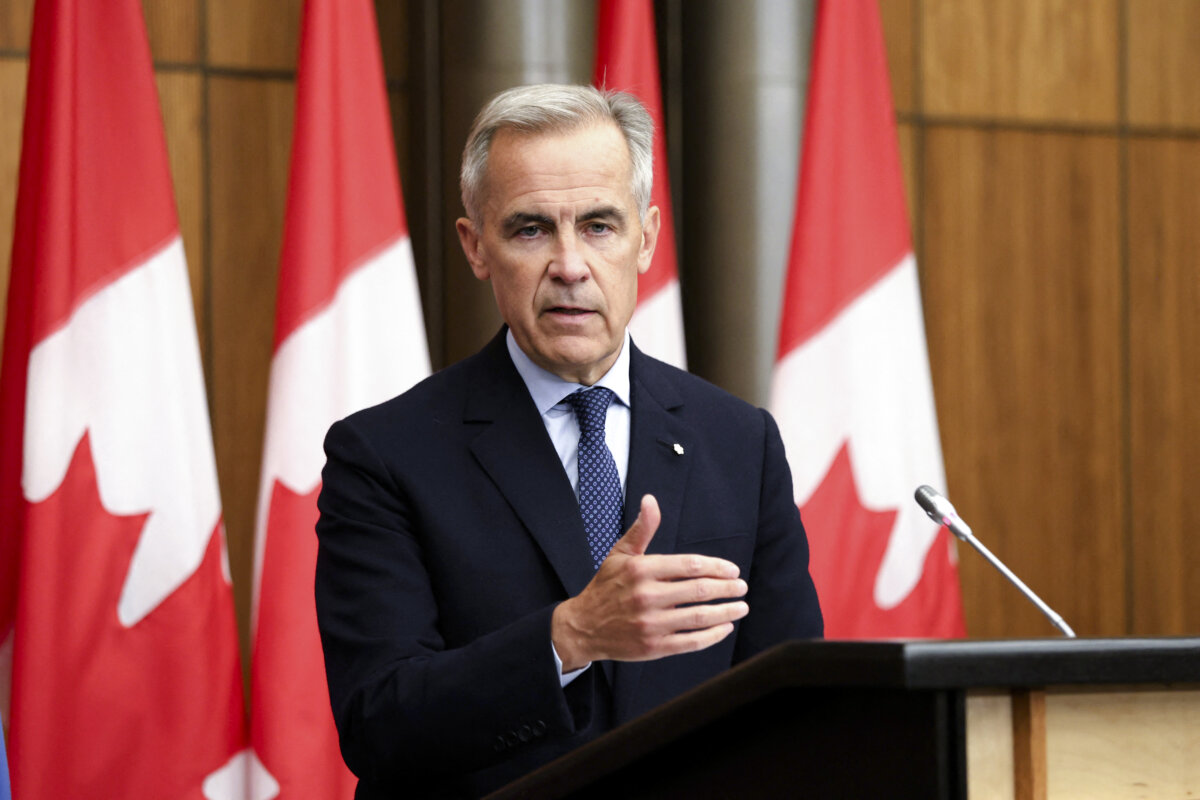
Carney held an Aug. 22 press conference to announce Canada would remove the reciprocal tariffs it had imposed in March on USMCA-compliant goods from the United States as of Sept. 1. The tariffs had affected goods such as oranges, alcohol, clothing and shoes, and cosmetics.
The order-in-council published seven days later, however, shows Ottawa is taking a more lenient approach than Carney announced.
The timing of the policy change remains uncertain, and a spokesperson for the prime minister’s office did not respond to a request for comment on the matter. The Epoch Times also contacted the Ministry of Finance for comment but did not receive a response before publication.
Carney told reporters in his Aug. 22 press conference that Canada already has a better trade deal with the United States than “any other country.” And while Canada’s retaliatory tariffs were implemented to protect Canadian workers and “incentivize a negotiated settlement” with the United States, Ottawa now needs to do everything it can to “preserve this unique advantage” of lower tariffs relative to other countries, Carney said. He added that this would be accomplished by building on the USMCA and creating a new trade and security partnership with the United States.
Conservative Leader Pierre Poilievre has been critical of Carney’s trade approach, saying the prime minister has made “generous concessions” to Trump without securing any reciprocal benefits.
Poilievre has made light of Carney’s “elbows up” election messaging in the past, remarking that “his elbows have mysteriously gone missing” and took to social media on Sept. 25 to comment on the newly reported discrepancy.
“Another elbows-down lie,” Poilievre said in a Sept. 25 X post.
US Tariffs
While Canada has dialled back its reciprocal tariffs on its southern neighbour, the White House is ramping up its own import tariffs, including a 100 percent levy on branded drugs whose manufacturers don’t have plants in the United States and a 25 percent tax on heavy-duty trucks.
Trump unveiled sweeping new import tariffs on Sept. 25 that also include a 50 percent levy on kitchen cabinets and bathroom vanities, and a 30 percent tariff on upholstered furniture. The tariffs are set to take effect on Oct. 1.
Trump’s announcements, which he made on his social media platform Truth Social, did not indicate if the tariffs would be on top of those he has already levied.
The most recent measure, which Trump said was to protect the U.S. manufacturing sector and national security, comes after extensive tariffs on trading partners reaching as high as 50 percent, along with additional specific taxes on imported goods like steel.
Increased tariffs on commercial vehicles could put pressure on transportation costs at a time when Trump has committed to lowering inflation.
The U.S. Chamber of Commerce previously cautioned against the implementation of new truck tariffs, saying that the top five import sources are Canada, Mexico, Japan, Germany, and Finland, which do not represent a “threat to U.S. national security.”
Reuters contributed to this report.
 Friends Read Free
Copy
Facebook
Tweet
Friends Read Free
Copy
Facebook
Tweet