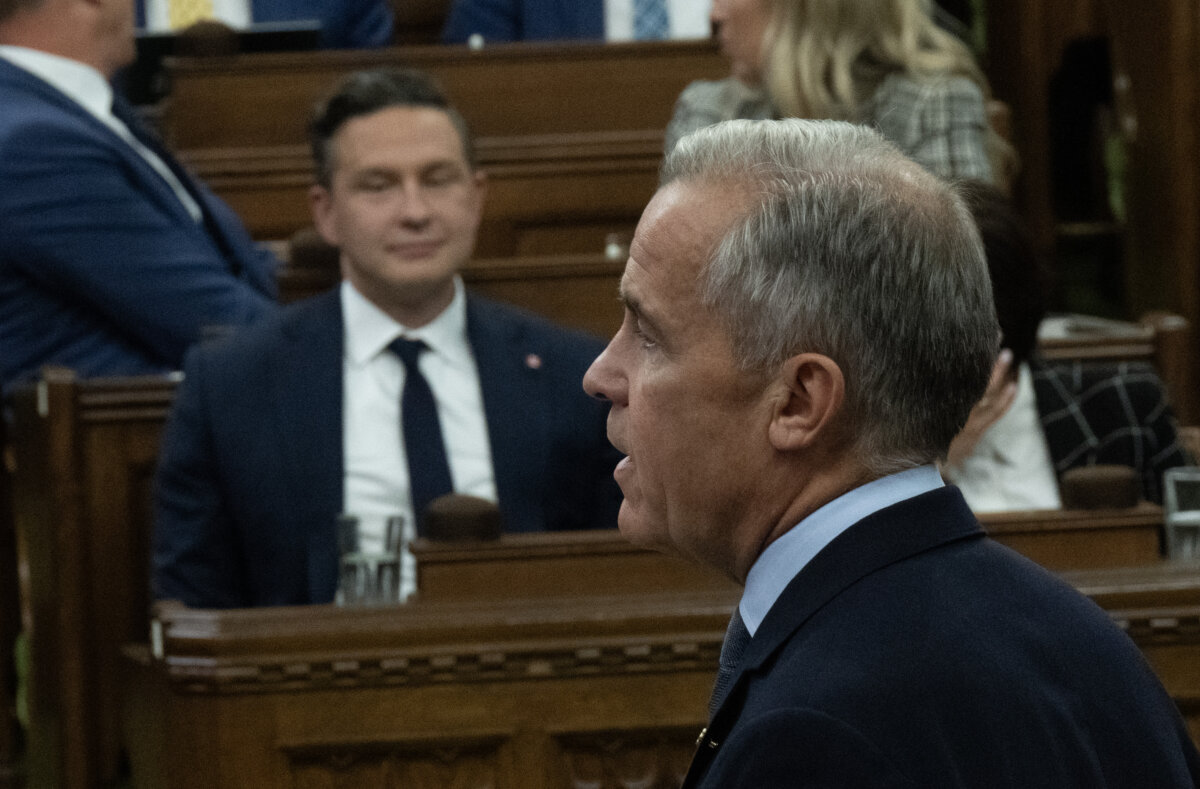

Prime Minister Mark Carney and Conservative Leader Pierre Poilievre squared off during question period for the first time in 2026, debating food affordability and the Conservatives’ proposed Canada Sovereignty Act.
Carney announced on Jan. 26 in an Ottawa grocery store that the government would implement a 25 percent increase to the GST credit, which would be sent out to around 12 million eligible Canadians for the next five years beginning in July. He also announced an additional one-time payment this year worth 50 percent of the credit.
Poilievre said in his address in the House of Commons on Jan. 27 that Canada is experiencing the fastest-rising grocery costs in the G7, with food inflation being higher than in the United States. “The hidden costs that this prime minister imposes on inflation will not go away because he tries to take down the price tag. Why won’t he take down the price?” Poilievre said.
He also accused Carney’s staff of removing food price tags from view during the prime minister’s announcement at the store in Ottawa the previous day. Poilievre said his staff later visited the store and found the price tags put “back up” and that “they’re really high.”
Carney did not directly respond to Poilievre’s accusation, instead bringing up a “productive” meeting he had with Ontario Premier Doug Ford on Jan. 26, where the two had discussed Canada’s automotive sector. Carney said the meeting happened in the “spirit of cooperation,” which came on the heels of Ford’s public criticism of federal policies, and that Poilievre could “learn something about cooperation” from Ford’s example.
Poilievre responded that Carney has had “lots of meetings” and announcements but hasn’t delivered on his election promise to make food more affordable for Canadians, noting food inflation has nearly doubled since Carney was elected in April 2025.
“If Canadians could eat the prime minister’s photo op, there wouldn’t be an empty stomach in the country,” Poilievre said. “He’s had lots of meetings. He’s had signing ceremonies. He’s had grand announcement and new bureaucracy. But what he hasn’t delivered is real results.”
Carney highlighted that wages have been rising faster than inflation, and said the Liberal government is seeking to make the National School Food program permanent to provide meals to up to 400,000 more children annually. He also said the GST benefit announced on Jan. 26 would provide families with up to around $1,800 a year in extra income.
Poilievre also called for the Liberals to vote in favour of the Tories’ proposed Canada Sovereignty Act, which would repeal several laws such as the Impact Assessment Act, Oil tanker moratorium, federal industrial carbon tax, and federal electric vehicle sales mandate. Poilievre introduced a motion on Jan. 27 calling on the House to support the proposed act.
“[Carney] hasn’t removed a single pre-existing Liberal bureaucracy or single pre-existing anti-development law. All he has to do is get out of the way, adopt the Canadian Sovereignty Act so that we can get building and become self-reliant and strong,” Poilievre said.
Carney responded that the Memorandum of Understanding (MOU) that Ottawa signed with Alberta in November 2025, which proposes a path to build one or more pipelines to carry Alberta crude oil to the B.C. coast if a private proponent comes forward, is “not consistent with the Sovereignty Act.”
“[The MOU] will build our future. The Sovereignty Act will destroy it,” Carney said.
The MOU proposes to suspend the Clean Electricity Regulations in Alberta, lift a proposed oil and gas sector emissions cap, speed up environmental review processes, and adjust the oil tanker ban on B.C.’s north coast if necessary, while a Pathways Alliance carbon capture project would be built to compress and store C02 underground. In exchange, Alberta has committed to increase its industrial carbon tax and reduce methane emissions.
 Friends Read Free
Copy
Facebook
Tweet
Friends Read Free
Copy
Facebook
Tweet