Prime Minister Mark Carney says he has no regrets about his speech at the World Economic Forum last week, which drew a sharp response from U.S. President Donald Trump and was followed by tariff threats tied to Ottawa’s push to deepen ties with Beijing.
When asked by reporters on Jan. 26 whether he regrets certain sections of his speech, or if he thinks he might have gone too far, Carney responded in French, “Not a word. Not at all.”
Carney added that his speech had accurately described the current state of global affairs.
Carney was holding his first press conference in Ottawa since delivering the Jan. 20 speech to government and business leaders in Davos, Switzerland.
Carney said Trump’s reactions to him, along with tariff threats made toward Canada in recent days, could be part of the U.S. president’s negotiating tactics. Trump has rescinded an invitation for Carney to join his “Board of Peace” and has threatened 100 percent tariffs on Canada if it makes an unspecified deal with China.
“The president is a strong negotiator and I view, I think, some of these comments and positioning should be viewed in the broader context,” Carney said, citing the upcoming review of the United States-Mexico-Canada Agreement (USMCA) on free trade.
In his Davos speech, the prime minister had offered his assessment of global affairs, saying they are marked by the erosion of the rules-based order amid intensifying rivalry among major powers. Without naming the United States, Carney said such powers are using “economic integration as a weapon, and tariffs as leverage.”
“A few great powers are using integration for coercion, to change the policies of one country or another,” Carney repeated on Jan. 26.
Canada’s economy is deeply integrated with the United States and the country has been significantly affected by Trump’s sectoral tariffs on metals and autos.
Carney said the current context increases the necessity and priority of diversifying partnerships. The prime minister had made the same point in Davos, noting how Canada has struck “new strategic partnerships” with China and Qatar.
Ottawa and Beijing signed multiple agreements during Carney’s visit in China in mid-January, including a deal for Canada to allow the entry of up to 49,000 Chinese electric vehicles (EVs) at the “most-favoured nation” tariff rate of 6.1 percent. China in exchange agreed to lower or reduce tariffs on some Canadian agricultural and seafood products. Ottawa had previously aligned with Washington to place 100 percent duties on Chinese EVs.
In his initial reaction to the deal during a scrum with reporters on Jan. 16, President Trump said it was a “good thing” for Carney to strike a trade deal with China. “If he can get a deal with China, he should do that,” Trump said.
Change of Tone
Trump’s tone changed dramatically after Carney’s speech in Davos. Trump had his own address in Davos the next day on Jan. 21, where he said that Canada should be “grateful” for its relationship with the United States while saying Carney “wasn’t so grateful.”
“Canada lives because of the United States. Remember that, Mark, the next time you make your statements,” Trump said.
In the following days, Trump wrote several posts on his Truth Social platform aimed at Canada and its trade relationship with China.
The president said on Jan. 22 he had rescinded an invitation to Carney to join his newly-formed “Board of Peace.” Carney had said in days prior he had accepted the invitation “in principle” and that he supported the Board’s aim to oversee the reconstruction of the Gaza Strip.
Trump’s focus shortly thereafter shifted to Ottawa’s pursuit of stronger relations with Beijing.
Trump on Jan. 24 said that if Canada makes an unspecified deal with China, it will face a 100 percent tariff on all Canadian goods. “If Governor Carney thinks he is going to make Canada a ‘Drop Off Port’ for China to send goods and products into the United States, he is sorely mistaken,” Trump said. “China will eat Canada alive, completely devour it, including the destruction of their businesses, social fabric, and general way of life.”
This was also the first time Trump referred to Carney as “Governor,” a term he had used regularly to describe former Prime Minister Justin Trudeau when he was in office. The president had used the term since his late 2024 election victory when he spoke about wanting to make Canada the “51st” U.S. state.
Carney told reporters on Jan. 26 he is not concerned by how Trump or others refer to him.
“In this role you get called a lot of things a lot of [the] time,” he said. “I’m not going to comment on every tweet or Truth or comment from whoever, so I can handle it.”
No Free Trade
Amid heightened U.S. tariff threats on Canada over China, Carney on Jan. 25 said that Canada has no intention of pursuing a free trade deal with China. He said that the USMCA has clauses which prevent signatories from pursuing free trade with a “non-market economy.”
“China is one of 15 or 17 economies that the U.S. views as non-market, I can understand why they say that,” Carney said on Jan. 26.
Carney’s comments follow those of Industry Minister Mélanie Joly in Beijing on Jan. 15, where she said Canada had to pursue “free trade approaches” with countries like China to deal with rising U.S. protectionism.
Top Trump officials in recent days have also criticized Canada for getting closer to China and over its plan to bring in Chinese EVs, saying it could jeopardize upcoming free trade negotiations.
“We can’t let Canada become an opening [for] the Chinese to pour their cheap goods into the U.S.,” Treasury Secretary Scott Bessent told ABC News on Jan. 25.
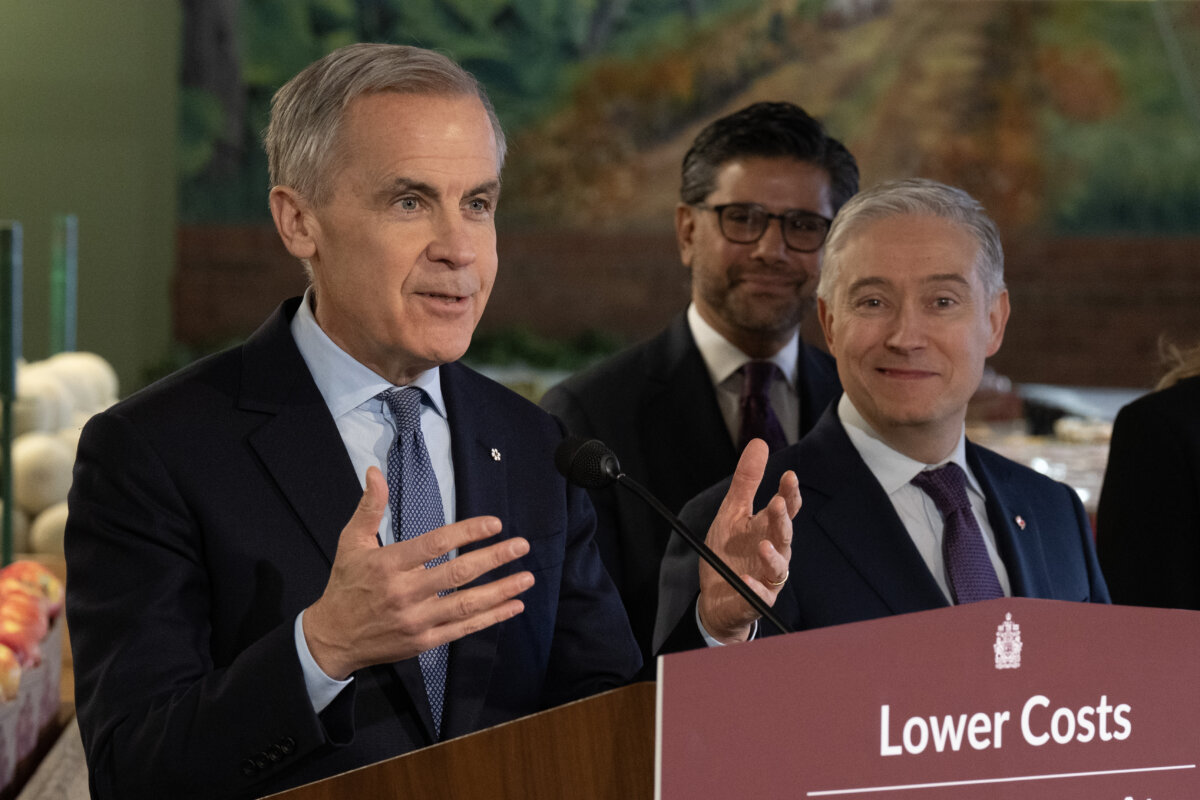
Carney’s press conference on Jan. 26 was to announce new affordability measures and he cited the “new strategic partnership” with China as part of his efforts to reduce costs for Canadians by bringing in “tens of thousands of affordable electric vehicles.”
Trump said on Jan. 25 the Chinese EV deal is a “disaster” for Canada, adding the country is “destroying itself” while its businesses are “moving to the USA.”
Car industry representatives in Canada have criticized the deal and Ontario Premier Doug Ford last week called for a boycott of Chinese EVs, citing impacts on Canadian workers and security concerns.
 Friends Read Free
Copy
Facebook
Tweet
Friends Read Free
Copy
Facebook
Tweet