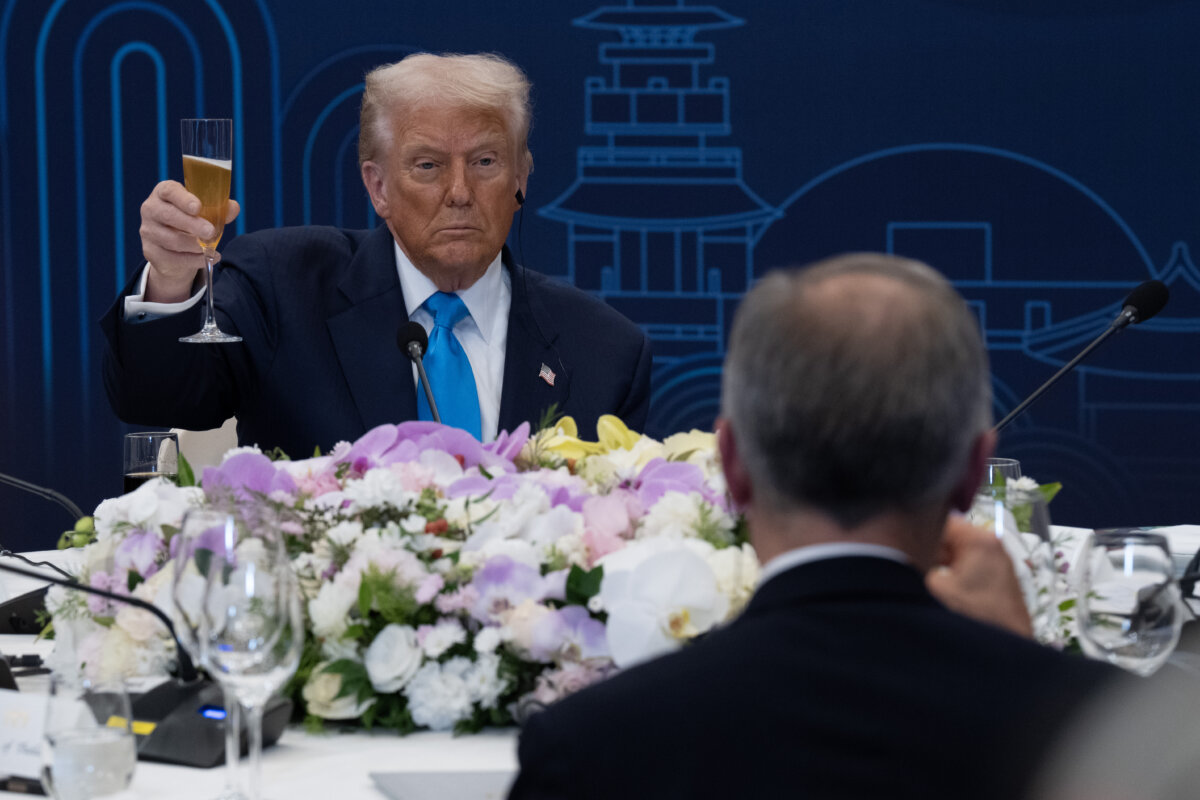

Prime Minister Mark Carney and U.S President Donald Trump pointed and smiled at each other as they sat down for dinner together in South Korea on Oct. 29, marking their first interaction in person since Trump called off all trade negotiations with Canada last week.
The two leaders sat across from each other among a small group of leaders who were invited to a dinner hosted by South Korean President Lee Jae-Myung, ahead of the Asia-Pacific Economic Cooperation (APEC) summit set to begin on Oct. 31. Signs on the dinner tables indicated the dinner was in honour of Trump “and state leaders.”
When asked by reporters if he had a message for Trump as he arrived at the dinner, Carney said, “I have a message for this president,” while pointing at Lee. “I’m very happy to be here,” he said.
Trump has repeatedly said he doesn’t plan to meet with Carney at the summit. He said on Oct. 27 that he’s not interested in meeting with Carney “for a while.” Trump made the comment after he cancelled trade talks and announced tariffs on Canada would be increased by 10 percent due to an anti-tariff TV ad put out by the Ontario government.
“For those that are asking, we didn’t come to South Korea to see Canada!” Trump posted to Truth Social late on Oct. 28.
When asked by reporters how dinner was and whether he chatted with Trump, Carney said it was “very good” and that they had “a very good conversation.”
Carney and Trump hadn’t seen each other or spoken since Trump cancelled trade talks, despite both leaders being in Asia for several days, including at the Association of Southeast Asian Nations Summit in Malaysia earlier in the week.
The United States and South Korea advanced trade talks on Oct. 29, including plans for a $350 billion investment in the American economy. The two countries have agreed to set tariffs on U.S. imports of Korean automobiles and auto parts at 15 percent, down from the current 25 percent, to put them on par with their Japanese competitors. Lee also awarded Trump with South Korea’s highest civilian honour, the “Grand Order of Mugunghwa.”
Meanwhile, Carney is set to meet with Lee on Oct. 30. He is also expected to visit a defence manufacturing facility and meet with leaders from Thailand, Australia, New Zealand, and Singapore. The APEC summit is set to kick off on Oct. 31.
Anti-Tariff Ad Controversy
Trump said on Oct. 23 he was terminating all trade negotiations with Canada over Ontario’s $75 million ad campaign, which uses portions of a 1987 address from late President Ronald Reagan praising free trade, including with Canada. Trump said the ad misrepresented Reagan’s address and was meant to interfere with an upcoming U.S. Supreme Court hearing into his administration’s use of tariffs.
Following discussions with Carney, Ontario Premier Doug Ford said on Oct. 24 he would pull the ads on Oct. 27, after Americans see the ads during the World Series baseball games over the weekend.
Ford said one purpose of the ad was to get “Reagan Republicans” to fight with “MAGA Republicans” to stop the tariffs. He also said he wanted to get the message out to Americans that tariffs are harming workers and businesses. He said Ontario had achieved its goal, “having reached U.S. audiences at the highest levels.”
In response to Ontario not pulling the ads immediately, Trump said on Oct. 25 that he would hike tariffs on Canada by 10 percent “over and above what [Canadians] are paying now.” This has yet to materialize, with Trump telling reporters in Asia that he hasn’t decided when it will take effect.
Despite the Ontario provincial government sponsoring the ad campaign, Trump has said he holds the Canadian government responsible for the ad because he said Carney knew about it and had seen it before it was released, which was confirmed by Ford on Oct. 27. The Prime Minister’s Office has not commented on the matter.
Trade Talks
Prior to the anti-tariff ad controversy, momentum had appeared to be building in trade talks between Canada and the United States following Carney’s visit to the White House on Oct. 7. Carney said “detailed, constructive negotiations” had taken place with the Trump administration around the sectors of steel, aluminum, and energy.
Canada-U.S. Trade Minister Dominic LeBlanc told reporters on Oct. 7 that the two leaders had directed their teams to “quickly land deals” on steel, aluminum, and energy to bring “greater certainty.”
While Carney has said Canada is ready to resume trade talks when the U.S. side is ready, he also said the halted discussions highlights the importance of his trip to Asia and Canada’s pledge to trade more with other countries.
“We’re not resting because the return on building at home is far greater than the hit from trade turbulence with the United States. And the opportunities internationally are considerable,” Carney told reporters in Malaysia on Oct. 27.
During a televised speech on Oct. 22, Carney said Canada will double its non-U.S. exports over the next decade to generate $300 billion more in trade. He said the shift was necessary as Canada’s heavy reliance on the United States had become a vulnerability.
Noé Chartier and The Canadian Press contributed to this report.
 Friends Read Free
Copy
Facebook
Tweet
Friends Read Free
Copy
Facebook
Tweet