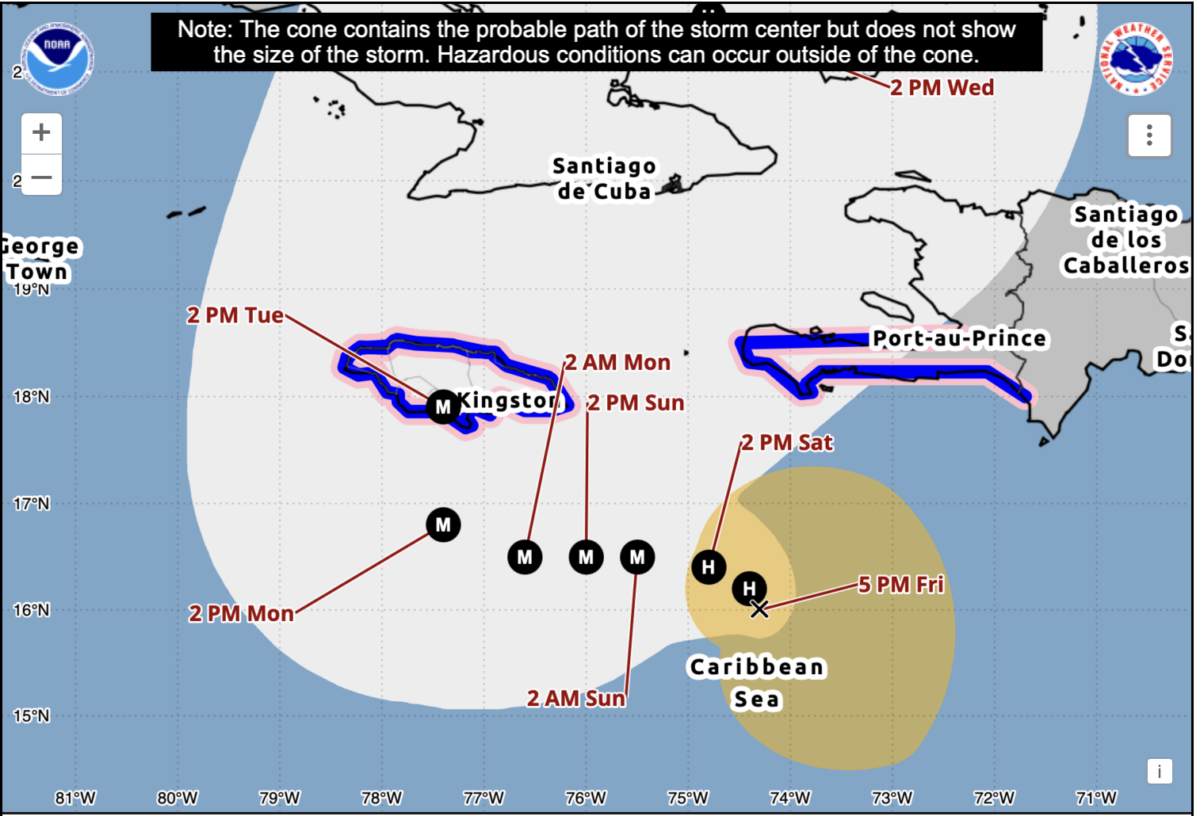

Tropical Storm Melissa is forecast to reach Jamaica on Oct. 28 as a Category 4 hurricane. However, the storm could become a Category 5 hurricane before making landfall.
This extreme weather update came from the National Hurricane Center at 5 p.m. ET on Oct. 24, and added that the storm was likely to reach a maximum sustained winds of 155 mph, maintaining sustained winds of 140 mph after making landfall.
“Rapid intensification is now forecast over the next several days, and Melissa is forecast to become a hurricane tomorrow [Oct. 25] and a major hurricane on Sunday [Oct. 26],” the hurricane center said.
Further, “it appears that Melissa could begin a period of rapid intensification (RI) at any time,” the National Hurricane Center said, adding that “there is a distinct possibility that Melissa could become a Category 5 hurricane during this time period.”
With the storm’s rapid intensification comes a significant lack of speed, meaning that the strong storm is expected to linger longer over an area, dumping more rain.
As much as three feet of rain could be dealt to southern Haiti, and more than two feet of rain is expected to fall on portions of Jamaica over the next several days, due to Tropical Storm Melissa’s intensification and lack of speed.
The National Hurricane Center’s 5 p.m. advisory on Friday warned that Melissa is expected to deliver 15 to 25 inches of total rainfall to portions of Jamaica and southern Hispaniola through Oct. 28, with local maximums on Haiti’s southern Tiburon Peninsula hitting as much as 35 inches.
“Due to Melissa’s slow motion, a prolonged multi-day period of damaging winds and heavy rainfall resulting in potentially catastrophic flash flooding and numerous landslides is likely to begin late Saturday or Sunday,” the National Hurricane Center warned. “There is an increasing risk of life-threatening storm surge when the center of Melissa nears Jamaica early next week.
“Preparations to protect life and property should be rushed to completion.”
The Jamaican government closed all non-essential offices at 2 p.m. ET on Oct. 24, but noted that essential services would remain operational and open to the public.
As for Haiti, the National Hurricane Center warned that catastrophic flash flooding and landslides could cause extensive damage to roads and buildings and could potentially isolate communities for an extended period of time.
Melissa’s center was tagged about 215 miles southeast of Kingston, Jamaica, and about 225 miles southwest of Port-au-Prince, Haiti, as of 5 p.m. ET Friday. That’s just a 25-mile difference since the 11 a.m. advisory, as the storm maintains a northward trajectory of only 2 mph.
Maximum sustained winds were 65 mph, nearing the 74 mph mark of a Category 1 Hurricane, with tropical-storm force winds (39–73 mph) extending 140 miles out.
The latest track has the storm turning to the north east and heading to the Atlantic next week, possibly crossing the eastern part of Cuba and the Bahamas in the process.
Landfall in Jamaica and Cuba will likely weaken the storm. Melissa is expected to be demoted from major hurricane status and enter the vicinity of the Bahamas by Oct. 29.
Interests in the Dominican Republic, Cuba, and the Bahamas were also advised to monitor the storm’s development for heavy rains, flash flooding, storm surge, damaging winds, and landslides.
 Friends Read Free
Copy
Facebook
Tweet
Friends Read Free
Copy
Facebook
Tweet