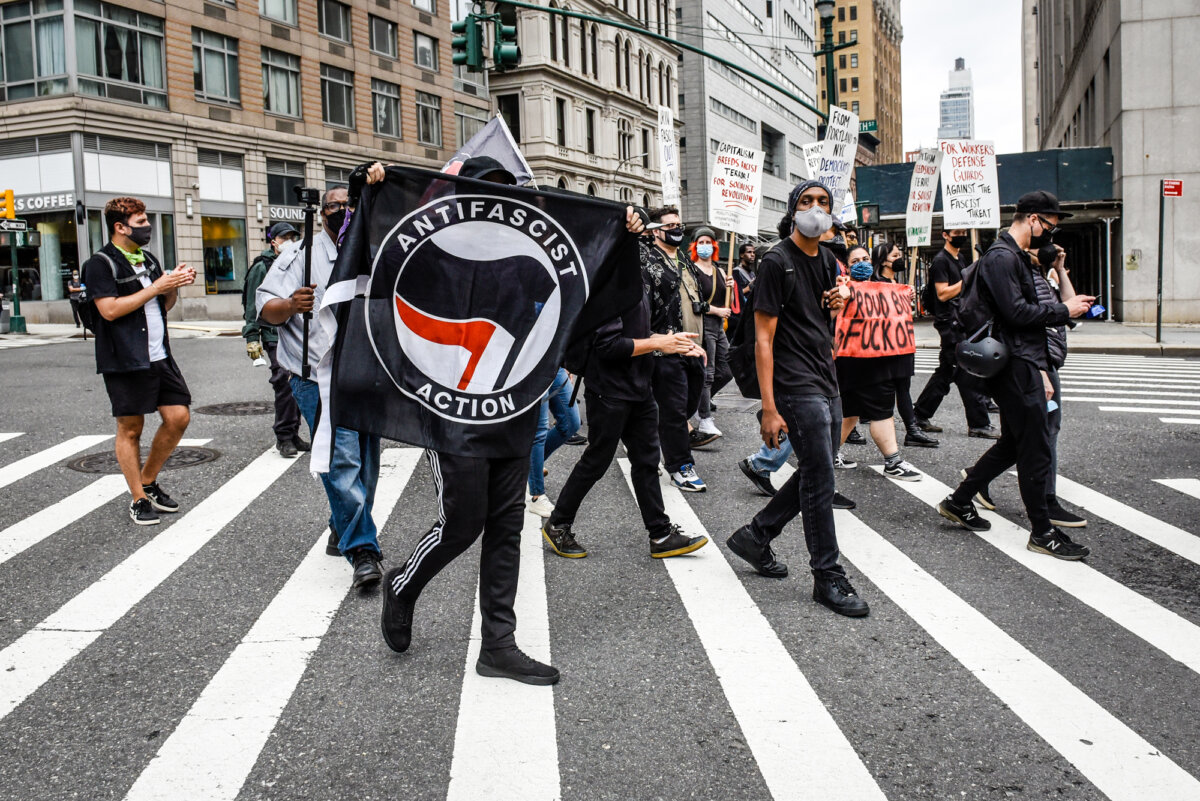

The Department of National Defence (DND) says it does not centrally track Antifa involvement among members of the Canadian Armed Forces or its employees, saying there is no “common definition” of the movement.
In an April 13 response to an order paper question by Conservative MP Garnett Genuis, the DND said it does “in-depth screenings” to identify past records of extremism or hateful conduct but does not “centrally track involvement with Antifa in its human resources systems.”
Genuis had asked whether federal public servants or members of the Canadian Armed Forces (CAF) are allowed to be involved with Antifa, and how many Antifa members currently work in the institutions. He also sought details from the past 10 years on any federal public service or CAF members who have “faced punitive consequences” for “Antifa-related activities.”
The DND said it is taking “deliberate steps” to screen job applicants.
“The Canadian Armed Forces promotion and selection processes now include greater consideration of past conduct and character traits,” DND spokesperson Sherry Romanado wrote. “All applicants to the Canadian Armed Forces undergo in-depth screenings of their background, educational and professional credentials, personal and professional references, and criminal records.”
With regard to Antifa members in the CAF, Romanado said that CAF and DND rules “prohibit any behaviour or affiliation that constitutes, encourages, justifies, or promotes violence or hatred against an identifiable group,” and no officer or non-commissioned member is allowed to do or say anything that “might reflect discredit on the Canadian Forces or on any of its members” if seen or heard by the public.
Romanado said she couldn’t respond to the order paper question about punishment of CAF members for Antifa-related activity because there is no “common definition” of Antifa. Antifa is short for “anti-fascist.”
Order paper questions are formal requests that MPs can send to seek detailed information from the government that can’t be easily answered during daily question period in the House of Commons. The government is required to respond in writing, typically within 45 days.
Accusations of Violence
Genuis said in a video posted to X in February that his goal is to understand the Liberal government’s position on Antifa, since the far-left group has been associated with illegal behaviour that members describe as “direct action.”
“Antifa is a specific political movement. It’s not a general descriptor of anyone with anti-fascist convictions,” Genuis said.
Antifa has come under the spotlight in the United States in recent years after repeated incidents of violence.
The Trump administration has designated Antifa as a domestic terror organization, describing it as a “militarist, anarchist enterprise that explicitly calls for the overthrow of the United States government, law enforcement authorities, and our system of law.”
Individuals who support the ideology of the Antifa movement have carried out a number of violent criminal offences, including an attack at an immigration detention facility in Alvarado, Texas, in July 2025 in which a police officer was shot in the neck. The officer survived, but several suspects were charged with attempted murder and firearms offences.
Another incident in the United States involved the fatal shooting of pro-Trump individual Aaron “Jay” Danielson in Portland, Oregon, on Aug. 29, 2020. The attacker was later identified as Michael Reinoehl, a self-described “anti-fascist.”
Funding
Although Antifa is not as prominent in Canada as in the United States, several Conservative MPs have raised concerns about the movement, including Tory MPs Kerry Diotte, Michael Cooper, and Dane Lloyd.
In a committee hearing last month, Diotte referred to Antifa as an “incredibly violent organization,” and last October Lloyd brought up allegations that an Antifa member was responsible for lobbing smoke bombs into a worship music performance in a Montreal church during the summer of 2025.
A related order paper question submitted last year by Conservative MP David Bexte asked how much federal funding given to the Canadian Anti-Hate Network (CAHN) went to groups associated with Antifa or other extremist organizations.
Then-Canadian Heritage Minister Steven Guilbeault responded that his department did not track how money sent to CAHN was disbursed once the organization received it, noting Heritage Canada had green-lighted $440,000 in 2024 to fund projects against hate groups. Public Safety Canada, which gave $200,000 to CAHN for research into far-right ideology and groups, said there were firm rules that barred any redistribution of funding.
Bexte’s question arose after a 2022 small-claims court accepted evidence that appeared to suggest CAHN had aided Antifa, which CAHN denied. Parliamentary Secretary Jacques Ramsay also denied that any funds had gone to Antifa or other extremist organizations.
 Friends Read Free
Copy
Facebook
Tweet
Friends Read Free
Copy
Facebook
Tweet