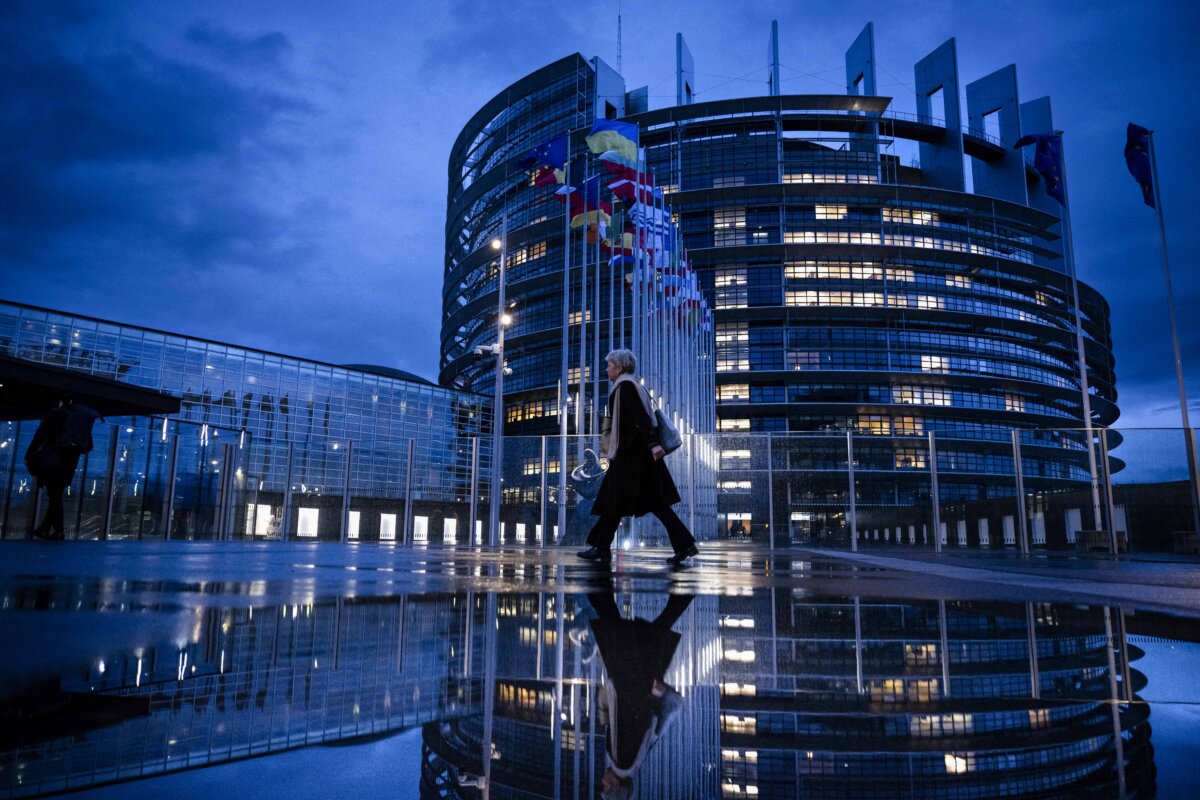

The European Parliament on Feb. 23 suspended the ratification process of the U.S.–European Union trade deal, after U.S. President Donald Trump announced a 15 percent global tariff following the Supreme Court’s decision to strike down his emergency tariffs.
Bernd Lange, chairman of the European Parliament’s International Trade Committee, said in a statement that the Feb. 20 ruling by the Supreme Court had implications for the proposed trade deal and that a “key instrument” used by the United States to initially strike the Turnberry Deal in Scotland in 2025 is “no longer available.”
“The situation is now more uncertain than ever,” Lange said. “This runs counter to the stability and predictability we sought to achieve with the Turnberry Deal.”
The Supreme Court last week invalidated the reciprocal tariff framework imposed by Trump under the International Emergency Economic Powers Act, prompting the Trump administration to look at alternative legal avenues.
After the ruling, Trump announced a 10 percent global tariff under Section 122 of the Trade Act of 1974 before increasing it to 15 percent on Feb. 21 following a detailed review of the court’s decision.
Lange said that Section 122 “applies indiscriminately to all countries exporting to the United States” and is imposed on top of the most favored nation rate.
“As a result, imports from the EU into the US would be subject to an applied rate exceeding the 15 percent threshold,” he said. “This, in itself, constitutes a clear departure from the terms of the Turnberry Deal.”
The deal requires approval by EU governments and the European Parliament, which comprises elected representatives from each of the 27 EU member states.
It was scheduled to be voted on by the European Parliament on Feb. 24.
“Shadow rapporteurs, representing a majority of Members, have agreed that under the current circumstances work on the two Turnberry files should be put on hold until clarity, stability, and legal certainty in EU–US trade relations are re-established,” Lange said.
“Consequently, the scheduled votes in committee tomorrow will not take place as planned, and the shadow rapporteurs will reassess the situation next week.”
The Turnberry Deal—reached as a political agreement in July 2025 and later detailed in an August 2025 joint statement announcing an EU–U.S. Framework Agreement—would have suspended tariffs on all U.S. industrial goods and established tariff-rate quotas for a large number of U.S. agri-food products entering the EU.
At the time, both sides described the deal as a reset for the world’s largest bilateral economic relationship, valued at more than $1.6 trillion a year.
Trump wrote on Truth Social on Feb. 23: “Any Country that wants to ‘play games’ with the ridiculous supreme court decision, especially those that have ‘Ripped Off’ the U.S.A. for years, and even decades, will be met with a much higher Tariff, and worse, than that which they just recently agreed to. BUYER BEWARE!!!”
Trump has previously accused the EU of taking advantage of the United States in trade.
2nd Deal Ratification Delay
This is the second time that the European Parliament has paused ratification of the deal.
The first occurred on Jan. 21, after Trump said he would impose additional tariffs on eight European countries that opposed the United States’ acquisition of Greenland, an autonomous territory within the Kingdom of Denmark, an EU member state.
Trump has said the United States needs Greenland for national security reasons and that a U.S. acquisition of the Arctic island is crucial to countering potential threats from Russia and China.
European leaders had called Trump’s tariff threats over Greenland unacceptable and previously signaled they would be seen as problematic for the EU–U.S. trade agreement.
Trump later canceled the tariffs after holding talks with NATO.
The tariffs would have gone into effect on Feb. 1 and would have affected the UK and EU member states Denmark, Finland, France, Germany, the Netherlands, Norway, and Sweden.
The Epoch Times contacted the White House and Office of the United States Trade Representative for comment but did not receive a response by publication time.
Aldgra Fredly, Tom Ozimek, and Reuters contributed to this report.
 Friends Read Free
Copy
Facebook
Tweet
Friends Read Free
Copy
Facebook
Tweet