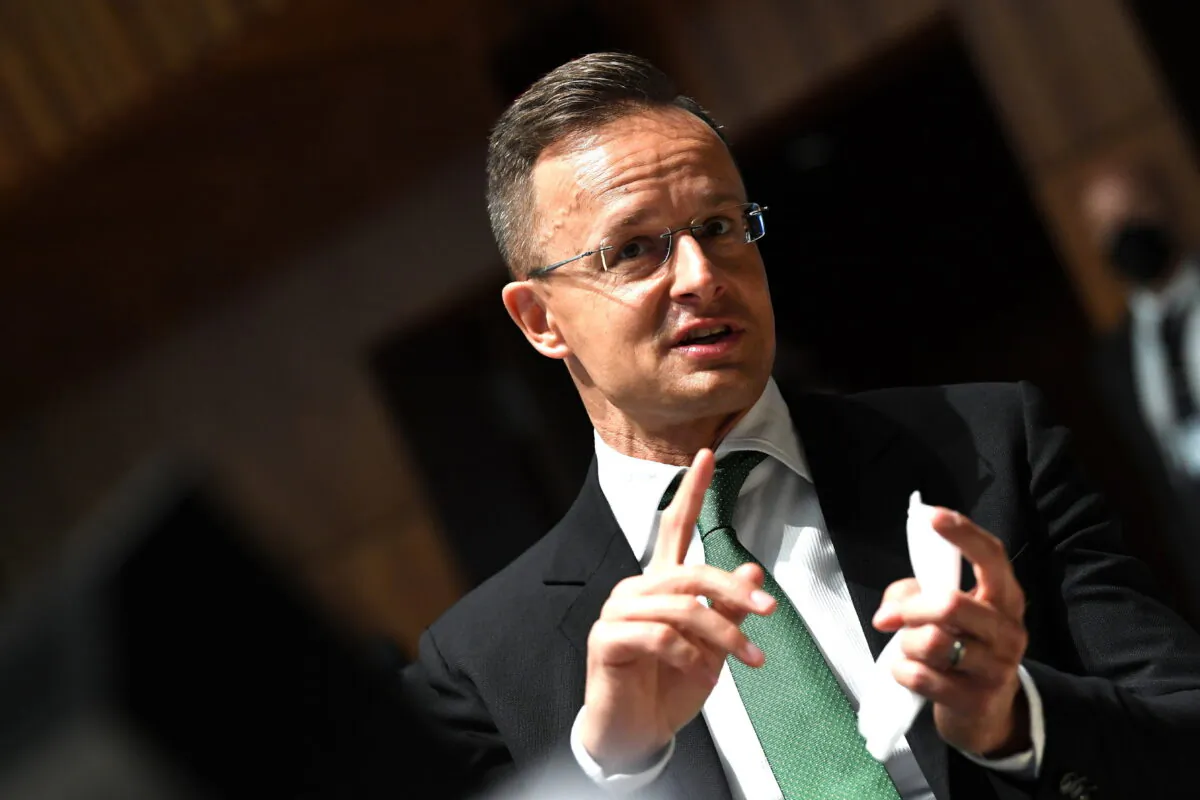

European countries are “acting like madmen” in terms of energy policy, Hungarian Foreign Minister Peter Szijjarto said on Oct. 15.
Budapest’s chief diplomat was attending the Russian Energy Week event in Moscow when he made the comments, which come as Brussels continues its push to eliminate the continent’s dependency on Kremlin-backed liquefied natural gas and oil.
“My European friends are acting like madmen when it comes to energy,” he said, according to Russian state news agency TASS. “Now Brussels is forcing us to replace cheap and reliable sources of gas supplies with more expensive and less reliable ones. Hungary sees no point in this.”
Szijjarto went on to say that reliable energy supplies were the “foundation” of Hungary’s sovereignty and that Budapest would not jeopardize that.
He said Russia has never let Hungarians down in terms of energy supply and condemned Ukrainian strikes on the Druzhba pipeline, which supplies both Hungary and Slovakia, Hungary’s neighbor and fellow European Union member state.
Hungary has long resisted plans by the EU to phase out imports of all Russian gas and liquefied natural gas by the end of 2027.
Budapest and Moscow signed a 15-year deal in 2021, before the full-scale Russian invasion of Ukraine, to buy 4.5 billion cubic meters of gas annually. In 2024, Hungary increased purchases from Gazprom, Russia’s state energy giant, importing some 7.5 billion cubic meters of gas via the TurkStream pipeline.
The country also imports most of its crude oil via the Druzhba pipeline, which runs through Belarus and Ukraine.
While in Moscow, Szijjarto said that Hungary would receive approximately 5 million tons of Russian oil via the Druzhba pipeline in 2025 and that it planned to maintain that level through 2026, according to TASS.
Hungary’s recalcitrant stance on the issue of Russian energy has sparked criticism, including from U.S. President Donald Trump.
In September, Trump said he would urge Hungary to stop buying Russian oil, part of a push to pressure NATO allies to cut energy ties with Moscow.
In his address to the U.N. General Assembly in New York City on Sept. 23, he criticized NATO members for continuing to buy Russian energy.
“But inexcusably, even NATO countries have not cut off much Russian energy and Russian energy products,” Trump said. “Think of it, they’re funding the war against themselves.”
Separately, that same day, he told reporters that he would be speaking directly to Hungarian Prime Minister Viktor Orban about the issue.
“He’s a friend of mine,” Trump said. “I have not spoken to him, but I have a feeling if I did, he might stop, and I think I’ll be doing that.”
The two had a phone conversation about Russian oil and other issues on Sept. 25.
In comments to state radio on Sept. 26, Orban said he told Trump that dropping Russian energy imports would be an economic “disaster” for Hungary.
“I told the U.S. president … that if Hungary is cut off from Russian oil and natural gas, immediately, within a minute, Hungarian economic performance will drop by 4 percent,” Orban said. “It means the Hungarian economy would be on its knees.”
When it comes to energy sources, “it is clear what is in Hungary’s interest,” he said.
“[Hungary and the United States] are sovereign countries. There is no need for either of us to accept the arguments of the other. America has its arguments and interests, and Hungary does, too,” he said.
Slovakia, the other EU and NATO state still heavily reliant on Russian energy, also pushed back on Trump’s demands.
“We don’t have any other options which could be sustainable and also for the price to be reasonable,” Slovak Foreign Minister Juraj Blanar told Reuters during an interview on the sidelines of the U.N. General Assembly on Sept. 24.
“It takes time to diversify this. So that’s why we are calling for some kind of empathy.”
Owen Evans contributed to this report.
 Friends Read Free
Copy
Facebook
Tweet
Friends Read Free
Copy
Facebook
Tweet