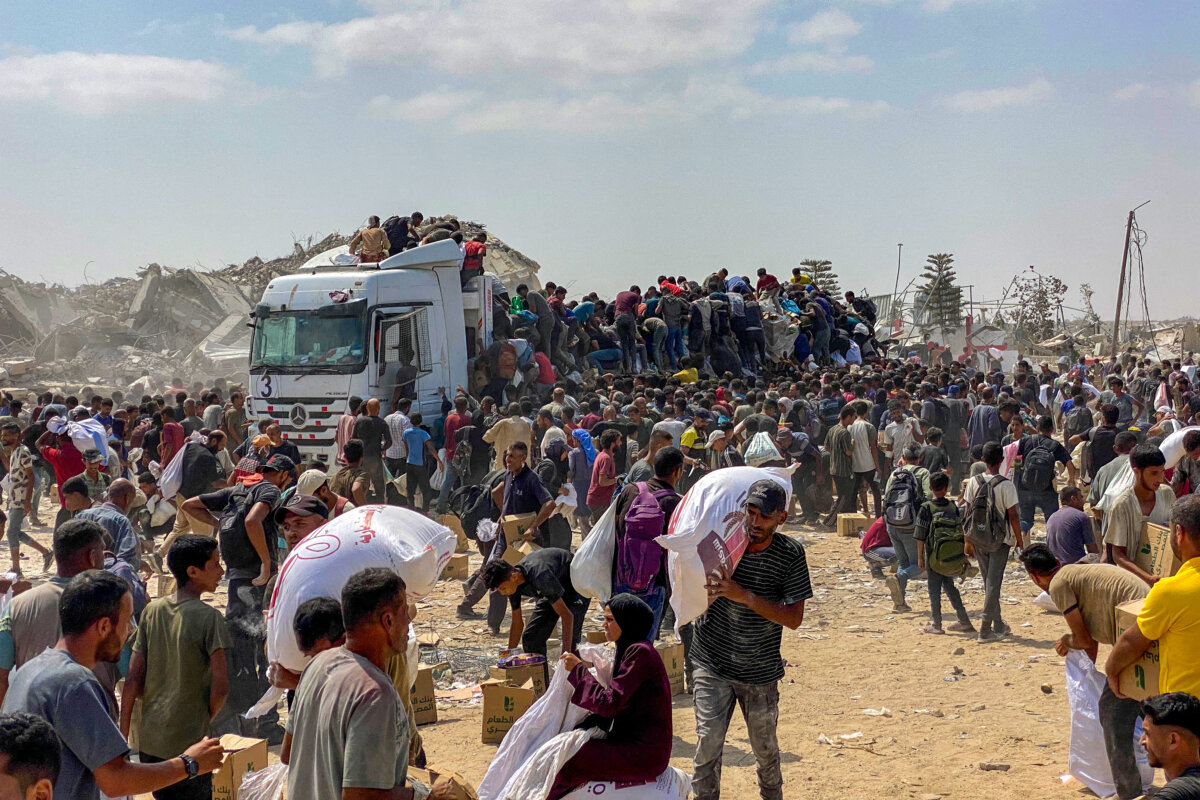

Food shortages in the Gaza Strip have reached the level of famine, according to a report from Integrated Food Security Phase Classification (IPC), an independent group of relief and intergovernmental organizations that monitors global hunger conditions.
Famine status indicates acute malnutrition in at least 20 percent of the population and two adult deaths or four child deaths due to starvation for every 10,000 inhabitants, according to IPC’s criteria.
Scott Paul, director of peace and security at Oxfam America, which is a member of IPC, said the IPC report confirms what the agency has been warning about for some time.
“Just a few weeks ago, the IPC warned the famine was unfolding,” Paul told The Epoch Times. “So no one should be surprised when, a few weeks later, they’ve confirmed that that tipping point has been surpassed.”
The report applies to one of the five administrative areas within the Gaza Strip, the Gaza Governorate, situated in the northern half of the Strip and comprising about one-third of the region’s approximately 2.1 million population.
Two other governorates, Deir al-Balah and Khan Younis, were also classified as in an emergency state and are expected to reach the threshold for a famine declaration within a few weeks.
By the end of September, IPC forecasts that nearly 1.8 million people will be living in famine conditions.
Since May, the number of children in Gaza expected to be at risk of death from malnutrition tripled, from about 14,000 to more than 43,000, according to the World Health Organization.
The Foundation for Defense of Democracies, a Washington-based think tank, critiqued the methodology of the IPC report and noted that IPC recently lowered its threshold for declaring a famine, from 30 percent acute malnutrition among children to 15 percent.
Aid agencies continue to report that people in Gaza are dealing with severe hunger.
“Mothers are now too malnourished to nurse their starving babies,” Mahmoud Alsaqqa of Oxfam said in an Aug. 22 statement. He also said Gazans seeking food have been the subject of reported violence.
Israel questioned the report’s criteria and accused the IPC of spreading misinformation.
“The IPC just published a tailor-made report to fit Hamas’s fake campaign,” read a post on the country’s official page on social media platform X. “They twisted their own rules, lowered famine thresholds, and ignored death-rate criteria — all to smear Israel with lies.”
The Aug. 22 report comes six months after the State of Israel temporarily halted, then resumed the passage of food assistance into the region. Israel said the blockade was imposed due to allegations that food shipments were being systematically diverted by the Gaza-based terrorist group Hamas. The group denied the accusations.
The U.S.-backed Gaza Humanitarian Foundation now does the majority of food distribution in Gaza. Some 100 humanitarian agencies alleged that the change further disrupts the food supply in the war zone.
Johnnie Moore, executive chairman of Gaza Humanitarian Foundation, said that his organization has corrected longstanding problems in the distribution system and is now getting food to the people who need it.
“The United Nations and other international agencies created a system which empowered virtually every bad actor and every bad force in the Gaza Strip to make a bad situation worse,” Moore told Jan Jekielek in an interview on EpochTV’s “American Thought Leaders.”
“We give away one to three million meals worth of food every single day for free, direct to the people,” Moore said.
The region has been a conflict zone since Hamas’s Oct. 7, 2023, terrorist attack on Israel and the ongoing war between the two that ensued.
Israel has set out principles for ending the war, including Hamas’s disarmament, the release of hostages held since October 2023, continued Israeli security control in Gaza, and the establishment of a civilian administration unaffiliated with either Hamas or the Palestinian Authority.
Israeli Defense Minister Israel Katz said on Aug. 22 that Gaza City could face destruction similar to Rafah and Beit Hanoun if Hamas does not disarm and release hostages.
Katz said the government had approved Israel Defense Forces plans to defeat Hamas in Gaza, involving “intense fire, evacuation of residents, and manoeuvring.”
Commenting on the impending military action, Paul said, “It goes without saying that an escalation in the midst of this situation would be a catastrophe upon a catastrophe.”
The United Nations has called for a cease-fire to allow increased delivery of food aid, while the Israeli government said, “Israel has gone to unprecedented lengths to enable aid to go into enemy territory.”
Evgenia Filimianova contributed to this report.
 Friends Read Free
Copy
Facebook
Tweet
Friends Read Free
Copy
Facebook
Tweet