
India’s Trade Minister Piyush Goyal will visit Canada from May 25 to May 27, along with a delegation of approximately 150 Indian industry leaders, to discuss trade and investment between the two countries.
The Indian delegation will hold meetings with Canadian ministers, business leaders, and industry groups in Ottawa and Toronto, Goyal told a media briefing on May 23.
Goyal will meet with Canadian Trade Minister Maninder Sidhu to advance ongoing negotiations of the Comprehensive Economic and Partnership Agreement (CEPA), a type of free trade agreement, between Canada and India, India’s Ministry of Commerce and Industry said in a May 23 news release.
A media advisory from Global Affairs Canada says the bilateral meeting between Goyal and Sidhu will be held on the morning of May 25.
Goyal and Sidhu will also explore new opportunities for trade and investment, the Indian ministry said.
Goyal is also expected to meet with Prime Minister Mark Carney and hold a series of bilateral meetings, including with Foreign Affairs Minister Anita Anand, to “strengthen strategic cooperation across priority sectors,” the ministry added.
The Indian ministry also noted that energy security and transition are “defining priorities” for both Canada and India, with Canada’s vast energy and natural resource base and India’s expanding energy requirements creating “strong complementarities.”
“There is substantial scope for deeper India–Canada collaboration in AI research, standards, and innovation ecosystems,” the ministry said.
Goyal’s visit to Canada comes after Carney visited India in March, marking the first visit to India by a Canadian prime minister since 2018.
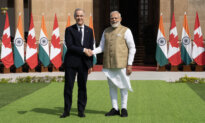
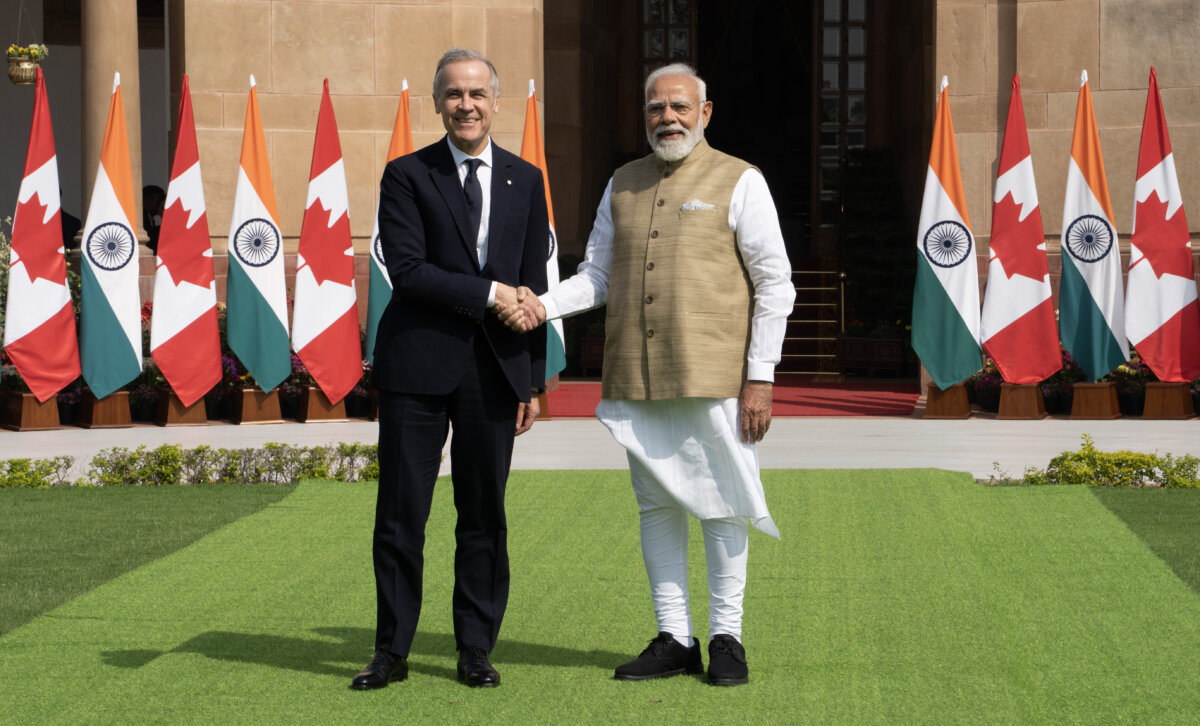
Carney met with Indian Prime Minister Narendra Modi in New Delhi on March 2 and the two agreed to move forward in signing the CEPA by the end of this year with the intention to double two-way trade by 2030.
Both countries are seeking to diversify trade amid a shifting geopolitical context, U.S. protectionist policies, and major armed conflicts.
Carney has called the free trade agreement “foundational” to Canada’s partnership with India. He also said while in New Delhi that India is one of Canada’s “natural partners.”
Canada and India also signed a number of memorandums of understanding (MOUs) and agreements on March 2, including a $2.6 billion uranium deal as part of a new “strategic energy partnership” between the two countries. The MOUs and agreements cover a variety of areas including trade and economic cooperation, civil nuclear energy, renewable energy, and critical minerals, as well as culture and knowledge partnerships and education and research mobility.
The two countries also agreed to launch an India-Canada Defence Dialogue at the joint secretary or assistant deputy minister level.
Canada-India Relations
Carney has worked to repair ties with India after relations between the two countries broke down under the previous Liberal government. Relations began to sour after the last visit by a Canadian prime minister, Justin Trudeau, to India in 2018.
Relations broke down further when Trudeau accused India in 2023 of being involved in the assassination of Sikh separatist Hardeep Singh Nijjar in British Columbia.
India has long accused Canada of sheltering Sikh separatists, who seek to carve an independent Khalistan state out of India’s Punjab region, but it has denied involvement in the Nijjar case.
In October 2024, the RCMP said serious crimes committed in Canada, including extortion and homicides, had links to Indian government agents. Ottawa expelled six Indian diplomats, including its high commissioner, the same day, saying the RCMP had gathered “ample, clear and concrete evidence” identifying them as “persons of interest” in the Nijjar case.
India responded by expelling Canadian diplomats, saying it “strongly rejects these preposterous imputations and ascribes them to the political agenda of the Trudeau Government that is centered around vote bank politics.”
Carney’s government has sought to repair relations with India since he took office last spring. He invited Modi to the G7 Summit in Alberta last June, which Carney has said triggered the repair.
Since then, the two countries have reappointed high commissioners and there have been multiple engagements between Canada and India at the ministerial level.
Anand and her Indian counterpart launched a new roadmap to rebuild ties last October during her visit to New Delhi, and she said a month later that Canada and India had agreed to relaunch negotiations for the CEPA. The Trudeau government had halted the deal’s negotiations in the summer of 2023 before accusing India of having a hand in the killing of Nijjar.
Energy Minister Tim Hodgson also visited India in January, with the two countries agreeing to expand trade in oil and gas.
Before Carney left for India in March, a senior government official suggested to reporters that New Delhi was no longer involved in plotting violent acts in Canada. This prompted rebuke by separatist activists in Canada, who said they still face threats.
Carney cancelled his media availability while in India and thus did not have to address the issue during the trip. He spoke to reporters on the issue in Australia on March 3 and disputed what his senior official had told reporters, saying he “would not use those words” the senior official had said.
Carney said the issues of foreign interference and transnational repression were raised during meetings with Modi and noted that progress has been made with India on the issues while Canada remains “vigilant” by tightening laws and ensuring an appropriate level of security resources.
Noé Chartier and Reuters contributed to this report.
 Friends Read Free
Copy
Facebook
Tweet
Friends Read Free
Copy
Facebook
Tweet