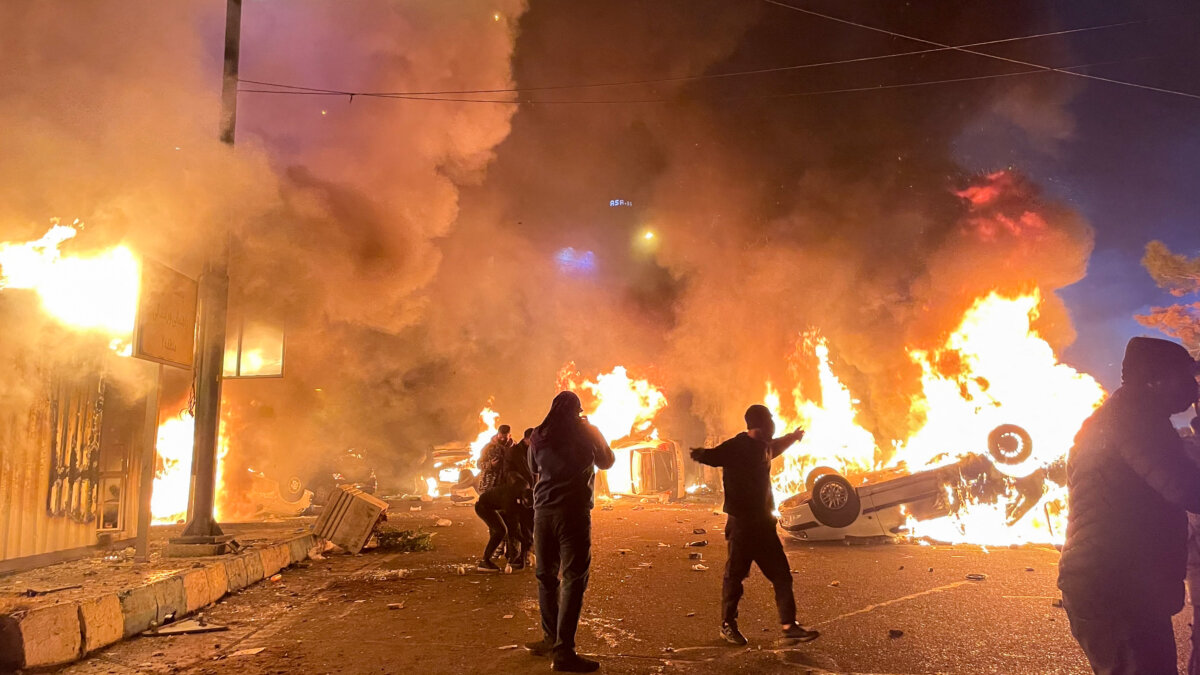

Iran has come down hard on dissent as the regime in Tehran looks to stamp its authority on the nation following the mass protests in recent weeks.
The Islamic Iran Nation’s Union Party sought the release of Secretary-General Azar Mansouri, Iranian newspaper Shargh reported on Feb. 9, after her arrest along with other members of the Reform Front, an umbrella body of reformists in the country.
Thousands have been arrested as authorities seek to deter further protests after last month saw the bloodiest unrest since the Islamic Revolution of 1979.
Shargh reported that Ebrahim Asgharzadeh and Mohsen Aminzadeh were arrested alongside Mansouri, who acts as head of the reform movement.
The publication noted that at least two further Reform Front members had been asked to report to the prosecutor’s office in Tehran’s Evin prison on Feb. 3.
The Reform Front’s spokesperson, Javad Imam, was also arrested, Mansouri’s lawyer, Hojjat Kermani, said on Feb. 9, noting that it was unclear what charges those detained were facing.
“We basically don’t know what caused these arrests because the Reform Front has not yet issued a statement on the recent events. Individuals may have made comments individually, but the Reform Front has not yet issued a statement,” Kermani told the Iranian Labour News Agency.
On Feb. 8, the judiciary’s media outlet, Mizan, said that “four important political elements supporting the Zionist [regime] and the United States” were indicted but didn’t name them.
“The individuals in question were organizing and leading extensive organizational activities aimed at disrupting the political and social situation in the country amid military threats from the United States and the Zionist regime,” Mizan reported.
“At the time of the terrorist events in January, the aforementioned individuals had done their utmost to justify the actions of the terrorist foot soldiers on the streets.”
Tehran has blamed the recent unrest in the country on agitation by the United States and Israel.
In addition to the fresh detentions, the already detained Nobel Peace Prize laureate Narges Mohammadi received another prison sentence of more than seven years as part of the repression.
“After 59 days in detention, Ms. #Narges_Mohammadi called from the security detention center in Mashhad and announced that yesterday she was taken to Branch 1 of the Mashhad Revolutionary Court for a hearing on her latest case, and after the session ended, her sentence of conviction was issued and formally notified to her,” her lawyer, Mostafa Nili, wrote on X.
Nili noted that Mohammadi had been sentenced to six years in prison for conspiracy and collusion, and 1 1/2 years in prison for promotional activities.
As of Feb. 5, at least 6,495 protesters, 214 security forces, and government supporters had died following the protests triggered by soaring inflation and the collapse of the Iranian rial, HRANA said in a Feb. 5 statement. The Epoch Times is unable to verify the figures. HRANA relies on supporters in Iran to cross-check its information. It previously stated that the figures were based solely on “verified individual reports” and are likely to be much higher.
About 50,921 people have been detained during the protests, according to the organization.
Iran and the United States held new nuclear talks last week in Oman.
Iranian Foreign Minister Abbas Araghchi, speaking on Feb. 8 to diplomats at a summit in Tehran, signaled that Iran would stick to its position that it must be able to enrich uranium—a major point of contention with the United States, which bombed Iranian atomic sites in June 2025 during the 12-day Iran–Israel war.
“No one has the right to tell us what we can or cannot have. Enrichment is our right, and it must continue. Even attacks on our facilities have failed to destroy our capabilities,” Araghchi said, according to MEHR news agency.
 Friends Read Free
Copy
Facebook
Tweet
Friends Read Free
Copy
Facebook
Tweet