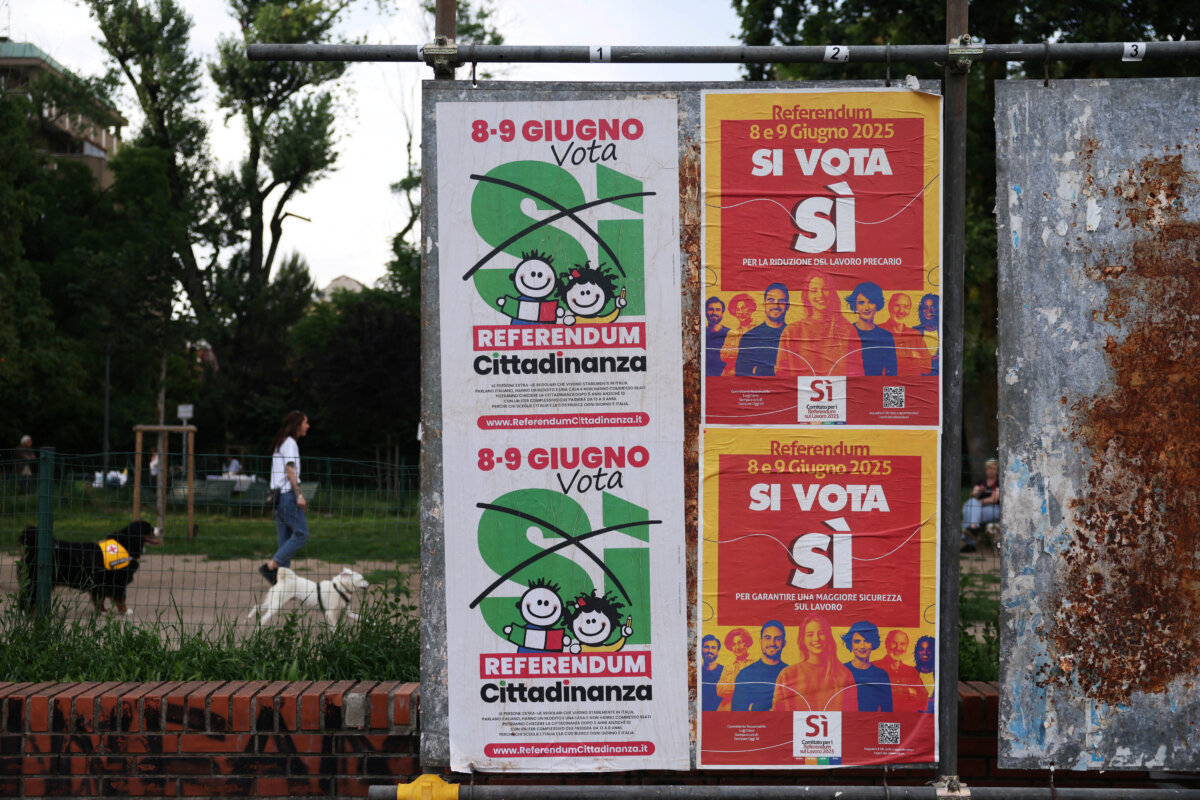

Italians are voting in a two-day referendum on a series of major reforms, including whether to ease citizenship laws. However, the vote may ultimately be void if it fails to meet the required turnout threshold.
Opposition parties, as well as a leading trade union opposed to Prime Minister Giorgia Meloni’s government, are pushing the changes.
After gathering millions of signatures in March, Italy’s CGIL labor union said it was able to trigger the referendum, which started on June 8.
One proposal seeks to reduce the residency requirement for naturalization from 10 years to five years for non-EU adults living in Italy.
The CGIL said this change will affect 2.5 million citizens of foreign origin in the country.
Meloni’s government has opposed the changes.
“I am totally against it,” she wrote on social media platform X on June 6.
There are five referendums in total. Italian voters are also being asked to make four changes to employment law.
This includes restoring the right of unfairly dismissed workers to be reinstated, removing the cap on dismissal payments in companies with fewer than 15 employees, changing the rules on temporary workers, and extending liability for accidents at work to subcontractors.
But for any of them to be valid, turnout must exceed 50 percent plus one of the electorate. If this is not met, the results will not be legally binding.
Partial data from Italy’s Interior Ministry published on the evening of June 8 showed that national turnout stood at 22.7 percent.
The polling stations close later on Monday at 1 p.m. GMT.
“Meloni is afraid of participation and has understood that many Italians, even those who voted for her, will go to vote,” said Elly Schlein, leader of the main opposition Democratic Party, who is spearheading the campaign along with Maurizio Landini, the CGIL labor union chief.
She is also leading calls for a change in EU law to make it easier to deport criminal foreign nationals.
Last month, nine EU countries signed an open letter regarding immigration on May 22, calling for the European Convention on Human Rights to be reinterpreted because it is limiting their “ability to make political decisions” in their “own democracies.”
The letter, signed by Meloni, Danish Prime Minister Mette Frederiksen, Polish Prime Minister Donald Tusk, and other leaders, said that the court “posed too many limitations on the states’ ability to decide whom to expel from their territories” in terms of the deportation of criminal foreign nationals.
Austria, Belgium, the Czech Republic, Estonia, Latvia, and Lithuania also signed the letter requesting “a new and open minded conversation about the interpretation” of the European Convention on Human Rights.
The letter said the scope has extended “too far as compared with the original intentions behind the Convention, thus shifting the balance between the interests which should be protected.”
The Council of Europe’s secretary-general, Alain Berset, rejected those calls.
On May 24, Berset said in a statement that courts must not be weaponized for political gain.
Italy is the first EU state to successfully send illegal immigrants beyond the bloc’s borders, after its first three attempts were blocked by national and European courts.
Only by adding Albania to its own safe third-country list and rebranding detention centers as “repatriation hubs” did Italy manage to bypass a European Court of Justice ban. On April 14, it sent 40 illegal immigrants to the Italian-run centers there.
Reuters and The Associated Press contributed to this report.
 Friends Read Free
Copy
Facebook
Tweet
Friends Read Free
Copy
Facebook
Tweet