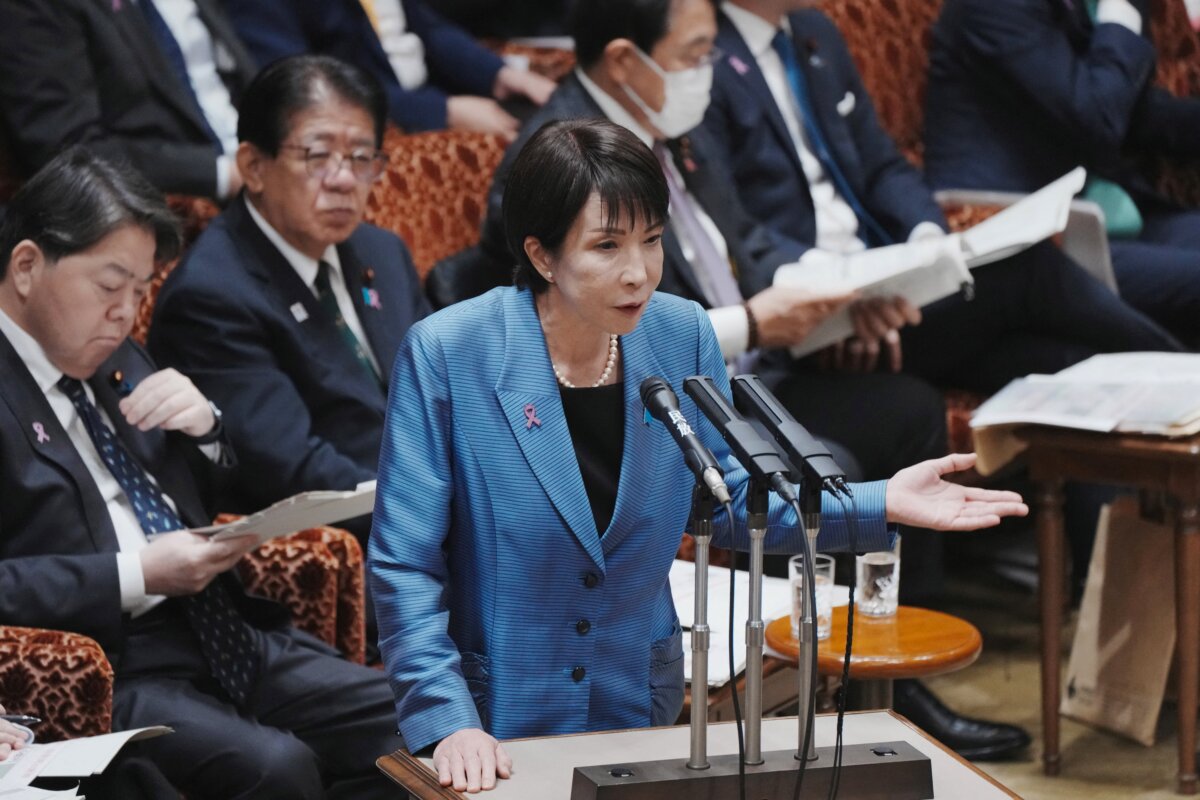

Japanese Prime Minister Sanae Takaichi has called a snap election for the lower house of parliament, saying she wanted voters to decide whether to entrust her new coalition government with far-reaching changes to Japan’s economic, fiscal, and security policies.
“I have decided to dissolve the House of Representatives on January 23,” Takaichi said during a press conference on Jan. 19.
The Japanese national legislature, the Diet, consists of two chambers—the House of Representatives and the House of Councillors—whose members are elected to represent the public.
Although Takaichi’s coalition governs the lower house, the ruling camp remains a minority in the upper House of Councillors, meaning it must rely on opposition cooperation to pass legislation and budgets.
Takaichi’s move sets up a snap general election on Feb. 8, which she said would help her government “make Japan stronger and more prosperous.”
“It is a decision to avoid running away, to avoid postponing issues, and to decide Japan’s course together with the people,” she told reporters.
Takaichi, leader of the ruling Liberal Democratic Party (LDP), took office on Oct. 21, 2025, becoming Japan’s first female prime minister after winning the party’s leadership race. She formed a coalition with the Japan Innovation Party, also known as Ishin no Kai, ending the LDP’s long-standing partnership with Komeito.
She said that the current political setup lacked a clear popular endorsement.
“Right now, the LDP president is serving as Prime Minister even though the party does not hold a majority in either house,” Takaichi said, referring to the fragile balance in parliament.
She added that voters had last passed judgment under the assumption of an LDP–Komeito coalition, “but the coalition framework has now changed.”
“That is why I chose to ask the people’s will directly, rather than act for the convenience of politicians,” she said.
Election Timing
Takaichi’s government put together a large supplementary budget for the 2025 fiscal year in November, and the following month, it approved a draft budget that set out a record 122.3 trillion yen ($770 billion) for the 2026 fiscal year. At that time, Takaichi told reporters the 2026 budget bill was designed to balance economic strength with fiscal discipline.
On Jan. 19, she said the government asked relevant ministries and local governments to execute the supplementary budget early.
“I want to be clear that this dissolution comes after establishing a system that prevents any gap in economic management,” Takaichi said.
Using the supplementary budget, the government introduced measures including cuts to gasoline and diesel prices, support for electricity and gas bills, targeted local grants, and assistance linked to rising prices and child-rearing costs.
“For a standard household, support is expected to exceed 80,000 yen [$506] per year,” she said.
She said that fuel prices had already fallen because of subsidies and that electricity and gas support began in January.
Takaichi said the government also acted quickly to stabilize health and social care systems, including a medical and nursing-care support package and wage support for care workers.
Energy, Security, and China
Takaichi said she wants to move more quickly on longer-term priorities, including energy, economic security, and defense.
Strengthening energy and resource security is vital, she said, citing stable and affordable power supplies and Japan’s technological strengths such as perovskite solar cells, next-generation nuclear technology, early deployment of fusion energy, and energy-efficient data centers.
Takaichi linked those goals to a tougher global environment.
“We cannot conduct strong diplomacy and security policy without public support,” she said, citing Chinese military exercises near Taiwan and signs of economic coercion.
She said the government would revise key security strategy documents earlier than planned and strengthen intelligence functions. This includes establishing a National Intelligence Bureau, tightening screening of inbound investment, and enacting counter-espionage legislation.
The Opposition Bloc
Ahead of the announcement on Jan. 19, the Constitutional Democratic Party of Japan and Komeito agreed last week to form a Centrist Reform Alliance for the election, a move that could create the largest opposition bloc.
Yoshihiko Noda, leader of the Constitutional Democratic Party of Japan, said last week that his party was ready to face an election and warned against creating a political vacuum amid economic pressures.
After Takaichi’s announcement on Jan. 19, Yuichiro Tamaki, leader of the Democratic Party for the People, held an urgent live broadcast.
“There are many things I would like to say, but once the Prime Minister has made the decision to move forward, all we can do is fight—and fight to win,” Tamaki said.
He criticized dissolving parliament while approval ratings are high, calling it a return to old-style LDP politics that prioritize elections over governance, while urging voters to choose a more policy-driven approach.
 Friends Read Free
Copy
Facebook
Tweet
Friends Read Free
Copy
Facebook
Tweet