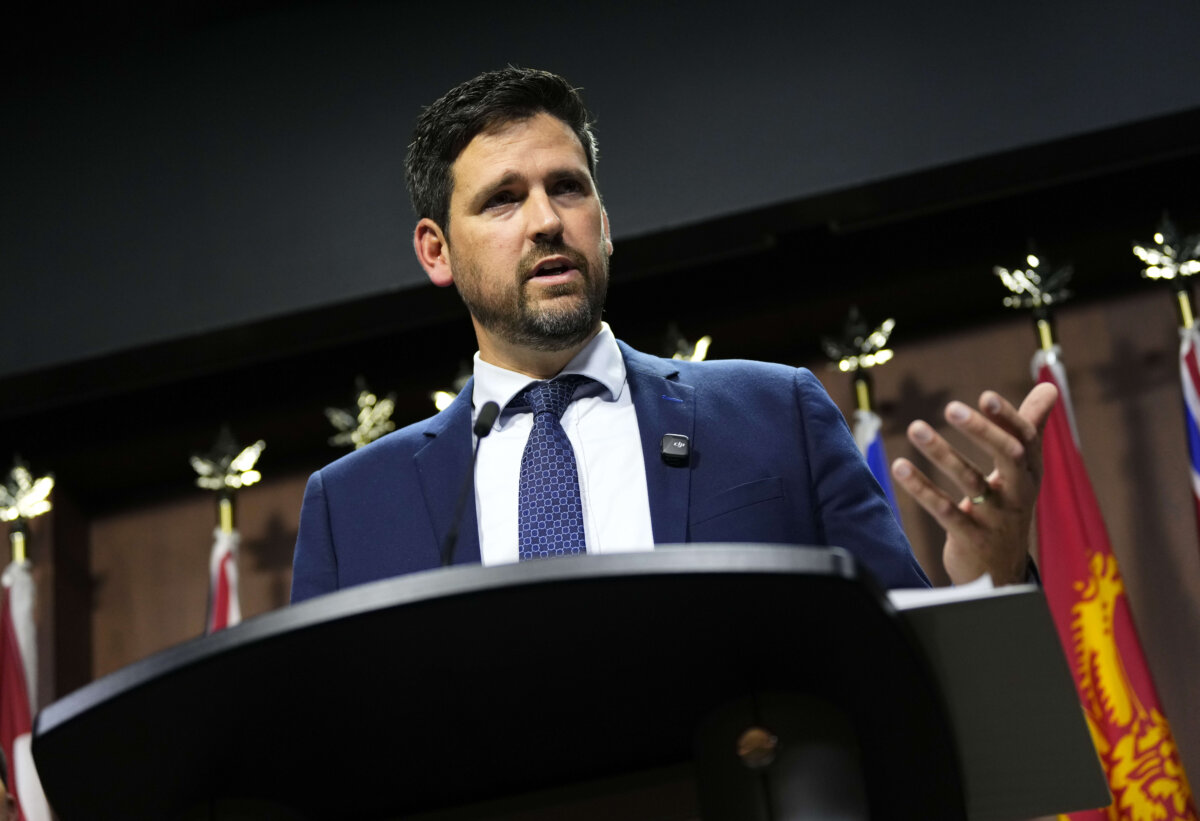

Justice Minister Sean Fraser has introduced legislation that aims to make bail laws stricter for violent and repeat offenders and makes amendments to sentencing laws.
“We are going to change the criminal law to ensure that the bail system is not viewed as some ‘get out of jail free’ card,” Fraser said at an Oct. 23 press conference in Ottawa. “We’re going to ensure that bail hearings treat public safety as a paramount concern.”
Bill C-14, also known as the Bail and Sentencing Reform Act, creates new reverse onuses for major crimes such as auto theft, breaking and entering, human smuggling, and sexual assault, meaning the accused will be required to prove why they should be released from detention, rather than prosecutors needing to prove they should be detained.
Fraser said the Liberal government had “heard directly” from police organizations and provincial governments that reverse onuses should be introduced at bail for certain serious crimes. The justice minister also said that a few violent offenders can represent a “huge proportion of the criminal activity we actually witness in our communities.”
The amendments in Bill C-14 direct police not to release an accused when it is against the public interest or when detention is needed to protect victims or witnesses. The courts will be required to consider factors such as whether the allegations involved unprovoked violence and whether the accused has any outstanding charges. The courts must also set stricter conditions, which include weapons bans.
The bill also includes amendments that would toughen sentencing laws for repeat and violent crimes like auto theft and extortion, meaning those found guilty will spend more time in jail. Consecutive sentences will also be imposed for crimes like auto theft, breaking and entering, and extortion, meaning those found guilty will serve one sentence after another instead of serving for multiple offences at once.
Additionally, new aggravating factors will apply to crimes against first responders, theft that harms essential infrastructure, or retail theft. House arrest would also not be allowed for certain sexual assault and child sexual offences. Fraser said some offenders who committed sexual assault have been serving their sentences at home in the same communities as their victims, and those victims have told the government “that doesn’t feel like justice.”
The bill would also restore driving prohibitions for criminal negligence causing bodily harm or death.
The Liberal government said that in the coming months, more changes will be brought about that aim to address court delays, strengthen victims’ rights, provide better protection for those facing sexual and intimate partner violence, and “keep children safe from horrific crimes.”
The government urged provincial and territorial governments to support the implementation of Bill C-14, which includes properly managing the administration of justice when it comes to bail courts, bail supervision programs, and provincial courts. Fraser said Ottawa and the provinces appear to be “singing from the same song book” when it comes to implementing reforms that will improve public safety.
The government said in a press release that while national police-reported crime rates decreased by 37 percent between 1998 and 2014, they began an upward trend of around 12 percent between 2014 and 2024. It said Canada’s Violent Crime Severity Index, which includes crimes like homicide, sexual assault, extortion, child sexual offences, and violent firearm offences, was 41 percent higher in 2024 than in 2014.
Conservative Leader Pierre Poilievre said during an Oct. 23 press conference that the Liberal government should go further and get rid of the principle of restraint, which requires judges to “release the arrested individual at the earliest opportunity under the least onerous conditions.”
“Today’s bill does not get rid of Liberal bail, and that means that there will be a lot of very serious and rampant offenders who will once again be released into our streets, often within hours of their most recent arrest,” he said.
The Conservative Party had previously introduced a motion in the House of Commons on Oct. 6 to pass its own bail reform legislation. The Tories’ “Jail Not Bail Act” would have eliminated the requirement for judges to release those accused of crimes under the least onerous conditions. It would also have introduced a new major offences category that made it more difficult for those accused of major crimes to receive bail, and required judges to consider the full criminal history of a person before granting them bail.
The motion failed to pass, with the Liberals, NDP, and Bloc Québécois voting against it. A separate Conservative motion calling for anyone convicted of three serious offences to be denied bail or parole also failed in the House of Commons on Sept. 18.
The Tories have blamed the increase in violent crimes in part on the Liberals’ Bill C-75, which directed judges in adjudicating bail to primarily focus on releasing the accused as quickly as possible and on the “least onerous conditions.” The Tories have also criticized Bill C-5 for removing mandatory minimum sentences for some serious crimes, instead allowing for parole or house arrest.
 Friends Read Free
Copy
Facebook
Tweet
Friends Read Free
Copy
Facebook
Tweet