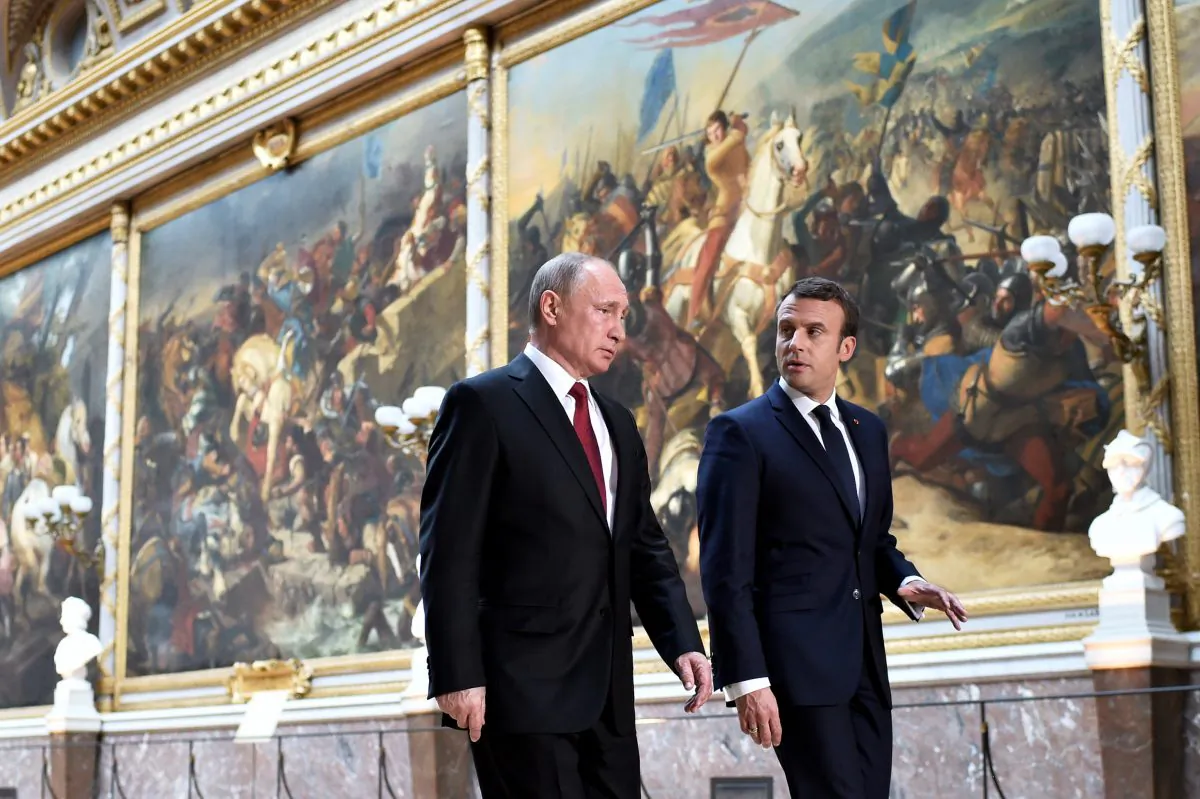
Russian President Vladimir Putin and French President Emmanuel Macron had their first phone call together since 2022, the Kremlin said on July 1.
Moscow said the pair had a “substantive” phone call and discussed the Iran–Israel conflict and the war in Ukraine.
Paris said the call lasted more than two hours and that the French leader had called for a cease-fire in Ukraine and the start of negotiations on ending the conflict.
Russian state news agency TASS said the last time such a conversation took place was on Sept. 11, 2022, and that this phone call was instigated by the Élysée Palace.
“It was the French side’s idea,” Kremlin spokesman Dmitry Peskov said on July 2.
On Ukraine, the Kremlin said Putin “reiterated that the Ukrainian conflict is a direct consequence of the policy of Western countries.”
Moscow said the West had ignored the security interests of Russia for years and had condoned violations of the rights of Russian-speaking residents of Ukraine.
Putin further said that any peace agreement between Moscow and Kyiv should be a “comprehensive and long-term” one in character and be based on “new territorial realities.”
Macron, according to a statement from the Élysée Palace, “emphasized France’s unwavering support for Ukraine’s sovereignty and territorial integrity.”
He also called for a cease-fire to be reached as soon as possible and for negotiations between Kyiv and Moscow to achieve a lasting settlement of the conflict.
The Élysée Palace noted that both heads of state would continue to discuss the situation.
The pair held regular discussions as Russia’s invasion of Ukraine began, a move for which Macron received some criticism. He also visited Moscow shortly before the invasion in February 2022.
Moscow said the pair’s regular dialogue was broken off after Macron “violated the confidentiality of a previous conversation by involving journalists without prior notice.”
Regarding the ongoing situation in Iran, Putin said Tehran’s right to the peaceful development of nuclear energy had to be respected, as well as its continued compliance with the nuclear nonproliferation treaty, according to the Kremlin.
The French president’s office said Macron saw the nuclear threat posed by Tehran as serious enough to warrant the involvement of all five permanent members of the U.N. Security Council, which includes both France and Russia.
The other permanent members are the UK, the United States, and China.
Macron also stressed the need for full cooperation from the Iranians with the International Atomic Energy Agency (IAEA), and “expressed his determination to seek a diplomatic solution that would lead to a lasting and rigorous resolution of the nuclear issue, the question of Iran’s missiles, and its role in the region.”
The Élysée noted that Macron and Putin had agreed to “coordinate” their effort to achieve this.
Last week, Iran announced its intention to end its relationship with the IAEA in the aftermath of the strikes made by Israel and the United States on its nuclear facilities.
Tehran’s foreign minister, Seyed Abbas Araghchi, took to social media platform X on June 27, stating that Iran’s Parliament had voted to end collaboration with the agency “until the safety and security” of the country’s nuclear activities “can be guaranteed.”
He also placed significant blame for the attack on the agency and its director general, Rafael Grossi.
“He directly facilitated the adoption of a politically-motivated resolution against Iran by the IAEA [Board of Governors] as well as the unlawful Israeli and US bombings of Iranian nuclear sites,” Araghchi said in his announcement.
“In an astounding betrayal of his duties, [Grossi] has additionally failed to explicitly condemn such blatant violations of IAEA safeguards and its statute.
“The IAEA and its director-general are fully responsible for this sordid state of affairs.”
On July 2, Iranian President Masoud Pezeshkian ratified legislation suspending the country’s cooperation with the global nuclear watchdog, according to the Islamic Republic News Agency.
T.J. Muscaro contributed to this report.
 Friends Read Free
Copy
Facebook
Tweet
Friends Read Free
Copy
Facebook
Tweet