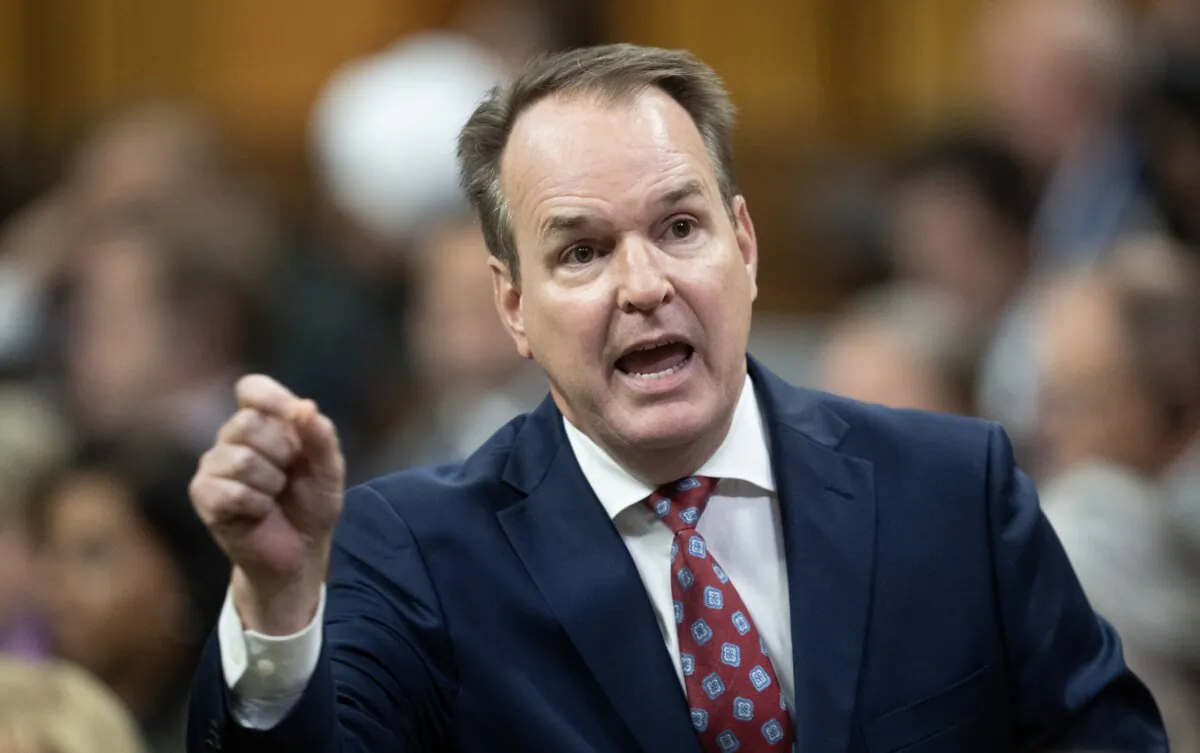

Liberal House Leader Steven MacKinnon says the government lacks the votes it needs to pass the upcoming federal budget, and he’s urging opposition parties to support Ottawa’s annual spending plan to avoid a Christmas election.
MacKinnon told CBC’s Rosemary Barton during an Oct. 26 interview that the government will require the support of at least one additional party to successfully pass the budget, which will be tabled Nov. 4 in the House of Commons. The budget represents a confidence vote and will topple the government if it fails to pass, effectively forcing Canadians back to the polls in December.
The Liberals have 169 seats in the House of Commons, three shy of a majority government.
“As we speak right now, we don’t have the votes,” MacKinnon said, noting that Prime Minister Mark Carney has spoken with opposition leaders about the budget but has yet to receive support from any of the other parties.
“The opposition parties will have to determine whether the differences between us are sufficiently large to cause Canadians to go to the polls,” MacKinnon said. “We would be reluctant to go to the polls. We, in fact, think Canadians would rather the government get on with things.”
Opposition parties have been outlining their budgetary demands in public and during private consultations with Carney.
Conservative Leader Pierre Poilievre met privately with Carney on Oct. 22 to discuss the conditions under which his party would support the budget.
Poilievre has requested the Liberal government keep the deficit in the upcoming budget below $42 billion, which aligns closely with the target set by the government in the previous fiscal update, as well as cut taxes on food, homes, and energy. He also wants the government to axe its industrial carbon tax.
“Our No. 1 priority is people’s take-home pay has to grow, and that comes through more affordable food and homes,” Poilievre said during an Oct. 22 press briefing. “The current Liberal policy is driving up the cost of living. If they sharply reverse that, then they can bring down the cost of living.”
MacKinnon was critical of Poilievre’s requests and described the Tory leader’s demands as “unattainable.”
“Mr. Poilievre … wants the deficit looked after, but wants to subtract hundreds of billions of dollars of revenues from the federal government,” he said. “So that’s pretty hard to square.”
He also criticized previous comments from Bloc Québécois Leader Yves-François Blanchet, who said earlier this month there was “no legitimacy” to the Liberals’ budget. The Bloc has made several budget demands, including calling for an increase in the federal health transfer to the provinces, additional investment in infrastructure, an expansion of the rapid housing initiative, and an increase in Old Age Security payments for individuals aged 65 to 75.
“Mr. Blanchet … called the budget illegitimate,” MacKinnon said. “Coming from someone with 22 seats in a 343-seat House of Commons, that’s a little rich.”
Meanwhile, MacKinnon had more positive remarks toward the NDP and its interim leader Don Davies. He said he would not “lump” Davies together with the other opposition leaders because the NDP has provided more constructive feedback to the budget.
“I have no idea what the NDP intends to do with respect to its votes on the budget, that’ll obviously be up to their caucus and to their party,” he added. “But again, the math is pretty clear. We don’t have a majority.”
MacKinnon acknowledged, when questioned about the matter, that it is the responsibility of a minority government to seek support and collaborate with other parties. But he said the government isn’t willing to negotiate on its overall spending plan or change any major details. Instead it is asking opposition parties what “contributions” they can make “to the government’s agenda.”
“We have made very plain that these are the parameters in which we are willing to have discussions,” he said. “We’ll negotiate on details, but we’re not negotiating on principles.”
Budget Estimates
Carney has been laying the groundwork over the past week for a budget that is expected to be much larger than the $42 billion proposed by the previous government under former Prime Minister Justin Trudeau.
The Parliamentary Budget Officer published his economic and fiscal outlook on Sept. 25, which estimated Ottawa’s upcoming budget will reach $68.5 billion in 2025-26 while the C.D. Howe Institute has projected a $92 billion deficit.
Carney has said his government will “spend less” to “invest more” and published a video comparing the act of incurring debt to purchase a home to the spending practices of his government, suggesting that any debt accumulated now will yield benefits in the future.
MacKinnon used the same “spend less” to “invest more” phrasing during his interview with Barton, calling this premise a core principle of the budget that rationalizes the operating expenditures of the government.
Carney said in a televised Oct. 22 speech that Canadians should be prepared to make “sacrifices” as his government works to diversify the economy.
“We won’t transform our economy easily or in a few months. It will take some sacrifices, and it will take some time,” Carney said. “Our government will work relentlessly to cut waste and drive efficiencies, and when we have to make difficult choices, we will be thoughtful, we will be transparent, we’ll be fair, we will work collaboratively with our colleagues across the aisle to build, protect, and empower Canadians.”
The Liberal government has announced its intention to distinguish between routine operational expenditures and capital investments in future federal budgets. The Conservatives have argued that the Liberals are attempting to “conceal the deficit under new categories to deceive Canadians.” The Liberals maintain their goal is to focus on investments in significant projects and infrastructure while offering a “more transparent view” to Canadians.
 Friends Read Free
Copy
Facebook
Tweet
Friends Read Free
Copy
Facebook
Tweet