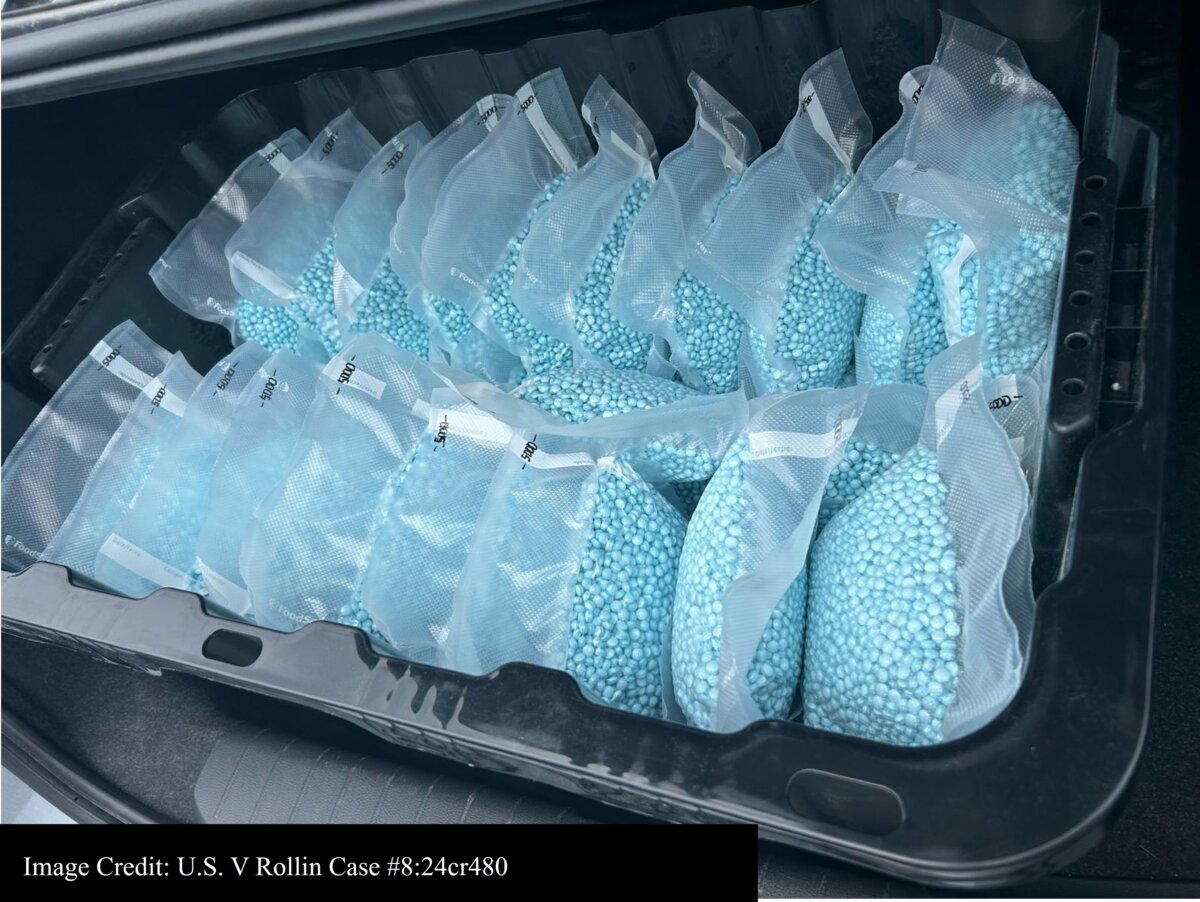

A 49-year-old Quebec man could spend the rest of his life in a U.S. prison cell after being charged in connection with a cross-border drug trafficking investigation that resulted in the seizure of 300,000 synthetic opioid pills by the RCMP.
The Middle District of Florida U.S. Attorney’s Office has announced a federal indictment against Montreal resident Sebastien Rollin, who has been charged with conspiracy to import protonitazene, distribution of protonitazene for importation into the United States, and international promotional money laundering.
Protonitazene is an extremely powerful opioid derived from benzimidazole that produces more intense effects than morphine.
Rollin faces a maximum 120-year sentence in federal prison if convicted on all counts, the U.S. attorney’s office said in a press release.
Rollin has been accused of orchestrating the sale of synthetic opioid pills disguised as oxycodone to Tampa, a major city located on the Gulf Coast of west-central Florida, the attorney’s office said. It alleges Rollin sold more than 10,000 of these pills on May 13, 2024, to an undercover officer and subsequently sold 25,000 pills to another undercover officer on July 9 of the same year.
It is further alleged that Rollin received payment for these transactions via cryptocurrency, which was transferred to Canada from an undercover cryptocurrency wallet located in the Middle District of Florida.
Rollin is then accused in mid-July 2024 of negotiating the sale of 300,000 synthetic opioid pills to the United States that were later seized by the RCMP after its officers stopped the vehicle of a “courier.”
That same day, the RCMP executed search warrants at two clandestine laboratories in Quebec used for the production of synthetic opioids, leading to the confiscation of “millions” of synthetic opioid pills, recipes for synthetic drugs, and a firearm, the attorney’s office said.
The Spanish National Police were credited by the attorney’s office with providing “critical assistance” in locating and apprehending Rollin. He was extradited to the United States on Feb. 20, according to the press release but no details have been disclosed about when Rollin fled to Spain or the date of his arrest there.
The United States will also pursue a forfeiture order against Rollin to seize the profits derived from the crimes he is accused of, if he is found guilty, according to the indictment.
“An indictment is merely a formal charge that a defendant has committed one or more violations of federal criminal law, and every defendant is presumed innocent unless, and until, proven guilty,” the attorney’s office said.
The case was a joint investigation by the U.S. Drug Enforcement Administration, the FBI, the U.S. Coast Guard, Homeland Security Investigations, and the RCMP.
 Friends Read Free
Copy
Facebook
Tweet
Friends Read Free
Copy
Facebook
Tweet