
North Korea launched suspected ballistic missiles toward the sea on Jan. 27 in apparent weapons tests, according to Japan and South Korea.
The Japanese prime minister’s office and Defense Ministry both said on X that Pyongyang had fired possible ballistic missiles, while the South Korean Defense Ministry said it detected the launch of at least one unidentified projectile off the East coast of North Korea.
Japan’s prime minister’s office issued instructions following the launch, instructing “maximum effort to gather and analyze information, and provide the public with information in a timely and appropriate manner.”
It also called for ensuring the safety of all their aircraft, vessels, and other assets and for taking “all possible measures for precaution.”
South Korea’s defense ministry said “North Korea’s ballistic missile launch is a provocative act that violates U.N. Security Council resolutions,” calling on Pyongyang to “immediately cease” these activities, according to Yonhap.
Seoul’s Joint Chiefs of Staff also said it detected the launches from an area north of Pyongyang at around 3:50 p.m. local time, adding that the projectiles flew about 350 kilometers (217 miles).
The launch came after North Korea recently threatened retaliation over what it called South Korean surveillance drone flights across the border, one earlier in January and another in September 2025.
“The Republic of Korea [the official name for South Korea] should be ready to pay a high price for having committed another provocation of infringing on the sovereignty of the DPRK [Democratic People’s Republic of Korea—the official name for North Korea] with drones,” a spokesman for the general staff of the North Korean army said on Jan. 9, according to Pyongyang state media.
On Jan. 10, North Korean leader Kim Jong-un’s sister Kim Yo-jong reiterated this sentiment, saying that South Korean authorities “can never evade the responsibility for infringing upon our sovereignty and would be well advised to seriously consider a dear price for it.”
The South Korean government denied operating any drones at the times Pyongyang suggested, with South Korean Defense Minister Ahn Gyu-back calling the allegations “absolutely not true,” Yonhap reported on Jan. 10.
The defense ministry also said South Korean President Lee Jae Myung had ordered a “thorough” investigation into the matter.
The reported missile launch comes a day after South Korea’s defense ministry announced that U.S. Undersecretary of War Elbridge Colby and Ahn had agreed to closely cooperate on South Korea’s pursuit of nuclear-powered submarines.
The South Korean Ministry of Defense said in a statement that Ahn and Colby met in Seoul to discuss the alliance, including the security situation on the Korean Peninsula and strengthening national defense capabilities.
“Both sides agreed that cooperation in building South Korea’s nuclear-powered submarines will strengthen South Korea’s military-led defense capabilities in the defense of the Korean Peninsula and serve as an important milestone in further elevating the ROK–US military alliance, and agreed to closely cooperate,” the defense ministry said in a statement.
Colby, on his first international trip as undersecretary of war and policy, wrote on X that South Korea is a “model ally.”
He also praised the ROK for committing to meet the global standard of spending 3.5 percent of gross domestic product on defense, and for taking “greater responsibility for its own defense in the context of our alliance, in line with the National Defense Strategy.”
“I look forward to discussing with ROK counterparts how to modernize and advance our vital alliance,” Colby wrote.
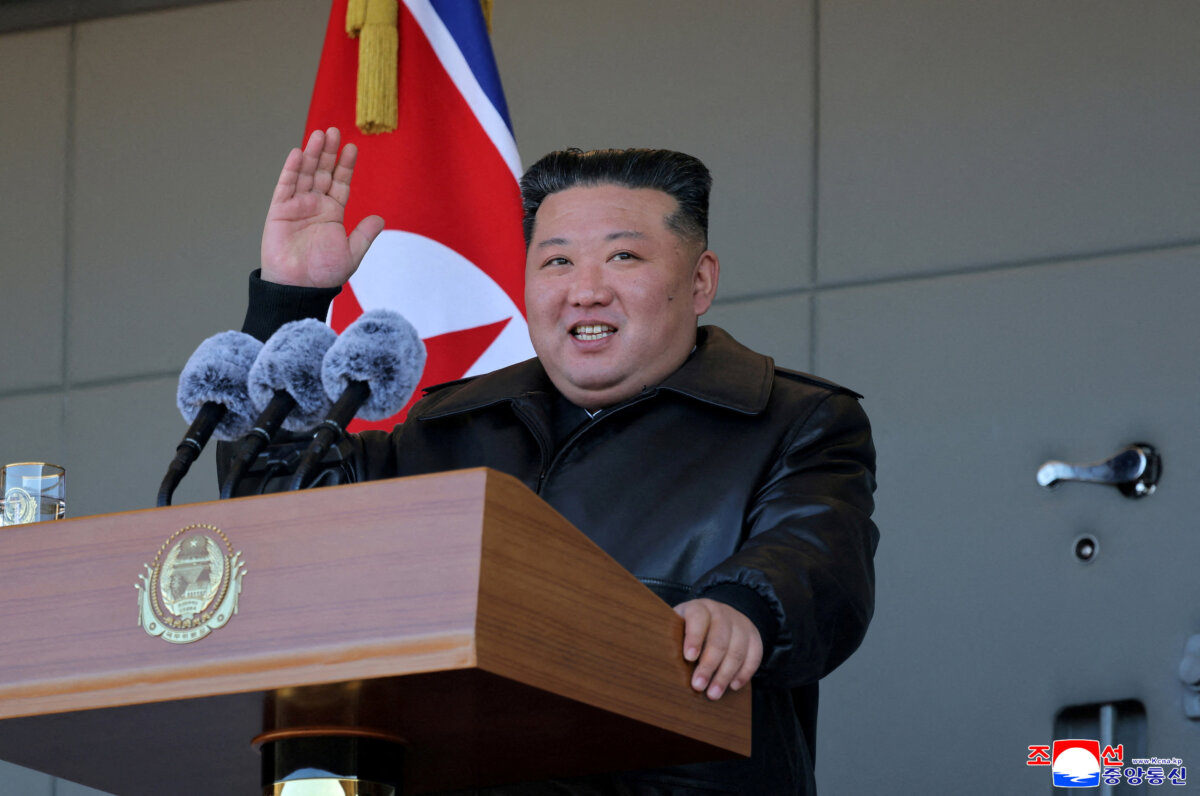
Earlier this month, North Korea said it performed test flights of hypersonic missiles. Kim observed the launches and underscored the need to bolster the country’s nuclear war deterrent, according to KCNA.
“It’s a very important strategy to maintain or expand the strong and reliable nuclear deterrent,” because of “the recent geopolitical crisis and various international circumstances,” Kim said.
The missiles hit targets about 1,000 km (621 miles) away, over the sea east of North Korea, KCNA said.
The Associated Press, Reuters, and Victoria Friedman contributed to this report.
 Friends Read Free
Copy
Facebook
Tweet
Friends Read Free
Copy
Facebook
Tweet