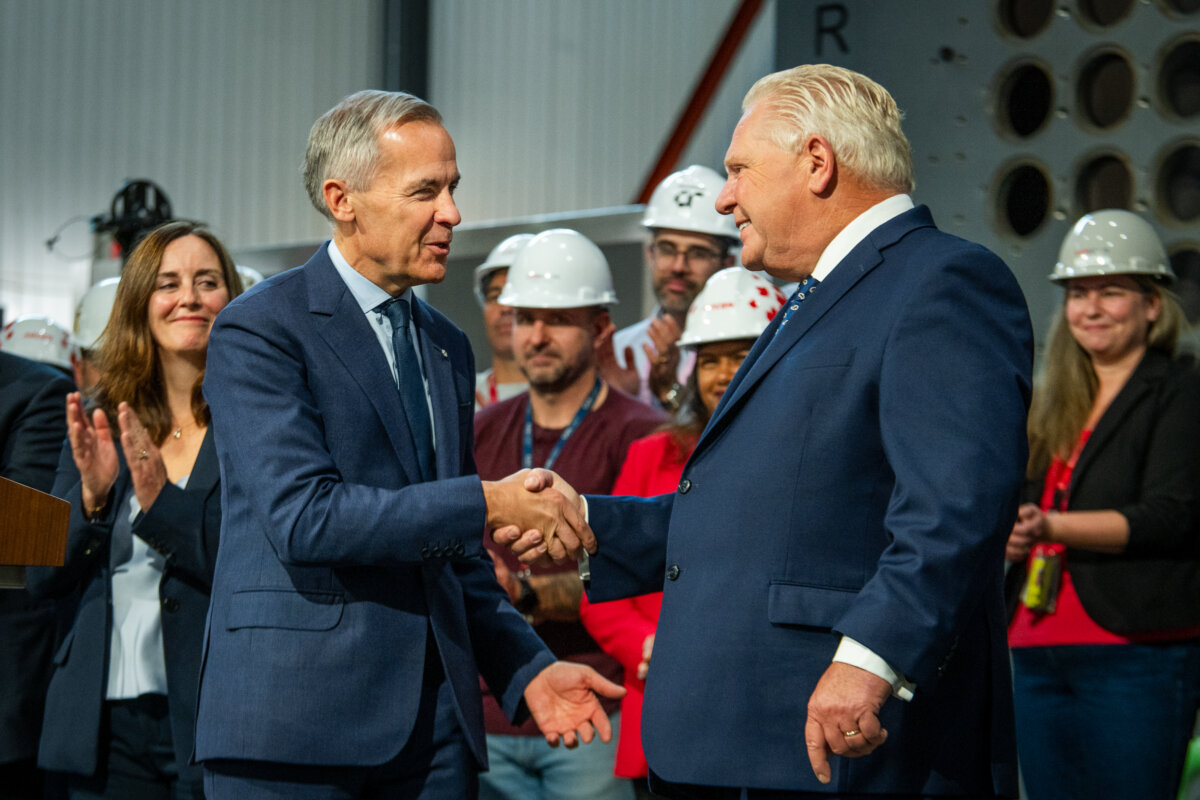
Ontario Premier Doug Ford is calling on Prime Minister Mark Carney to keep 100 percent tariffs on Chinese electric vehicle (EVs) in place, ahead of Carney’s upcoming trip to Beijing.
Canada is reviewing its decision to put 100 percent tariffs on Chinese-manufactured EVs in October 2024, in addition to a 25 percent surtax on imports of Chinese steel and aluminum. Ottawa said at the time the move was necessary to safeguard Canadian automakers from unfair Chinese-state-subsidized vehicles. China retaliated by putting 100 percent tariffs on various Canadian agricultural, pork, and seafood products, and 75.8 percent duties on Canadian canola.
“We can’t back down. It’s as simple as that,” Ford said Jan. 8 at an unrelated press conference in Toronto. “You’ve got to start building here.”
China’s ambassador to Canada, Wang Di, said last fall that if Canada lifts the EV tariffs as well as levies Ottawa put on Chinese steel and aluminum, China will reciprocate by lifting its tariffs and duties on Canadian agricultural and food products.
Ford has repeatedly urged Ottawa to keep its tariffs on Chinese-made EVs in place, penning a letter to Carney in September of last year in which he said that lifting the tariffs could endanger 157,000 jobs in Ontario.
“As you know, China’s pervasive use of non-market policies and practices, including heavy subsidization and low environmental and labour standards, gives its industry unfair advantages over Canadian automotive manufacturers,” Ford wrote in the letter.
Manitoba Premier Wab Kinew and Saskatchewan Premier Scott Moe both support getting rid of the EV tariffs, with the tariffs having an outsized impact on the economies of Prairie provinces, which produce canola. Canada’s exports of canola products to China in 2024 amounting to almost $5 billion.
“We gotta be there for the farmer in the field who’s facing a really strong trade headwind right now,” Kinew said in August of last year.
Alberta Premier Danielle Smith has said that China understands divisions in Canada and uses them for its advantage by pitting regions against each other.
“They understand that if you’re going to retaliate and create maximum pressure, you do it by pitting one region against the other,” Smith said in May 2025.
Ford said that while he understood where Moe and Kinew were coming from in terms of wanting to protect the farmers in their provinces, he also has to do the same for automakers in Ontario.
“So I respect what they’re doing, but there’s no damn way we should drop tariffs on China, I’ll tell you that. Absolutely not,” Ford said October last year.
Speaking Jan. 8, Ford reiterated his position in favour of keeping the tariffs in place and said the prospect of Canada scrapping the EV tariffs in return for China dropping its retaliatory tariffs is not something he is open to.
“The only compromise I would have is if they open up here, they hire Unifor employees, and they produce vehicles here,” Ford responded, when asked if he would support Carney making a compromise with China on the EV tariffs. “Come here and look at the market and maybe it will hold other automakers accountable, well the U.S. automakers accountable when they’re shipping vehicles up here.”
China watchers such as think tank scholar and former diplomat Charles Burton have warned against closer industrial ties with China, saying both state-owned enterprises as well as private Chinese companies are controlled by the regime.
“All the industries in China belong to these systems. Each ministry has a system, and this includes the military,” Burton told MPs in 2020.
Carney has not specifically commented on the potential dropping of tariffs on Chinese-made EVs in return for China easing its retaliatory tariffs, saying only in October of last year that Canada was restarting broader engagement with China. Conservative Leader Pierre Poilievre, meanwhile, has said Ottawa should keep the tariffs on Chinese-made EVs in place in order to safeguard Canadian national security, saying it could be threatened by surveillance and remote-control technology in Chinese-brand EVs that may be controllable or accessible by the Chinese regime.
Carney is set to meet Chinese regime leader Xi Jinping Jan. 13 to 17 in Beijing as part of a broader trip that will include a Jan. 18 meeting with the leader of Qatar and attendance at the World Economic Forum’s annual meeting in Davos, Switzerland, from Jan. 19 to 21.
A Nanos survey from last September found that 63 percent of Canadians support or somewhat support Ottawa putting the tariff on Chinese-made EVs. The survey also found 60 percent of respondents said they would be less likely or somewhat less likely to purchase a vehicle knowing it was made in China.
Chinese brands of EVs are not for sale in Canada, but vehicles such as Tesla that are made in China are widely sold and purchased, with total import of Chinese-made EVs reaching $2.3 billion in 2023.
Carolina Avendano contributed to this report.
 Friends Read Free
Copy
Facebook
Tweet
Friends Read Free
Copy
Facebook
Tweet