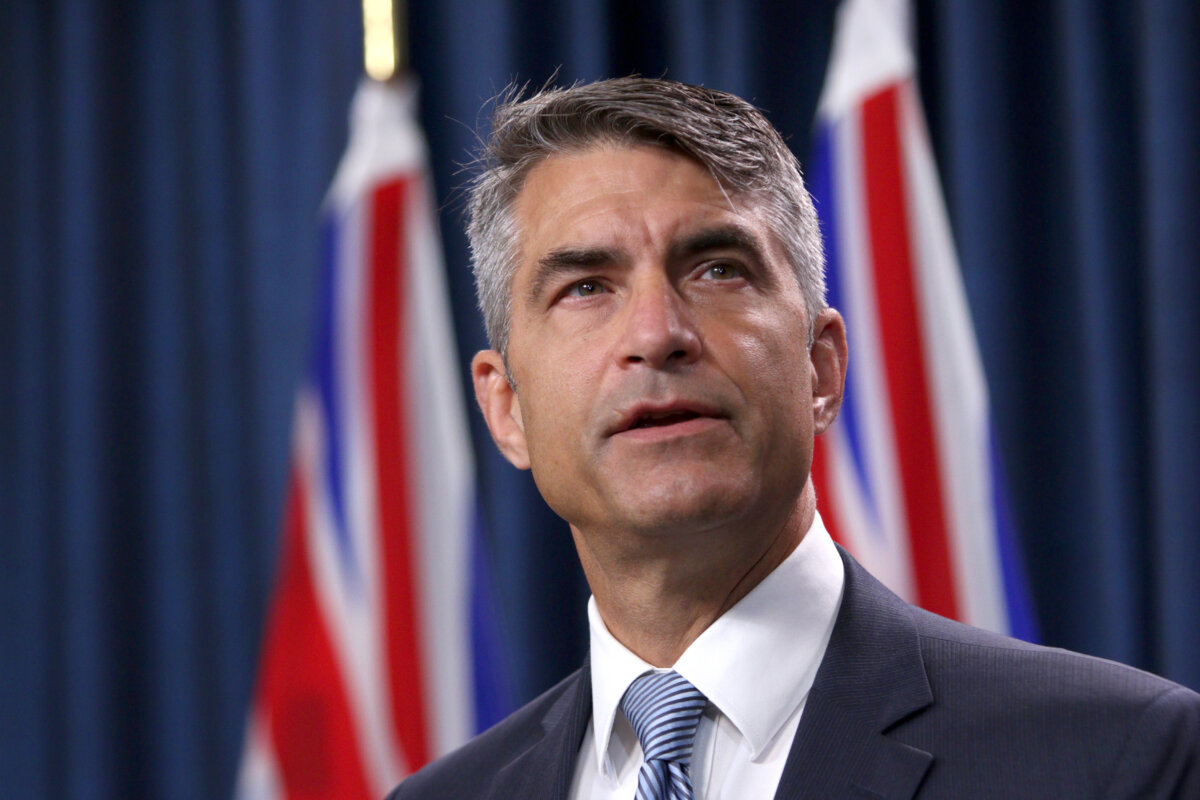

The Liberal government is proposing to appoint Anton Boegman, a former chief electoral officer of British Columbia, as Canada’s first foreign influence commissioner, more than a year and a half after Parliament passed legislation to create the position.
Before Boegman is officially appointed, Ottawa must consult with opposition parties and Senate leaders, and receive approval by resolution of the House of Commons and Senate.
Boegman served as B.C. chief electoral officer from June 2018 to November 2025. He also served as Election BC’s deputy chief electoral officer of operations for eight years prior to that, and held a senior management role at Elections BC since 2004.
Speaking to reporters on Jan. 26, Public Safety Minister Gary Anandasangaree said he had sent letters out to the opposition parties that day, and described the nominee, who had not been named at the time, as someone of “a high level of integrity” who has served the country “over many decades” outside of the political world.
The Epoch Times contacted Anandasangaree’s office for comment on the appointment but didn’t hear back before publication.
Ottawa’s proposed appointment comes more than a year and a half after Parliament passed Bill C-70, “An Act respecting countering foreign interference,” in June 2024, which brought forward several measures aimed at combatting foreign interference in Canada.
The legislation provided for the creation of a foreign influence registry to keep track of those working in Canada as agents on behalf of foreign governments, as well as the appointment of a foreign interference commissioner.
Ottawa has said the registry is needed because countries engaging in foreign interference to advance political goals might employ people to act on their behalf without disclosing those ties. The legislation was passed amid heightened public awareness about China’s meddling in Canada’s affairs via intelligence leaks in the media.
A public inquiry into foreign interference in Canada concluded last year that China is the most active foreign power meddling in Canada’s affairs.
While Public Safety Canada had told The Epoch Times in October that it had “a name” in mind for the role, there had been no proposed appointments until now.
Public Safety Canada had said the registry would be operational by June 2025, but when that didn’t materialize, Anandasangaree said in August that the commissioner would be appointed in September.
Foreign Affairs Minister Anita Anand later told MPs on the House of Commons foreign affairs committee that Anandasangaree had assured her the registry would be implemented by the end of the year, but that did not materialize either.
She told MPs that Ottawa “will never tolerate any form of foreign interference or meddling in our democracy,” adding that Canada was “showing leadership at a crucial time” by signing a joint statement with its G7 partners in June. The statement condemned transnational repression and pledged to support those who may be targets of this “aggressive form of foreign interference.”
Conservative MPs raised concerns that Canada was risking being viewed as a “playground for foreign interference” by continuing to delay the registry’s implementation.
Registration Scheme
Earlier this month, Ottawa published newly proposed regulations under the foreign influence registry, along with a regulatory impact analysis statement, in the Canada Gazette.
“Non-transparent foreign influence activities that aim to affect political and governmental processes for the undisclosed benefit of a foreign power undermines Canada’s sovereignty and democracy,” the statement said.
If approved as commissioner, Boegman would be responsible for administering the registration scheme, which is expected to be enforced through notices, monetary fines, and criminal penalties in the most serious cases.
The public registry is expected to contain data such as identifying information about the individuals and entities that have entered into an agreement, information about the foreign entity, and details of each arrangement, including its purpose and the types of influence activities involved.
Ottawa has said the registry would enhance transparency by allowing Canadians to see who is engaging in foreign influence, the nature of their activities, and any enforcement actions that have been taken.
Violations under the foreign influence registry could include failing to provide information within 14 days of entering into an agreement with a foreign entity, or knowingly providing false or misleading information to the commissioner.
The regulations would establish monetary penalties ranging from $50 to $1 million, and when determining the penalty amount, the commissioner would consider factors such as compliance history, whether the violation was intentional or not, capacity to pay, and the degree of cooperation with the commissioner after receiving the violation notice.
The commissioner could also reduce or remove a penalty entirely if the individual or organization meets specified conditions set out in a compliance agreement with the commissioner.
Jennifer Cowan and The Canadian Press contributed to this report.
 Friends Read Free
Copy
Facebook
Tweet
Friends Read Free
Copy
Facebook
Tweet