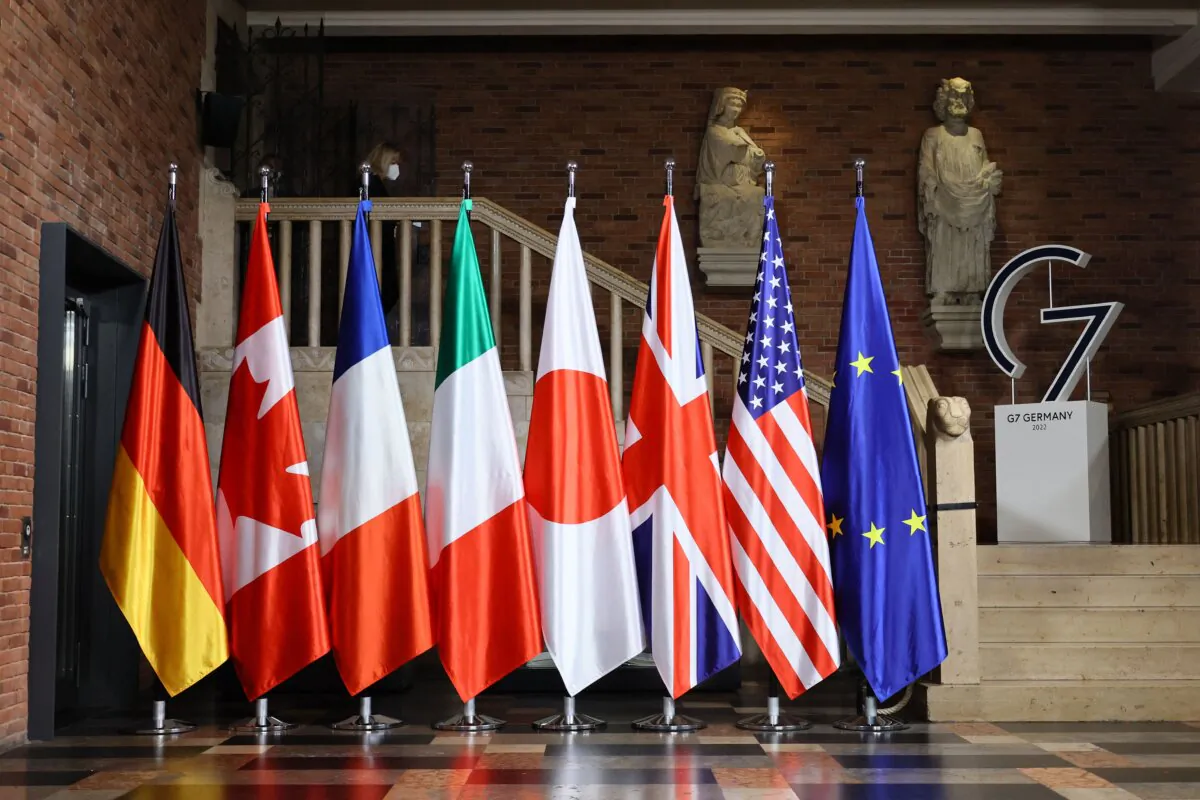

PARIS—G7 trade ministers wrapped up two days of talks in Paris this week with a joint statement that, without naming China, took aim at Beijing’s grip on critical mineral supply chains and signaled the bloc’s intent to push back against what they called attempts to “weaponize economic dependencies.”
Held May 5–6 under France’s rotating G7 presidency, the meeting targeted Western reliance on Chinese-controlled supplies of lithium, cobalt, rare earths, and other materials essential for defense systems, electric vehicles, semiconductors, and industrial manufacturing. The talks set the stage for a leaders’ summit scheduled for mid-June in Évian, France.
In their statement issued on May 7, the trade ministers expressed “grave concerns regarding economic coercion, including coercion through arbitrary export restrictions” and pledged to “deter and stand ready to take actions, where necessary, against economic coercion.”
They identified “non-market policies and practices,” industrial subsidies, and forced technology transfers as targets for coordinated G7 responses, although the document stopped short of naming Beijing directly.
The Paris meeting unfolded against the backdrop of fresh trade friction between Washington and Brussels after U.S. President Donald Trump indicated last week that the United States would raise tariffs on European Union-made cars to 25 percent from 15 percent, citing what he called Brussels’s failure to implement the Turnberry trade agreement reached in Scotland in the summer of 2025.
French Foreign Trade Minister Nicolas Forissier, who chaired the meeting, told reporters the announcement was “a call to keep moving forward” on Turnberry’s implementation, and EU Trade Commissioner Maros Sefcovic said in Paris that he and U.S. Trade Representative Jamieson Greer had agreed “it’s important to respect the deal from Turnberry from both sides.”
Forissier made clear, however, that critical minerals were “certainly one of the major subjects” of the talks.
Permanent Body to Direct Work on Critical Minerals
G7 countries are considering a permanent secretariat to ensure that critical minerals initiatives outlast the bloc’s rotating presidencies. The body could be housed at the International Energy Agency or at the Organisation for Economic Co-operation and Development, both based in Paris.
Forissier confirmed the idea but stressed that France was seeking to create not an additional institution, but rather a streamlined task force under direct ministerial authority. He described the plan as a complement to the American-led Indo-Pacific trade and critical minerals initiative, working toward a “common toolbox.”
The April 24 memorandum of understanding signed in Washington by U.S. Secretary of State Marco Rubio and Sefcovic already provides a transatlantic anchor. It contemplates border-adjusted price floors, standards-based markets, price-gap subsidies, and joint procurement, and a pilot project on price floors could begin before the end of the year.
In comments to The Epoch Times, Gérard Vespierre, a French geopolitical analyst and researcher, called the secretariat proposal “a very good idea,” arguing that coordination on prospecting and on technological improvements to refining would prove valuable.
Emmanuel Dupuy, French associate professor of geopolitics at several universities and president of the Institute for European Perspective and Security Studies, was less convinced.
He described the announcement as more presentational than substantive in a context in which the U.S.–EU tariff dispute is putting transatlantic unity under strain.
“They likely wanted to flatter the U.S. secretary of commerce, to give the impression of Western cohesion in the face of China’s grip on critical materials and rare earths on which our economy depends,” Dupuy told The Epoch Times.
He said that “very few European mining companies are in a position, or even willing, to extract critical materials in Africa” and that the G7 does not include other European countries.
The G7 statement identified specific tools under consideration, including resilience criteria, transparency mechanisms, diversification requirements, revenue stabilization through price-gap subsidies, joint procurement instruments, and trade-related measures such as quotas and price floors.
Whether such measures translate into binding commitments will likely become clearer at the Évian summit next month.
For now, Philippe Chalmin, a French economic historian at Paris-Dauphine University and a specialist in commodity markets who has been heard several times by French parliamentary commissions of inquiry, said in an interview with The Epoch Times that the West has “put its head on the Chinese chopping block, and it will have the greatest difficulty in pulling it out.”
Dupuy said: “Why is China dominant in the critical minerals market? Because it made the investments we were unwilling to make. Political leaders have only recently realized that, three decades ago, they made the wrong industrial choices.”
CCP’s Industrial Stranglehold
Beijing’s dominance in critical minerals stems from a deliberate, decades-long strategy, according to Chalmin.
“They concentrated on a few key sectors, then captured the upstream mining and concentrated the metallurgy at home,” he said.
Chalmin also said the West’s predicament was largely self-inflicted.
The dependence, he said, results from decisions the West itself made under pressure from environmental activists, as Western governments were content to outsource the environmental burden of metallurgy to China at a time when political leaders did not perceive the strategic dimension of these materials.
Rare earths are found all over the world: in former Eastern Bloc countries, across Asia, and in South America, Southern Africa, Australia, and the United States. The challenge lies in their low concentration levels, which is why they are described as “rare”; obtaining 1 kilogram of lutetium, for example, requires crushing 1,200 tons of rock.
Although China directly or indirectly extracted about 270,000 metric tons of rare earths in 2024, representing nearly 70 percent of global production, the country refined more than 90 percent of the world’s output.
The central technical obstacle to reducing Chinese dominance lies not in mining but in processing, Chalmin said.
“The bottleneck is not the mine,” he said. “It is the metallurgy.”
China now holds dominant or near-monopolistic positions in the processing of rare earths, cobalt, lithium, germanium, gallium, and antimony, among others, he said.
In its 2025 annual report, the International Energy Agency warned of the risks posed by such dominance.
“A single country is the dominant refiner for 19 out of 20 energy-related strategic minerals, with an average market share of around 70 [percent],” the agency stated.
“The minerals in question are vital for power grids, batteries and electric vehicles (EVs), but they also play a crucial role in AI chips, jet engines, defence systems and other strategic industries.”
The United States was almost entirely dependent on foreign countries for rare earths in 2023, and China accounted for about 70 percent of imports, according to the U.S. Geological Survey.
 Friends Read Free
Copy
Facebook
Tweet
Friends Read Free
Copy
Facebook
Tweet