
Canada and Qatar have secured new partnerships in trade, commerce, and defence cooperation, with Prime Minister Mark Carney saying the Middle Eastern country has committed to making “significant strategic investments” in Canada’s nation-building projects.
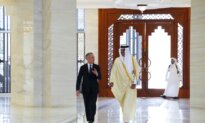
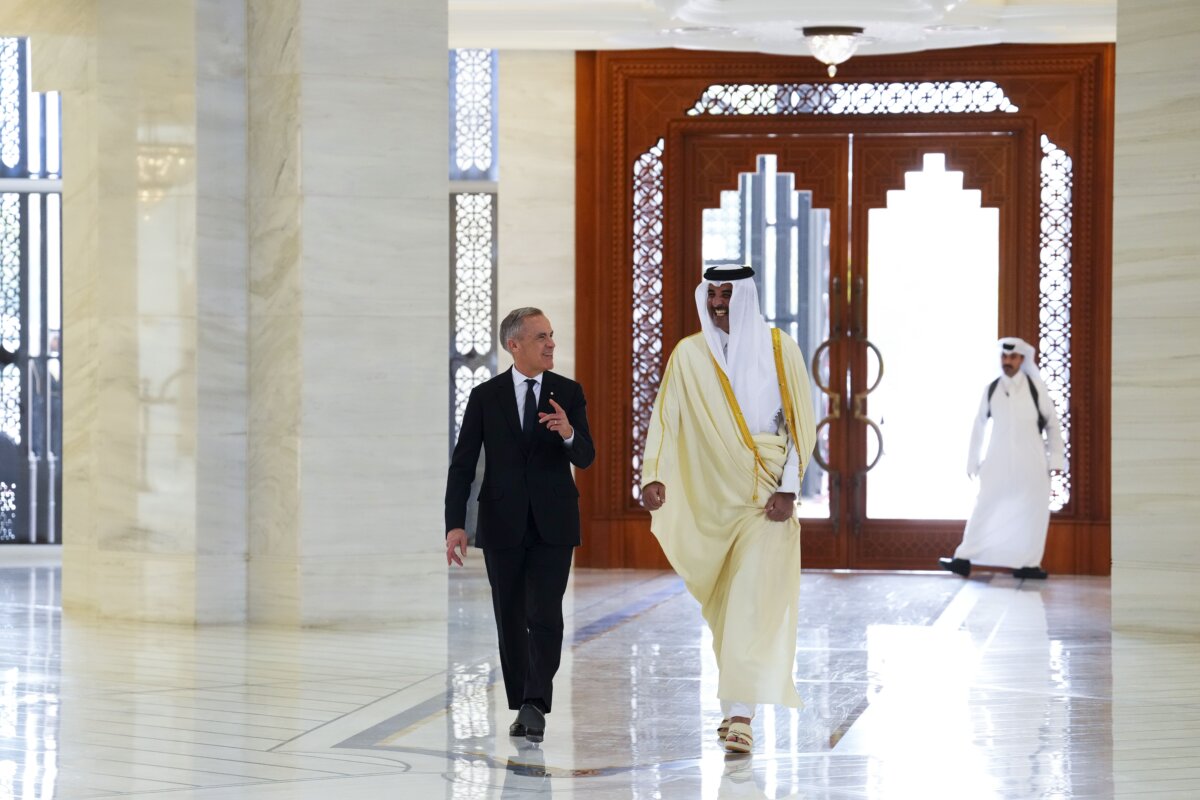
Carney made the announcement in Doha on Jan. 18, concluding his one-day visit to Qatar’s capital, where he met with Sheikh Tamim bin Hamad Al Thani, the Amir of Qatar, to discuss expanding Canada’s economic opportunities as part of his goal of doubling non-U.S. exports over the next decade.
Carney’s trip to Qatar marks the first visit by a sitting Canadian prime minister to the state. Following his visit, the Prime Minister’s Office (PMO) issued a news release saying the two countries have committed to “accelerated two-way investment and collaboration” in areas such as artificial intelligence (AI), aerospace, defence technologies, agriculture, and agri-food.
“This capital will help the projects get built faster and supercharge our energy industries, while helping to create thousands of high-paying careers for Canadians,” Carney told reporters at the Doha press conference. The PMO added that those investments will enhance the development of the “clean energy, health, AI, and defence” sectors.
Carney reiterated his recent talking points, citing “a state of uncertainty” in the global landscape, which he said has undermined the effectiveness of multilateral institutions on which middle powers such as Canada and Qatar have historically relied for trade and investment.
“In response, Canada is focused on what we can control, securing new trade, investment partnerships, so we’re not reliant on a single country but are stronger and more resilient to global shocks,” he said.
‘Deepen Work’
Bilateral merchandise trade between Canada and Qatar totalled $325 million in 2024, according to a PMO news release on Jan. 8. Data from platform Trading Economics indicate that Canada’s top exports to Qatar by value are machinery and nuclear reactors, aircraft and spacecraft, electrical and electronic equipment, and commodities, while Canada’s top imports from Qatar are mineral fuels, oils distillation products, aluminum, and fertilizers.
The latest Canadian-Qatari partnership will see the two nations prioritize a new Foreign Investment Promotion and Protection Agreement (FIPA) and finalize it by this summer, Carney said on Jan. 18, noting that negotiations were stalled for years after talks were initiated in 2018. Signing the FIPA would attract investment from Qatar and allow Canadian businesses easier access to expand their operations in the Gulf country, whose economy is worth nearly $290 billion, the prime minister added.
Speaking from Qatar on Jan 17, Finance Minister François- Philippe Champagne said having a FIPA signed would give investors the confidence that their capital would be secured and protected.
“I think it’s a good thing because what you do, you remove barriers, you increase predictability and security of investment and that’s needed in the world,” he told reporters.
The Jan. 18 PMO news release said Canada and Qatar have “agreed to immediately deepen work together” on four initiatives. One is to establish a Joint Canada–Qatar Commission on Economic, Commercial, and Technical Cooperation to boost bilateral trade and investment. As well, the two countries will soon start negotiating a new “double-taxation agreement” that would make it easier for Canadians to work and invest in Qatar and vice versa.
In terms of information technology, the two nations will expand investment opportunities in areas such as AI and information and computer technology.
The PMO in its Jan. 18 news release also said Ottawa will launch negotiations with Doha on a framework to facilitate expertise sharing on military, security, and defence matters.
“Canada will also establish a defence attaché here in Doha to further opportunities to partner in defence, joining Canadian Forces in this country,” Carney added during the press conference.
In addition, Carney said the two countries will strengthen “people-to-people” and cultural ties, which will include expanding direct flights from Canada to Qatar to boost tourism and business. The prime minister said he has also extended an invitation for the Emir to visit Canada later this year.
‘New Era’
During the press conference, Carney noticeably used language similar to what he used during his Beijing visit from Jan. 13 to 17, prior to visiting Doha.
“It marks a new era for our relationship, one in which we move from being close friends to strategic partners,” the prime minister said of the ties between Canada and Qatar, adding that the two countries are launching a “new chapter” in their relations.
In his meeting with Chinese Premier Li Qiang in Beijing on Jan. 15, Carney had commented that Ottawa is in a “strategic partnership” with China and that the relationship has entered a “new era,” drawing criticism from the Conservatives, who warned of the perils of getting closer to the Chinese communist regime. While Ottawa has framed the visit as a way to “recalibrate” relations with Beijing after years of frosty ties, China watchers and human rights organizations have raised concerns over the regime’s widespread human rights violations, including its engagement in transnational repression in Canada.
Former Canadian diplomat Michael Kovrig expressed his concerns on social media on Jan. 11, warning against expanding ties with the Chinese Communist Party (CCP) to reap short-term economic benefits.
“How the CCP behaves toward people it governs, detains, or dislikes is a preview for how it’s likely to deal with other citizens and countries it acquires power over,” he said in a post on X.
“That’s why the necessary whole-of-government-and-society responses must be holistic, strategic, and grounded in principled realism and a long-term vision of statecraft rather than short-term, transactional, issue-by-issue dealmaking.”
Conservative Leader Pierre Poilievre meanwhile posted on social media on Jan. 16, saying Carney needs to “explain how he has gone from saying China was Canada’s ‘biggest security threat’ before the election, to announcing a ’strategic partnership’ with Beijing after the election.”
Concerns over Qatar’s human rights record have also been raised by Human Rights Watch, including migrant labour abuses, increased surveillance, and restrictions on free expression.
The PMO said in a Jan. 18 readout that the prime minister recognized Al Thani’s leadership “in promoting global peace and stability, particularly in the Middle East, and emphasized Canada’s gratitude for the many times Qatar has provided consular and diplomatic assistance.”
With his stay in Doha wrapping up, Carney will attend the World Economic Forum’s annual meeting in Davos, Switzerland, from Jan. 19 to 21.
Noé Chartier, Olivia Gomm, Paul Rowan Brian, and The Canadian Press contributed to this report.
 Friends Read Free
Copy
Facebook
Tweet
Friends Read Free
Copy
Facebook
Tweet