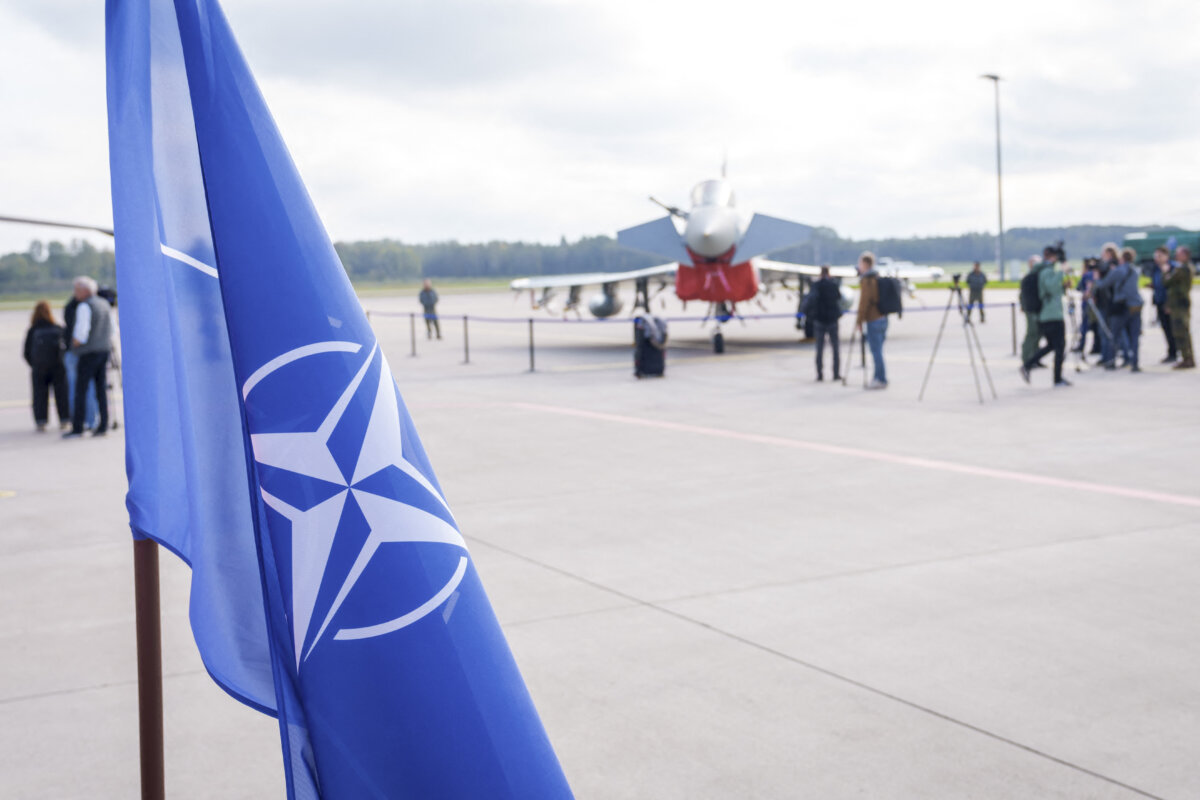

NATO’s top military commander has said the likelihood of Russia launching a full-scale attack on the alliance’s eastern flank was low, but he did not rule out the possibility of some smaller action.
Air Force Gen. Alexus Grynkewich, also commander of U.S. European Command, made the comments to Polish broadcaster TVP World on Sunday ahead of his appearance at the Warsaw Security Forum (WSF).
Grynkewich told TVP World that NATO bases its threat assessment on information from intelligence sources, the adversary’s intent, and analysis of the actual military threat based on the adversary’s capabilities.
In the case of Russia, “the risk of a major attack on NATO territory right now is actually relatively low, and the reason is Vladimir Putin’s war is ongoing in Ukraine, and his military is, unfortunately, engaged in that conflict,” he said.
“That force is not available to threaten NATO territory,” Grynkewich said, adding the caveat that it “doesn’t mean he couldn’t do something smaller.”
“Obviously, we do see the sabotage activity and everything else that’s ongoing,” the NATO military commander said, alluding to drone incursions and hybrid attacks that the West has attributed to Russia.
Sabotage and hybrid warfare have gained renewed attention following the attempted drone attack at Leipzig/Halle Airport in August, which Germany stated was orchestrated by Russia.
Moscow has repeatedly denied that it has been involved in any kind of hybrid warfare and has rejected claims of involvement in the Leipzig incident.
There have been increasing warnings from European authorities that Russia is likely to escalate covert operations against the West, including from Danish intelligence.
The Danish Defence Intelligence Service stated on Sept. 24 that Russia is likely to increase its hybrid warfare on NATO allies, with the agency not ruling out the possibility that Moscow could launch a limited military attack on a Western country.
Threshold for Triggering Article 5
In the context of hybrid attacks, the TVP World interviewer asked what would be the threshold for triggering Article 5, the clause of the North Atlantic Treaty under which NATO derives its pledge of mutual security, which states that an armed attack against one NATO member shall be considered an attack against them all.
Article 5 has only been invoked once, after 9/11.
NATO leaders are “intentionally ambiguous about what would cause Article Five to be triggered,” Grynkewich responded, adding that there are other procedures, including Article 4, that can be invoked for allied consultations.
Article 4 allows a NATO ally to table a discussion at the North Atlantic Council if they have a matter of concern, particularly regarding security.
NATO’s top commander said that during the Cold War, there was a fair amount of what is now called hybrid warfare across Europe.
“The Red Brigades were blowing things up across Western Europe during several periods of the Cold War,” he said.
“Article Four was invoked zero times, so Allies consulted and dealt with the issue without any formal mechanism.
“I think that that’s a model of just staying calm, carrying on, working our way through this that we need to emulate as long as possible.”
Theory of Victory
On Monday, Grynkewich will be delivering a speech at WSF, which brings together heads of government, representatives from the European Union, NATO officials, and military figures to discuss European and transatlantic security.
He told TVP World on Oct. 11 that he would be laying out NATO’s new strategy, the “Theory of Victory,” which he described as a commander’s intent for how forces would conduct an operation should allies find themselves in conflict.
“This Theory of Victory is grounded in a strategy of what we call denial, which is consistent with the alliance’s overall strategy to deter and defend in the Euro-Atlantic area,” he said.
Grynkewich said that strategy of denial means denying adversaries the ability to achieve their objectives.
“They don’t hold our territory; they’re unable to strike our locations, and that’s what victory looks like for us,” he said.
He added that NATO is a defensive alliance, “so we don’t have any desire here to escalate the situation, and we don’t have any need to do it.”
“All we need to do is make sure no one can threaten us, no one’s going to threaten our territory or our people, and that’s our main objective,” he said.
 Friends Read Free
Copy
Facebook
Tweet
Friends Read Free
Copy
Facebook
Tweet